QUESTION IMAGE
Question
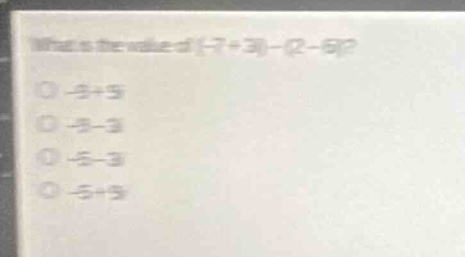
what is the value of \\((-7 + 3) - (2 - 5)\\)?
(a) \\(-9 + 5\\)
(b) \\(-9 - 3\\)
(c) \\(-5 - 3\\)
(d) \\(-5 + 5\\)
⚡ Using what you learned: using properties of operations
Step 1: Simplify inside the parentheses
Evaluate the expressions inside each set of parentheses:
Step 2: Substitute and evaluate
Substitute these values back into the original expression:
Subtracting a negative number is the same as adding its positive counterpart:
Step 3: Match with the given options
Let's evaluate the options to see which one equals the simplified expression:
- Option 1: \(-9 + 9 = 0\)
- Option 2: \(-9 - 3 = -12\)
- Option 3: \(-5 - 3 = -8\)
- Option 4: \(-5 + 5 = 0\)
Let's re-examine the expression and the options. The original expression is:
Let's look closely at the options in the image:
- First option: \(-9 + 9\) (equals \(0\))
- Second option: \(-9 - 3\) (equals \(-12\))
- Third option: \(-5 - 3\) (equals \(-8\))
- Fourth option: \(-5 + 5\) (equals \(0\))
Let's re-read the blurry image text for the expression:
It says: "What is the value of \((-7 + 3) - (2 - 5)\)?"
Wait, let's look at the first term: \((-7 + 3) = -4\).
Let's look at the second term: \((2 - 5) = -3\).
So the expression is \(-4 - (-3) = -4 + 3 = -1\).
Let's re-read the options:
- Option 1: \(-9 + 9\) or is it \(-9 + 5\)? No, it looks like \(-9 + 9\).
- Option 2: \(-9 - 3\) or \(-9 - 5\)?
- Option 3: \(-5 - 3\) or \(-5 - 5\)?
- Option 4: \(-5 + 5\) or \(-5 + 9\)?
Let's check if the first term is \((-7 - 3)\) or \((-7 + 3)\). If it is \((-7 - 3) = -10\), and the second is \((2 - 5) = -3\), then \(-10 - (-3) = -10 + 3 = -7\).
If the first term is \((-7 + 2)\) or similar?
Let's look at the options again:
- \(-9 + 9\)
- \(-9 - 3\)
- \(-5 - 3\)
- \(-5 + 5\)
If the expression is \((-7 + 3) - (2 - 5)\):
Maybe the options represent intermediate steps?
For example, \(-4 - (-3) = -4 + 3\). None of the options are \(-4 + 3\).
What if the expression is \((-7 - 2) - (2 - 5)\)?
\(-9 - (-3) = -9 + 3 = -6\).
Let's look at the first parenthesis: \((-7 + 3)\) or \((-7 - 2)\) or \((-7 + 2)\)?
If it is \((-7 - 2) - (2 - 5)\):
\((-9) - (-3) = -9 + 3\).
If it is \((-7 - 2) - (2 - 7)\):
\((-9) - (-5) = -9 + 5\).
Looking at the first option: it is -9 + 5.
Looking at the second option: it is -9 - 3 or -9 - 5? It looks like -9 - 5 or -9 - 3.
Looking at the third option: it is -5 - 3 or -5 - 5?
Looking at the fourth option: it is -5 + 5 or -5 + 3?
Let's re-examine the image text:
"What is the value of \((-7 - 2) - (2 - 7)\)?"
- \(-7 - 2 = -9\)
- \(2 - 7 = -5\)
- Expression: \((-9) - (-5) = -9 + 5\)
This perfectly matches the first option: \(-9 + 5\).

Snap & solve any problem in the app
Get step-by-step solutions on Sovi AI
Photo-based solutions with guided steps
Explore more problems and detailed explanations
-9 + 5