QUESTION IMAGE
Question
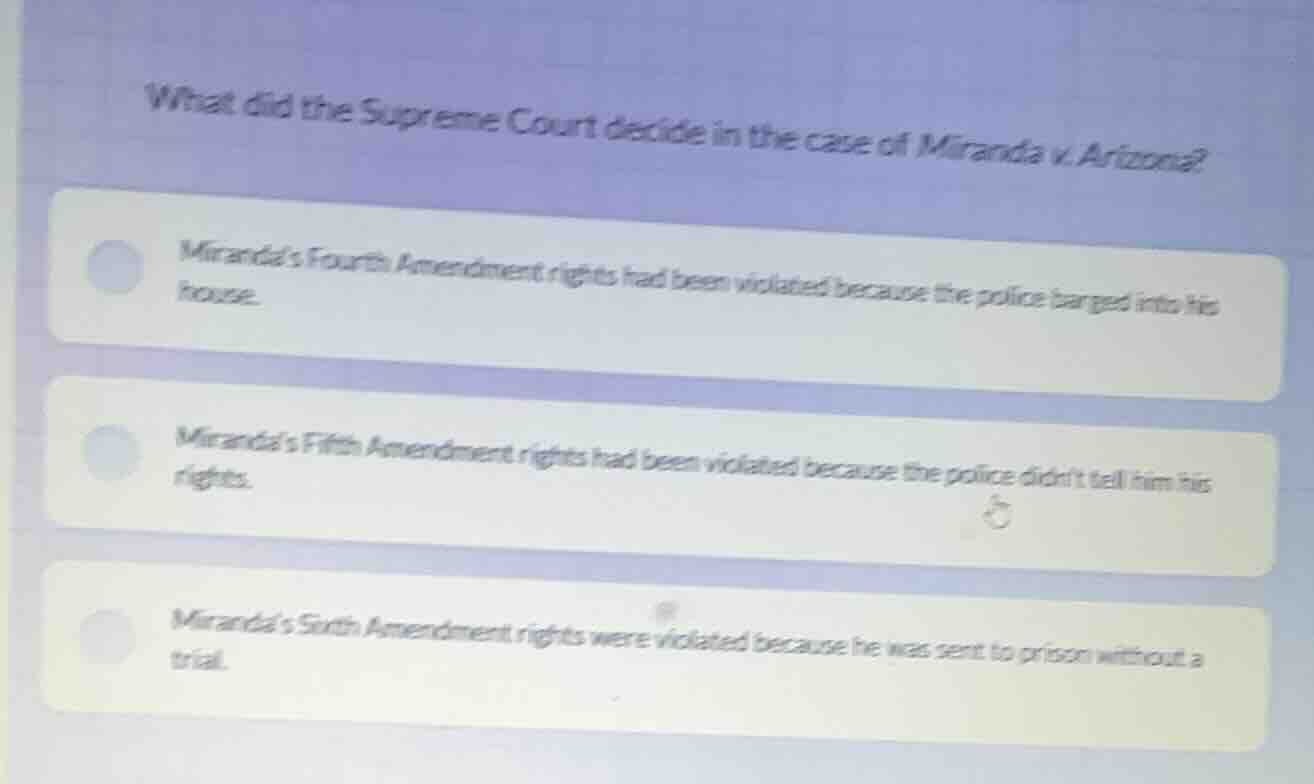
what did the supreme court decide in the case of miranda v. arizona?
mirandas fourth amendment rights had been violated because the police barged into his house.
mirandas fifth amendment rights had been violated because the police didnt tell him his rights.
mirandas sixth amendment rights were violated because he was sent to prison without a trial.
Analyze the case of Miranda v. Arizona
Using the Miranda Rights and Fifth Amendment Rights knowledge points
- The Supreme Court ruled that suspects in police custody must be informed of their constitutional rights before interrogation.
- This decision protects individuals against self-incrimination during custodial interrogation.
Evaluate the given options
Using the Fifth Amendment Rights knowledge point
- Option 1: Incorrect. The Fourth Amendment protects against unreasonable searches and seizures, which was not the central issue in Miranda v. Arizona.
- Option 2: Correct. The Court held that Miranda's Fifth Amendment rights were violated because officers failed to advise him of his right to remain silent and his right to an attorney.
- Option 3: Incorrect. The Sixth Amendment guarantees the right to a speedy and public trial, which does not address the pre-trial interrogation warning requirements of this case.

Snap & solve any problem in the app
Get step-by-step solutions on Sovi AI
Photo-based solutions with guided steps
Explore more problems and detailed explanations
- Miranda's Fourth Amendment rights had been violated because the police barged into his house.
- Miranda's Fifth Amendment rights had been violated because the police didn't tell him his rights. (Correct answer)
- Miranda's Sixth Amendment rights were violated because he was sent to prison without a trial.