QUESTION IMAGE
Question
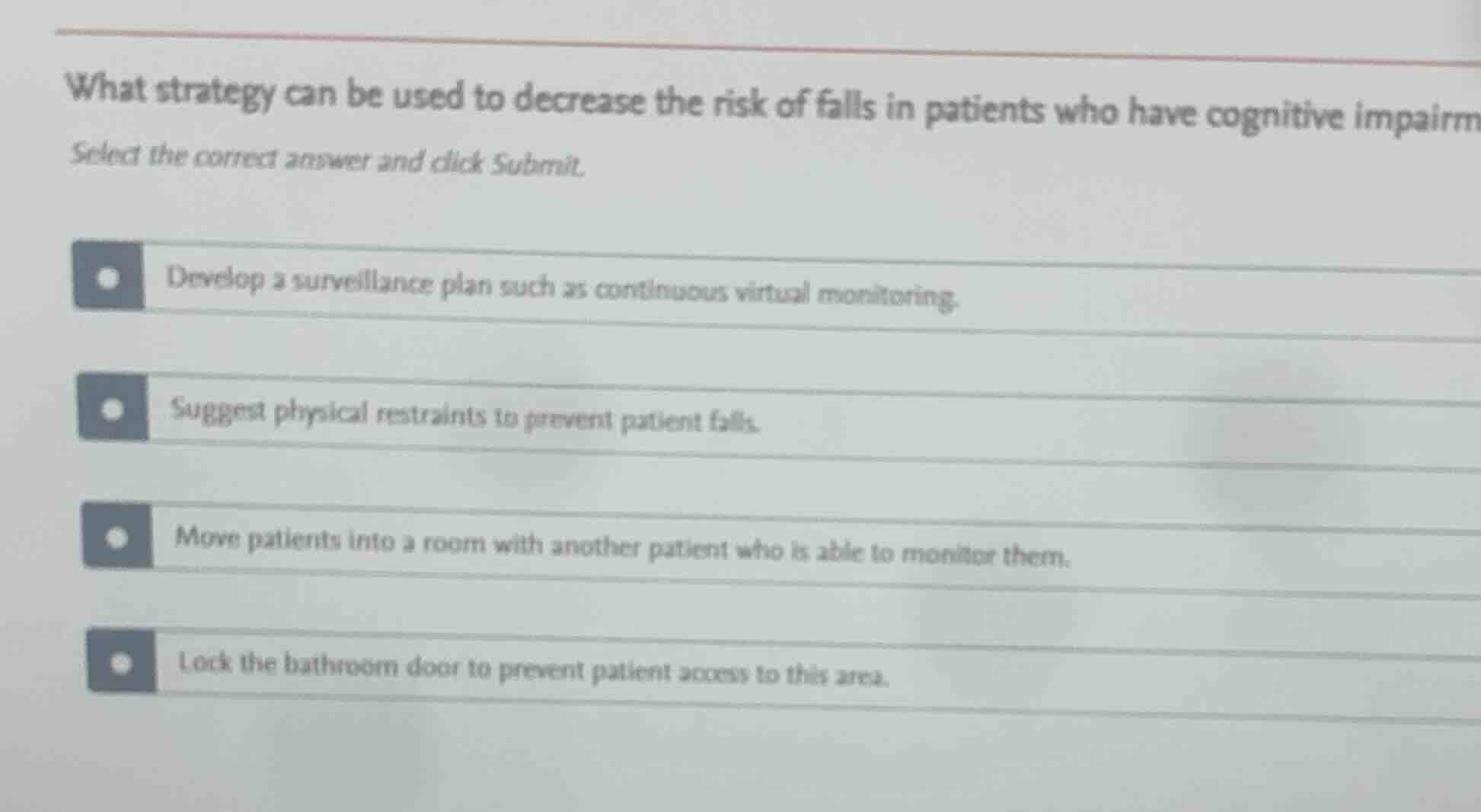
what strategy can be used to decrease the risk of falls in patients who have cognitive impairment?
select the correct answer and click submit.
- develop a surveillance plan such as continuous virtual monitoring.
- suggest physical restraints to prevent patient falls.
- move patients into a room with another patient who is able to monitor them.
- lock the bathroom door to prevent patient access to this area.
Analyze the clinical safety of each option
- Option 1: Continuous virtual monitoring provides non-invasive, real-time surveillance to alert staff immediately if a cognitively impaired patient attempts to get up, directly reducing fall risk.
- Option 2: Physical restraints are highly restricted, increase agitation, and can lead to more severe injuries if a patient tries to bypass them.
- Option 3: Placing the burden of monitoring on another patient violates safety, privacy, and professional care standards.
- Option 4: Locking bathroom doors creates a major safety hazard and restricts basic physiological needs.
Determine the safest evidence-based strategy
- Continuous virtual monitoring is an established, safe, and effective technological intervention for high-risk patients with cognitive impairment.

Snap & solve any problem in the app
Get step-by-step solutions on Sovi AI
Photo-based solutions with guided steps
Explore more problems and detailed explanations
- (A) Develop a surveillance plan such as continuous virtual monitoring. (Correct answer)
- (B) Suggest physical restraints to prevent patient falls.
- (C) Move patients into a room with another patient who is able to monitor them.
- (D) Lock the bathroom door to prevent patient access to this area.