QUESTION IMAGE
Question
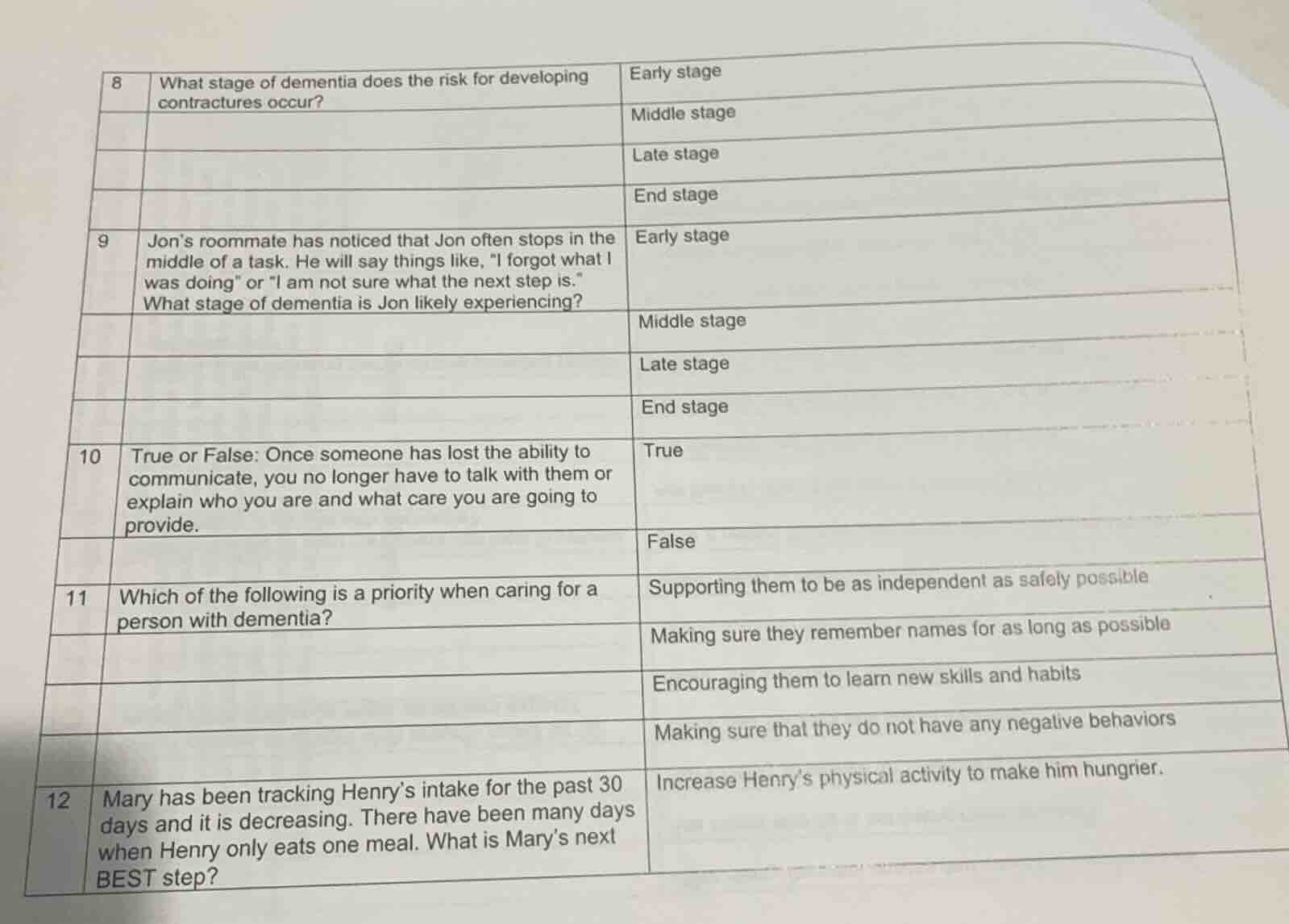
- what stage of dementia does the risk for developing contractures occur?
- early stage
- middle stage
- late stage
- end stage
- jons roommate has noticed that jon often stops in the middle of a task. he will say things like, \i forgot what i was doing\ or \i am not sure what the next step is.\ what stage of dementia is jon likely experiencing?
- early stage
- middle stage
- late stage
- end stage
- true or false: once someone has lost the ability to communicate, you no longer have to talk with them or explain who you are and what care you are going to provide.
- true
- false
- which of the following is a priority when caring for a person with dementia?
- supporting them to be as independent as safely possible
- making sure they remember names for as long as possible
- encouraging them to learn new skills and habits
- making sure that they do not have any negative behaviors
- mary has been tracking henrys intake for the past 30 days and it is decreasing. there have been many days when henry only eats one meal. what is marys next best step?
- increase henrys physical activity to make him hungrier.
Analyze contracture risk stages
Using the Dementia Stages knowledge point, we analyze when contractures develop. Contractures are the permanent tightening of muscles, tendons, or skin, which occurs when a person becomes immobile and bedridden. This profound loss of physical mobility typically occurs during the late or end stages of dementia. In standard clinical frameworks, the risk of developing contractures becomes a significant care concern during the late stage.
Identify Jon's dementia stage
Using the Dementia Stages knowledge point, we evaluate Jon's symptoms. Jon is forgetting the steps of a task midway through execution ("I forgot what I was doing"). This difficulty with sequential tasks and executive functioning is a classic hallmark of the middle stage of dementia, where complex instrumental activities of daily living begin to break down, whereas early-stage individuals usually maintain more task independence.
Evaluate communication principles
Using the Dementia Communication knowledge point, we assess the statement about non-verbal individuals. Even when a person with dementia loses verbal communication abilities, they still perceive tone, touch, and presence. Respectful, person-centered care dictates that caregivers must always introduce themselves and explain care actions to preserve dignity and reduce anxiety. Thus, the statement is false.
Determine care priorities
Using the Person-Centered Care knowledge point, we identify the primary goal of dementia care. The core philosophy of modern dementia care is to promote autonomy and dignity. Therefore, supporting individuals to remain as independent as safely possible is the highest priority, rather than forcing memory retention or preventing all behaviors.
Determine nutrition intervention
We analyze Mary's best next step for Henry's decreasing food intake. A significant, prolonged decrease in nutritional intake over 30 days requires professional clinical evaluation to rule out underlying medical issues, pain, or dysphagia. While increasing physical activity might seem helpful, the safest and most appropriate clinical next step is to consult a healthcare professional or physician.

Snap & solve any problem in the app
Get step-by-step solutions on Sovi AI
Photo-based solutions with guided steps
Explore more problems and detailed explanations
Question 8
- Early stage
- Middle stage
- Late stage (Correct answer)
- End stage
Question 9
- Early stage
- Middle stage (Correct answer)
- Late stage
- End stage
Question 10
- True
- False (Correct answer)
Question 11
- Supporting them to be as independent as safely possible (Correct answer)
- Making sure they remember names for as long as possible
- Encouraging to learn new skills and habits
- Making sure that they do not have any negative behaviors
Question 12
- Increase Henry's physical activity to make him hungrier.
- Report the decrease in intake to a supervisor or healthcare professional for evaluation. (Correct answer)