QUESTION IMAGE
Question
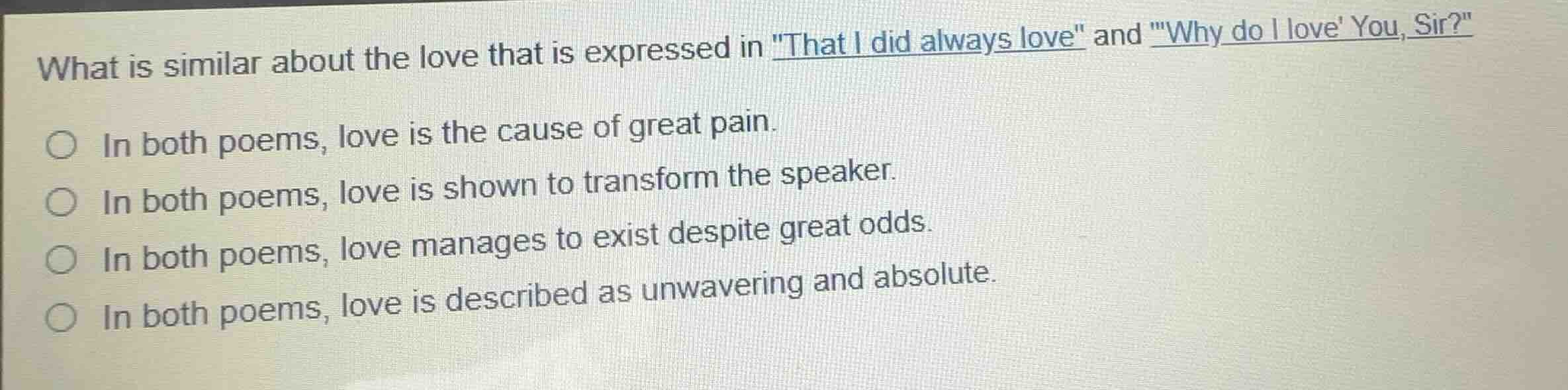
what is similar about the love that is expressed in \that i did always love\ and \why do i love you, sir?\
in both poems, love is the cause of great pain.
in both poems, love is shown to transform the speaker.
in both poems, love manages to exist despite great odds.
in both poems, love is described as unwavering and absolute.
<pre_analysis>
{
"quality": "clear",
"question_count": 1,
"skills_matched": [
"direct_cot",
"multiple_choice_formatter",
"explain_then_answer",
"tutor",
"mastery_adaptive_brevity"
],
"needs_drawing": false,
"concepts_used": [
"Emily Dickinson Analysis",
"Thematic Analysis"
],
"new_concepts": [
"Comparative Poetry Analysis"
],
"current_concepts": [
"Emily Dickinson Analysis",
"Thematic Analysis",
"Comparative Poetry Analysis"
]
}
</pre_analysis>
<reasoning>
Analyze "That I did always love"
Using the Emily Dickinson Analysis and Thematic Analysis knowledge points
- In "That I did always love" (Poem 549), the speaker declares that love is an absolute, constant state of existence: "That I did always love / I bring thee Proof / That till I loved / I never lived - Enough -".
- The poem argues that love is eternal, transcending even death, showing it to be completely unwavering and absolute.
Analyze "Why do I love' You, Sir?"
Using the Emily Dickinson Analysis and Thematic Analysis knowledge points
- In "Why do I love' You, Sir?" (Poem 480), the speaker explains that love cannot be reasoned or explained, comparing it to natural, inevitable phenomena: "The Wind does not require the Grass / To answer Wherefore when he pass / She cannot keep her cover / ... / Because He is - / And Noise is - / And the Silence - / And I - because I love / Thee -".
- This portrays love as an inherent, unquestionable, and absolute force that exists simply because it must, without condition or change.
Compare the themes of love
Using the Thematic Analysis knowledge point
- Both poems by Emily Dickinson depict love not as a source of pain, a transformative journey, or a struggle against odds, but as an inherent, constant, and unquestionable reality.
- Therefore, in both poems, love is described as unwavering and absolute.
</reasoning>
<answer>
<mcq-option>In both poems, love is the cause of great pain.</mcq-option>
<mcq-option>In both poems, love is shown to transform the speaker.</mcq-option>
<mcq-option>In both poems, love manages to exist despite great odds.</mcq-option>
<mcq-correct>In both poems, love is described as unwavering and absolute.</mcq-correct>
</answer>
<post_analysis>
{
"subject": "Arts",
"question_type": "Multiple Choice",
"knowledge_point": [
"Arts",
"Others",
"Comparative Poetry Analysis"
]
}
</post_analysis>
Snap & solve any problem in the app
Get step-by-step solutions on Sovi AI
Photo-based solutions with guided steps
Explore more problems and detailed explanations
<pre_analysis>
{
"quality": "clear",
"question_count": 1,
"skills_matched": [
"direct_cot",
"multiple_choice_formatter",
"explain_then_answer",
"tutor",
"mastery_adaptive_brevity"
],
"needs_drawing": false,
"concepts_used": [
"Emily Dickinson Analysis",
"Thematic Analysis"
],
"new_concepts": [
"Comparative Poetry Analysis"
],
"current_concepts": [
"Emily Dickinson Analysis",
"Thematic Analysis",
"Comparative Poetry Analysis"
]
}
</pre_analysis>
<reasoning>
Analyze "That I did always love"
Using the Emily Dickinson Analysis and Thematic Analysis knowledge points
- In "That I did always love" (Poem 549), the speaker declares that love is an absolute, constant state of existence: "That I did always love / I bring thee Proof / That till I loved / I never lived - Enough -".
- The poem argues that love is eternal, transcending even death, showing it to be completely unwavering and absolute.
Analyze "Why do I love' You, Sir?"
Using the Emily Dickinson Analysis and Thematic Analysis knowledge points
- In "Why do I love' You, Sir?" (Poem 480), the speaker explains that love cannot be reasoned or explained, comparing it to natural, inevitable phenomena: "The Wind does not require the Grass / To answer Wherefore when he pass / She cannot keep her cover / ... / Because He is - / And Noise is - / And the Silence - / And I - because I love / Thee -".
- This portrays love as an inherent, unquestionable, and absolute force that exists simply because it must, without condition or change.
Compare the themes of love
Using the Thematic Analysis knowledge point
- Both poems by Emily Dickinson depict love not as a source of pain, a transformative journey, or a struggle against odds, but as an inherent, constant, and unquestionable reality.
- Therefore, in both poems, love is described as unwavering and absolute.
</reasoning>
<answer>
<mcq-option>In both poems, love is the cause of great pain.</mcq-option>
<mcq-option>In both poems, love is shown to transform the speaker.</mcq-option>
<mcq-option>In both poems, love manages to exist despite great odds.</mcq-option>
<mcq-correct>In both poems, love is described as unwavering and absolute.</mcq-correct>
</answer>
<post_analysis>
{
"subject": "Arts",
"question_type": "Multiple Choice",
"knowledge_point": [
"Arts",
"Others",
"Comparative Poetry Analysis"
]
}
</post_analysis>