QUESTION IMAGE
Question
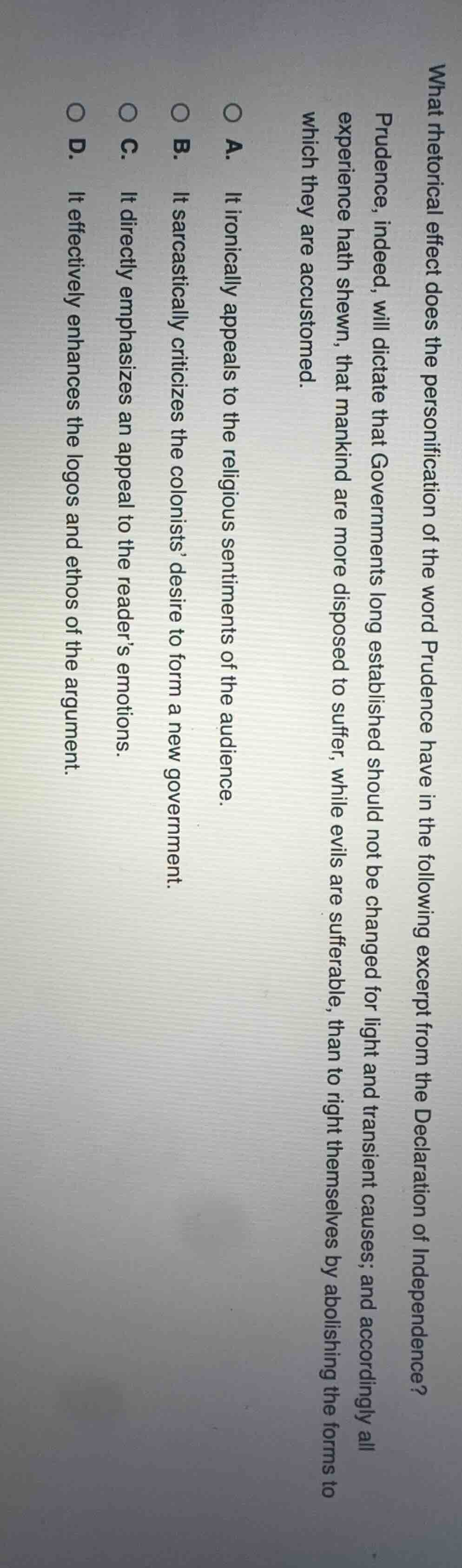
what rhetorical effect does the personification of the word prudence have in the following excerpt from the declaration of independence?
prudence, indeed, will dictate that governments long established should not be changed for light and transient causes; and accordingly all experience hath shewn, that mankind are more disposed to suffer, while evils are sufferable, than to right themselves by abolishing the forms to which they are accustomed.
a. it ironically appeals to the religious sentiments of the audience.
b. it sarcastically criticizes the colonists’ desire to form a new government.
c. it directly emphasizes an appeal to the reader’s emotions.
d. it effectively enhances the logos and ethos of the argument.
Personifying "Prudence" (giving it human - like action of "dictating") in the Declaration of Independence excerpt. Option A: There's no ironic religious appeal here. Option B: The personification isn't sarcastic criticism of colonists' desire for new government. Option C: It doesn't directly appeal to emotions. Option D: By personifying Prudence, it gives a logical (logos) sense of the principle of not changing long - established governments lightly and an ethical (ethos) weight as if a wise entity is dictating, thus enhancing logos and ethos.

Snap & solve any problem in the app
Get step-by-step solutions on Sovi AI
Photo-based solutions with guided steps
Explore more problems and detailed explanations
D. It effectively enhances the logos and ethos of the argument.