QUESTION IMAGE
Question
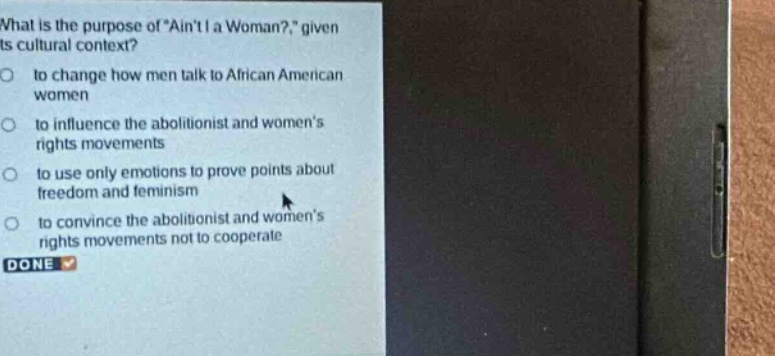
what is the purpose of \aint i a woman?,\ given its cultural context?
- to change how men talk to african american women
- to influence the abolitionist and womens rights movements
- to use only emotions to prove points about freedom and feminism
- to convince the abolitionist and womens rights movements not to cooperate
🆕 New Concept Discovered: Analyzing Rhetorical Purpose and Historical Context
Connecting a text's message to its historical era
Step 1: Understand the Historical Context of the Speech
Sojourner Truth delivered her famous "Ain't I a Woman?" speech in 1851 at the Ohio Women's Rights Convention. During this era in the United States, two major social reform movements were highly active and deeply interconnected:
- The Abolitionist Movement: working to end slavery.
- The Women's Rights Movement: working to secure equal rights and suffrage for women.
As a formerly enslaved woman, Sojourner Truth stood at the intersection of both movements, advocating for the rights of Black women who were often excluded or ignored by white-dominated reform groups.
Step 2: Analyze the Purpose of the Speech
The purpose of the speech was to challenge prevailing stereotypes about women's physical and intellectual capabilities while simultaneously demanding that the rights of Black women be recognized within both the anti-slavery and feminist platforms.
By speaking directly to reformers, her goal was to shape, unite, and push forward the agendas of both the abolitionist and women's rights movements.
Step 3: Evaluate the Given Options
- Option 1: "to change how men talk to African American women" — This is too narrow and does not capture the broad political and social goals of her speech.
- Option 2: "to influence the abolitionist and women's rights movements" — This correctly identifies her intent to shape the goals and inclusivity of these two major contemporary reform movements.
- Option 3: "to use only emotions to prove points about freedom and feminism" — This is incorrect; Truth used logical arguments, personal anecdotes, and religious references, not just emotion.
- Option 4: "to convince the abolitionist and women's rights movements not to cooperate" — This is incorrect; she wanted these movements to work together and support all marginalized groups, including Black women.

Snap & solve any problem in the app
Get step-by-step solutions on Sovi AI
Photo-based solutions with guided steps
Explore more problems and detailed explanations
to influence the abolitionist and women's rights movements