QUESTION IMAGE
Question
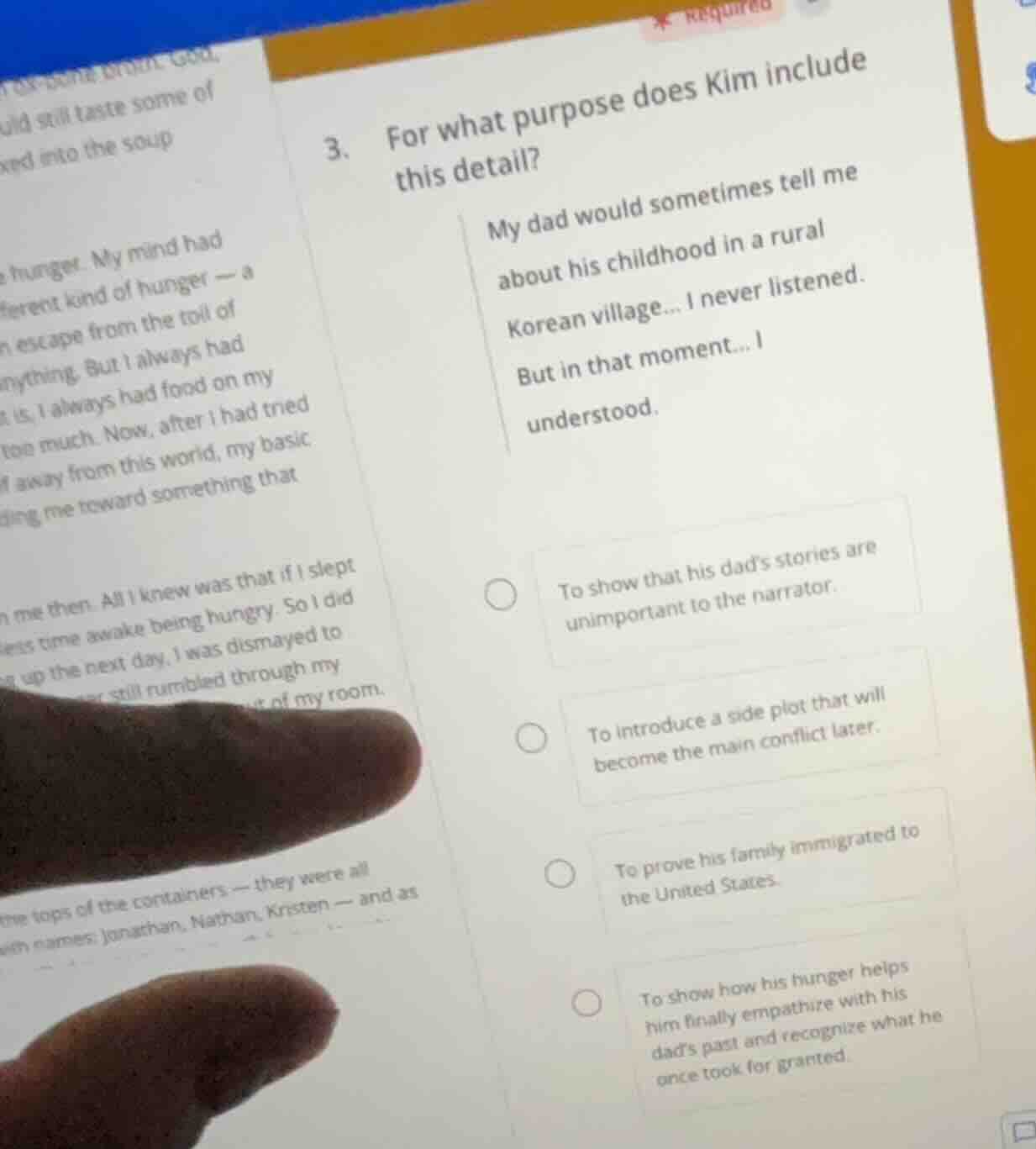
- for what purpose does kim include this detail?
my dad would sometimes tell me about his childhood in a rural korean village... i never listened. but in that moment... i understood.
- to show that his dads stories are unimportant to the narrator.
- to introduce a side plot that will become the main conflict later.
- to prove his family immigrated to the united states.
- to show how his hunger helps him finally empathize with his dads past and recognize what he once took for granted.
<pre_analysis>
{
"quality": "clear",
"question_count": 1,
"skills_matched": [
"direct_cot",
"multiple_choice_formatter",
"explain_then_answer",
"tutor",
"mastery_adaptive_brevity"
],
"needs_drawing": false,
"concepts_used": [
"Authors Purpose",
"Narrative Details",
"Korean-American Literature"
],
"new_concepts": [],
"current_concepts": [
"Authors Purpose",
"Narrative Details",
"Korean-American Literature"
]
}
</pre_analysis>
<reasoning>
Analyze the quoted passage
Using the Narrative Details and Korean-American Literature knowledge points
The narrator reflects on ignoring his father's stories about a rural Korean childhood, but notes that "in that moment... I understood." This shift marks a transition from indifference to deep empathy and connection.
Evaluate the author's intent
Using the Authors Purpose knowledge point
The narrator's physical experience of hunger bridges the gap between his comfortable life and his father's past struggles. This realization highlights a newfound appreciation for his father's history and sacrifices, which he previously ignored.
Assess the multiple-choice options
- Option 1 suggests the stories are unimportant, which contradicts the narrator's realization of understanding.
- Option 2 mentions a side plot becoming a main conflict, which is unsupported by this reflective moment.
- Option 3 focuses on proving immigration, which is not the emotional or thematic purpose of this realization.
- Option 4 directly connects the narrator's hunger to empathizing with his father's past and recognizing what was once taken for granted.
</reasoning>
<answer>
<mcq-option>To show that his dad's stories are unimportant to the narrator.</mcq-option>
<mcq-option>To introduce a side plot that will become the main conflict later.</mcq-option>
<mcq-option>To prove his family immigrated to the United States.</mcq-option>
<mcq-correct>To show how his hunger helps him finally empathize with his dad's past and recognize what he once took for granted.</mcq-correct>
</answer>
<post_analysis>
{
"subject": "Others",
"question_type": "Multiple Choice",
"knowledge_point": [
"Others",
"Literature",
"Authors Purpose"
]
}
</post_analysis>
Snap & solve any problem in the app
Get step-by-step solutions on Sovi AI
Photo-based solutions with guided steps
Explore more problems and detailed explanations
<pre_analysis>
{
"quality": "clear",
"question_count": 1,
"skills_matched": [
"direct_cot",
"multiple_choice_formatter",
"explain_then_answer",
"tutor",
"mastery_adaptive_brevity"
],
"needs_drawing": false,
"concepts_used": [
"Authors Purpose",
"Narrative Details",
"Korean-American Literature"
],
"new_concepts": [],
"current_concepts": [
"Authors Purpose",
"Narrative Details",
"Korean-American Literature"
]
}
</pre_analysis>
<reasoning>
Analyze the quoted passage
Using the Narrative Details and Korean-American Literature knowledge points
The narrator reflects on ignoring his father's stories about a rural Korean childhood, but notes that "in that moment... I understood." This shift marks a transition from indifference to deep empathy and connection.
Evaluate the author's intent
Using the Authors Purpose knowledge point
The narrator's physical experience of hunger bridges the gap between his comfortable life and his father's past struggles. This realization highlights a newfound appreciation for his father's history and sacrifices, which he previously ignored.
Assess the multiple-choice options
- Option 1 suggests the stories are unimportant, which contradicts the narrator's realization of understanding.
- Option 2 mentions a side plot becoming a main conflict, which is unsupported by this reflective moment.
- Option 3 focuses on proving immigration, which is not the emotional or thematic purpose of this realization.
- Option 4 directly connects the narrator's hunger to empathizing with his father's past and recognizing what was once taken for granted.
</reasoning>
<answer>
<mcq-option>To show that his dad's stories are unimportant to the narrator.</mcq-option>
<mcq-option>To introduce a side plot that will become the main conflict later.</mcq-option>
<mcq-option>To prove his family immigrated to the United States.</mcq-option>
<mcq-correct>To show how his hunger helps him finally empathize with his dad's past and recognize what he once took for granted.</mcq-correct>
</answer>
<post_analysis>
{
"subject": "Others",
"question_type": "Multiple Choice",
"knowledge_point": [
"Others",
"Literature",
"Authors Purpose"
]
}
</post_analysis>