QUESTION IMAGE
Question
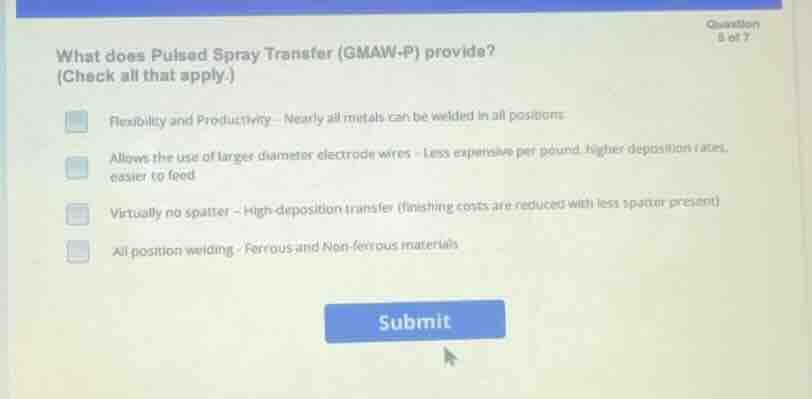
what does pulsed spray transfer (gmaw-p) provide?
(check all that apply.)
- flexibility and productivity - nearly all metals can be welded in all positions
- allows the use of larger diameter electrode wires - less expensive per pound, higher deposition rates, easier to feed
- virtually no spatter - high-deposition transfer (finishing costs are reduced with less spatter present)
- all position welding - ferrous and non-ferrous materials
Identify the characteristics of Pulsed Spray Transfer (GMAW-P)
Pulsed Spray Transfer (GMAW-P) is an advanced variation of the spray transfer mode in Gas Metal Arc Welding (GMAW Transfer Modes). It alternates between a high peak current (which pushes a single droplet across the arc) and a low background current (which maintains the arc but is too low for metal transfer). This allows for lower overall heat input while retaining the benefits of spray transfer.
Evaluate Option 1
The first option states: "Flexibility and Productivity - Nearly all metals can be welded in all positions".
Because the background current allows the weld puddle to cool slightly between pulses, GMAW-P provides excellent puddle control. This makes it highly flexible, allowing out-of-position welding (all positions) on almost any weldable metal. This statement is correct.
Evaluate Option 2
The second option states: "Allows the use of larger diameter electrode wires - Less expensive per pound, higher deposition rates, easier to feed".
GMAW-P allows operators to use larger, more rigid, and less expensive wire diameters (such as 0.045" instead of 0.035") even at lower average currents where a standard spray transfer would normally require smaller wires. This increases deposition rates and improves wire feeding reliability. This statement is correct.
Evaluate Option 3
The third option states: "Virtually no spatter - High-deposition transfer (finishing costs are reduced with less spatter present)".
Because the metal transfer is controlled precisely droplet-by-droplet during the peak current phase, there is virtually no spatter compared to short-circuit or globular transfer modes. This significantly reduces post-weld cleanup and finishing costs. This statement is correct.
Evaluate Option 4
The fourth option states: "All position welding - Ferrous and Non-ferrous materials".
As established, the pulsed nature of the current lowers the average heat input, allowing the puddle to freeze quickly enough for out-of-position welding on both ferrous (steel, stainless steel) and non-ferrous (aluminum, nickel alloys) metals. This statement is correct.

Snap & solve any problem in the app
Get step-by-step solutions on Sovi AI
Photo-based solutions with guided steps
Explore more problems and detailed explanations
- (A) Flexibility and Productivity - Nearly all metals can be welded in all positions (Correct answer)
- (B) Allows the use of larger diameter electrode wires - Less expensive per pound, higher deposition rates, easier to feed (Correct answer)
- (C) Virtually no spatter - High-deposition transfer (finishing costs are reduced with less spatter present) (Correct answer)
- (D) All position welding - Ferrous and Non-ferrous materials (Correct answer)