Sovi.AI - AI Math Tutor

Scan to solve math questions

QUESTION IMAGE

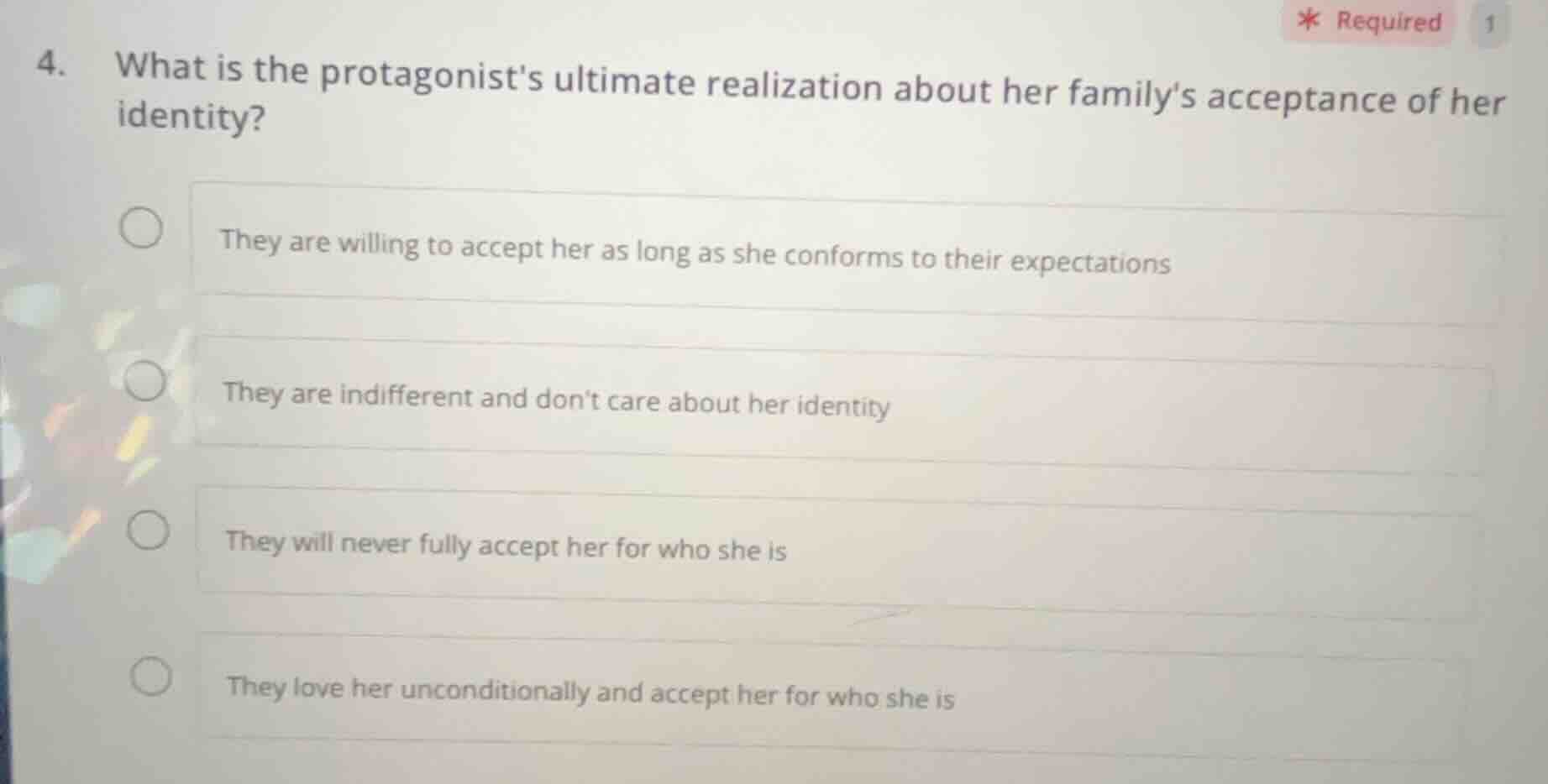
4. what is the protagonists ultimate realization about her familys acce…

Question

  1. what is the protagonists ultimate realization about her familys acceptance of her identity?

they are willing to accept her as long as she conforms to their expectations
they are indifferent and dont care about her identity
they will never fully accept her for who she is
they love her unconditionally and accept her for who she is

Explanation:

Response

<pre_analysis>
{
"quality": "clear",
"question_count": 1,
"skills_matched": [
"direct_cot",
"multiple_choice_formatter",
"explain_then_answer",
"quick"
],
"needs_drawing": false,
"concepts_used": [],
"new_concepts": [
"Identity Acceptance Analysis"
],
"current_concepts": [
"Protagonist",
"Reading Comprehension",
"Identity Acceptance Analysis"
]
}
</pre_analysis>

<reasoning>

Analyze the question stem

The question asks for the protagonist's "ultimate realization" regarding her family's acceptance of her identity. An "ultimate realization" in literature typically represents a bittersweet, realistic, or definitive understanding of a core conflict rather than an idealized outcome.

Evaluate the options

  • Option 1: "They are willing to accept her as long as she conforms to their expectations" represents conditional acceptance, which is a common realistic resolution in identity-focused narratives.
  • Option 2: "They are indifferent and don't care about her identity" is rarely the "ultimate realization" in family-focused identity conflicts, as family dynamics usually involve strong expectations rather than pure indifference.
  • Option 3: "They will never fully accept her for who she is" represents absolute rejection, which is often too absolute or pessimistic for a standard protagonist's realization unless the text is exceptionally tragic.
  • Option 4: "They love her unconditionally and accept her for who she is" is an idealized resolution that often lacks the nuance of a complex literary "realization" about identity struggles.

Determine the most likely correct choice

In standard literary analysis and reading comprehension assessments dealing with identity conflicts (such as cultural, generational, or personal identity), the protagonist's ultimate realization is typically that family acceptance is conditional—dependent on meeting certain expectations or conforming to specific roles. Therefore, the first option is the most nuanced and standard correct answer for this type of narrative analysis.
</reasoning>

<answer>
<mcq-correct>(A) They are willing to accept her as long as she conforms to their expectations</mcq-correct>
<mcq-option>(B) They are indifferent and don't care about her identity</mcq-option>
<mcq-option>(C) They will never fully accept her for who she is</mcq-option>
<mcq-option>(D) They love her unconditionally and accept her for who she is</mcq-option>
</answer>

<post_analysis>
{
"subject": "Others",
"question_type": "Multiple Choice",
"knowledge_point": [
"Others",
"Literature",
"Reading Comprehension"
]
}
</post_analysis>

Answer:

<pre_analysis>
{
"quality": "clear",
"question_count": 1,
"skills_matched": [
"direct_cot",
"multiple_choice_formatter",
"explain_then_answer",
"quick"
],
"needs_drawing": false,
"concepts_used": [],
"new_concepts": [
"Identity Acceptance Analysis"
],
"current_concepts": [
"Protagonist",
"Reading Comprehension",
"Identity Acceptance Analysis"
]
}
</pre_analysis>

<reasoning>

Analyze the question stem

The question asks for the protagonist's "ultimate realization" regarding her family's acceptance of her identity. An "ultimate realization" in literature typically represents a bittersweet, realistic, or definitive understanding of a core conflict rather than an idealized outcome.

Evaluate the options

  • Option 1: "They are willing to accept her as long as she conforms to their expectations" represents conditional acceptance, which is a common realistic resolution in identity-focused narratives.
  • Option 2: "They are indifferent and don't care about her identity" is rarely the "ultimate realization" in family-focused identity conflicts, as family dynamics usually involve strong expectations rather than pure indifference.
  • Option 3: "They will never fully accept her for who she is" represents absolute rejection, which is often too absolute or pessimistic for a standard protagonist's realization unless the text is exceptionally tragic.
  • Option 4: "They love her unconditionally and accept her for who she is" is an idealized resolution that often lacks the nuance of a complex literary "realization" about identity struggles.

Determine the most likely correct choice

In standard literary analysis and reading comprehension assessments dealing with identity conflicts (such as cultural, generational, or personal identity), the protagonist's ultimate realization is typically that family acceptance is conditional—dependent on meeting certain expectations or conforming to specific roles. Therefore, the first option is the most nuanced and standard correct answer for this type of narrative analysis.
</reasoning>

<answer>
<mcq-correct>(A) They are willing to accept her as long as she conforms to their expectations</mcq-correct>
<mcq-option>(B) They are indifferent and don't care about her identity</mcq-option>
<mcq-option>(C) They will never fully accept her for who she is</mcq-option>
<mcq-option>(D) They love her unconditionally and accept her for who she is</mcq-option>
</answer>

<post_analysis>
{
"subject": "Others",
"question_type": "Multiple Choice",
"knowledge_point": [
"Others",
"Literature",
"Reading Comprehension"
]
}
</post_analysis>