QUESTION IMAGE
Question
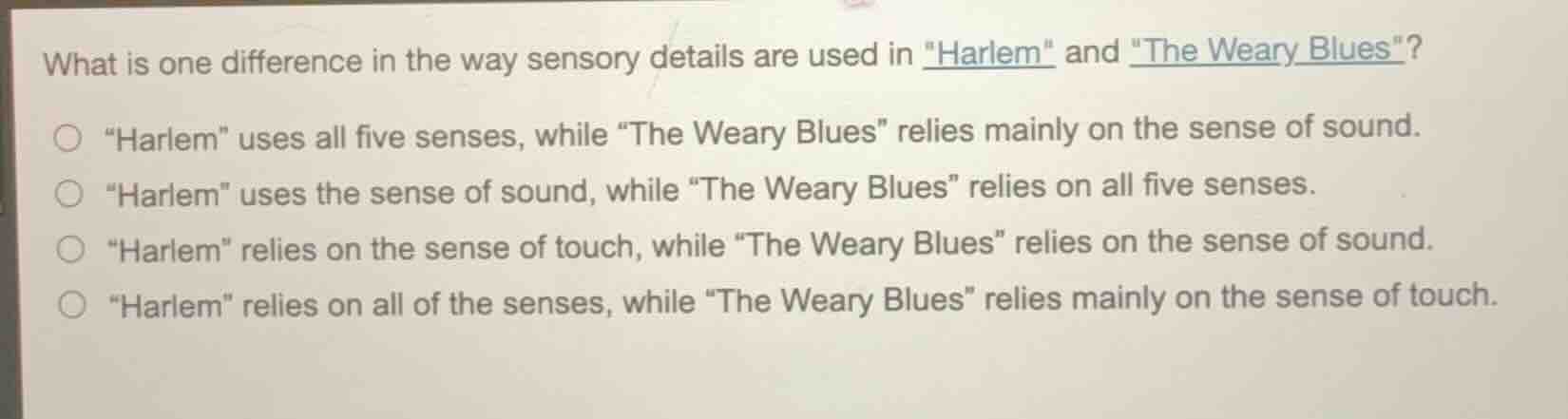
what is one difference in the way sensory details are used in \harlem\ and \the weary blues\?
- \harlem\ uses all five senses, while \the weary blues\ relies mainly on the sense of sound.
- \harlem\ uses the sense of sound, while \the weary blues\ relies on all five senses.
- \harlem\ relies on the sense of touch, while \the weary blues\ relies on the sense of sound.
- \harlem\ relies on all of the senses, while \the weary blues\ relies mainly on the sense of touch.
Langston Hughes' Harlem uses sensory details across all five senses: it references the smell of "rotten meat," the sight of "a raisin in the sun," the touch of "a sore," the taste of "syrupy sweet," and the implied sound of a "explosion." In contrast, The Weary Blues centers almost entirely on auditory (sound) details, focusing on the piano playing, the singer's voice, and the rhythm of the blues music.

Snap & solve any problem in the app
Get step-by-step solutions on Sovi AI
Photo-based solutions with guided steps
Explore more problems and detailed explanations
A. "Harlem" uses all five senses, while "The Weary Blues" relies mainly on the sense of sound.