QUESTION IMAGE
Question
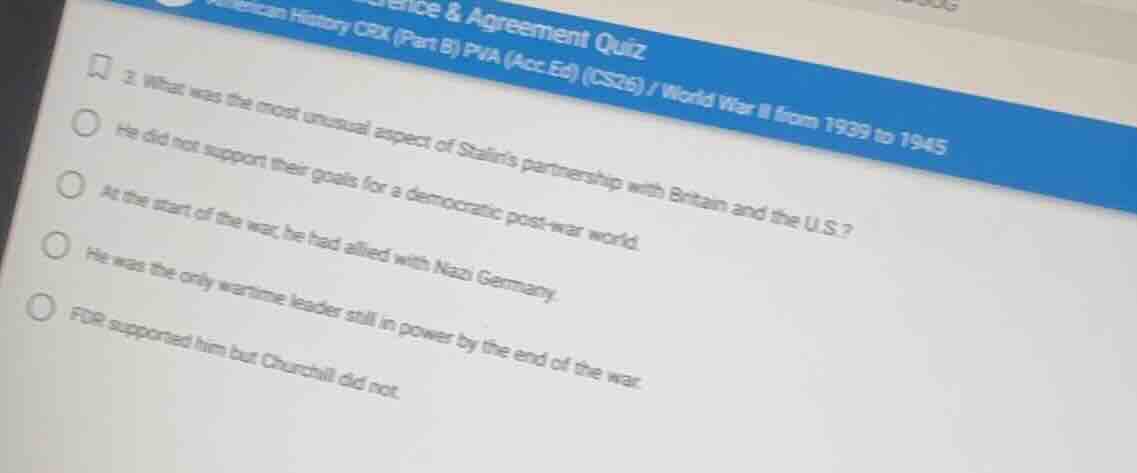
what was the most unusual aspect of stalins partnership with britain and the u.s.?
he did not support their goals for a democratic post-war world.
at the start of the war, he had allied with nazi germany.
he was the only wartime leader still in power by the end of the war.
fdr supported him but churchill did not.
Analyze the question prompt
The question asks for the most unusual aspect of Joseph Stalin's partnership with Great Britain and the United States during World War II.
Evaluate the historical context
Using the World War II Leaders knowledge point
- Stalin signed the Molotov-Ribbentrop Pact with Adolf Hitler in August 1939, effectively allying with Nazi Germany at the start of the war.
- This initial alliance makes his subsequent partnership with the democratic Allied powers (Britain and the US) highly unusual.
Assess the given options
- Option 1: "He did not support their goals for a democratic post-war world." While true, this ideological difference was expected rather than "unusual" for a communist dictator.
- Option 2: "At the start of the war, he had allied with Nazi Germany." This is historically accurate and represents a dramatic, unusual shift in alliances.
- Option 3: "He was the only wartime leader still in power by the end of the war." This is incorrect (e.g., Harry Truman, Winston Churchill, and others held power, though leadership changed, and Stalin's longevity itself wasn't the defining unusual aspect of the partnership).
- Option 4: "FDR supported him but Churchill did not." This is incorrect; both leaders supported the alliance to defeat Germany.
Formulate the final selection
The most unusual aspect of the partnership was Stalin's initial non-aggression pact and division of Eastern Europe with Nazi Germany before being invaded in 1941.

Snap & solve any problem in the app
Get step-by-step solutions on Sovi AI
Photo-based solutions with guided steps
Explore more problems and detailed explanations
- He did not support their goals for a democratic post-war world.
- At the start of the war, he had allied with Nazi Germany. (Correct answer)
- He was the only wartime leader still in power by the end of the war.
- FDR supported him but Churchill did not.