QUESTION IMAGE
Question
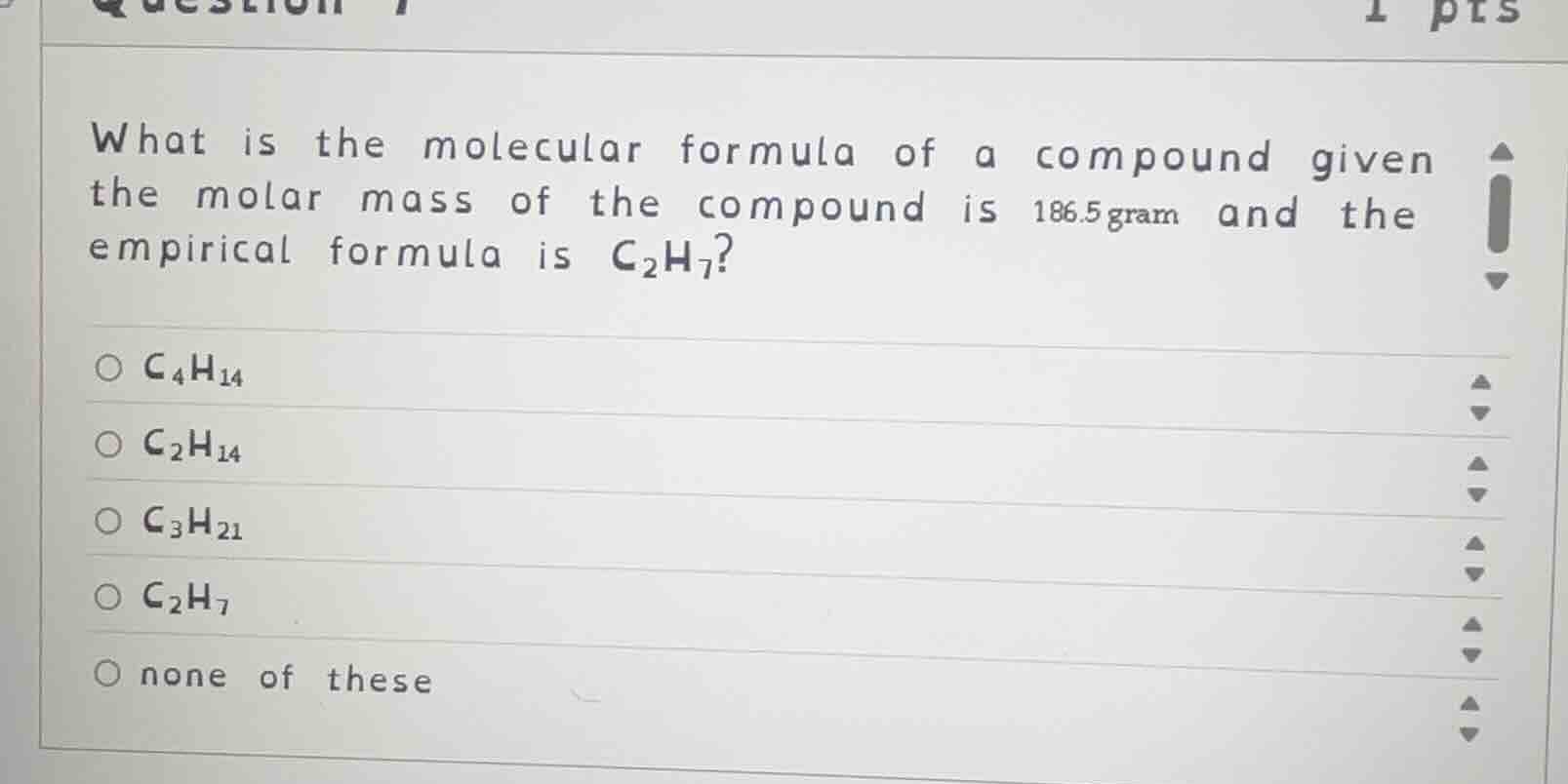
what is the molecular formula of a compound given the molar mass of the compound is \\(186.5\text{ gram}\\) and the empirical formula is \\(\text{c}_2\text{h}_7\\)?
\\(\bigcirc\text{ c}_4\text{h}_{14}\\)
\\(\bigcirc\text{ c}_2\text{h}_{14}\\)
\\(\bigcirc\text{ c}_3\text{h}_{21}\\)
\\(\bigcirc\text{ c}_2\text{h}_7\\)
\\(\bigcirc\text{ none of these}\\)
🆕 New Concept Discovered: Empirical and Molecular Formulas
Scaling up the simplest ratio to find the real molecule
Step 1: Calculate the empirical formula mass
The empirical formula is \(\text{C}_2\text{H}_7\). We find its mass by adding the average atomic masses of its constituent atoms:
- Carbon (\(\text{C}\)): \(\approx 12.011\text{ g/mol}\)
- Hydrogen (\(\text{H}\)): \(\approx 1.008\text{ g/mol}\)
Step 2: Determine the scaling factor
The molecular formula is always a whole-number multiple (\(n\)) of the empirical formula. To find this multiplier, divide the given molar mass of the compound by the empirical formula mass:
This means the actual molecule is \(6\) times heavier than the empirical unit.
Step 3: Determine the molecular formula
Multiply the subscripts in the empirical formula \(\text{C}_2\text{H}_7\) by the scaling factor \(n = 6\):
- Carbon: \(2 \times 6 = 12\)
- Hydrogen: \(7 \times 6 = 42\)
The molecular formula is \(\text{C}_{12}\text{H}_{42}\).
Looking at the given choices:
- \(\text{C}_4\text{H}_{14}\) (this corresponds to \(n = 2\))
- \(\text{C}_2\text{H}_{14}\)
- \(\text{C}_3\text{H}_{21}\) (this corresponds to \(n = 1.5\))
- \(\text{C}_2\text{H}_7\) (this corresponds to \(n = 1\))
- none of these
Since \(\text{C}_{12}\text{H}_{42}\) is not listed among the specific molecular formulas, the correct choice is "none of these".

Snap & solve any problem in the app
Get step-by-step solutions on Sovi AI
Photo-based solutions with guided steps
Explore more problems and detailed explanations
none of these