QUESTION IMAGE
Question
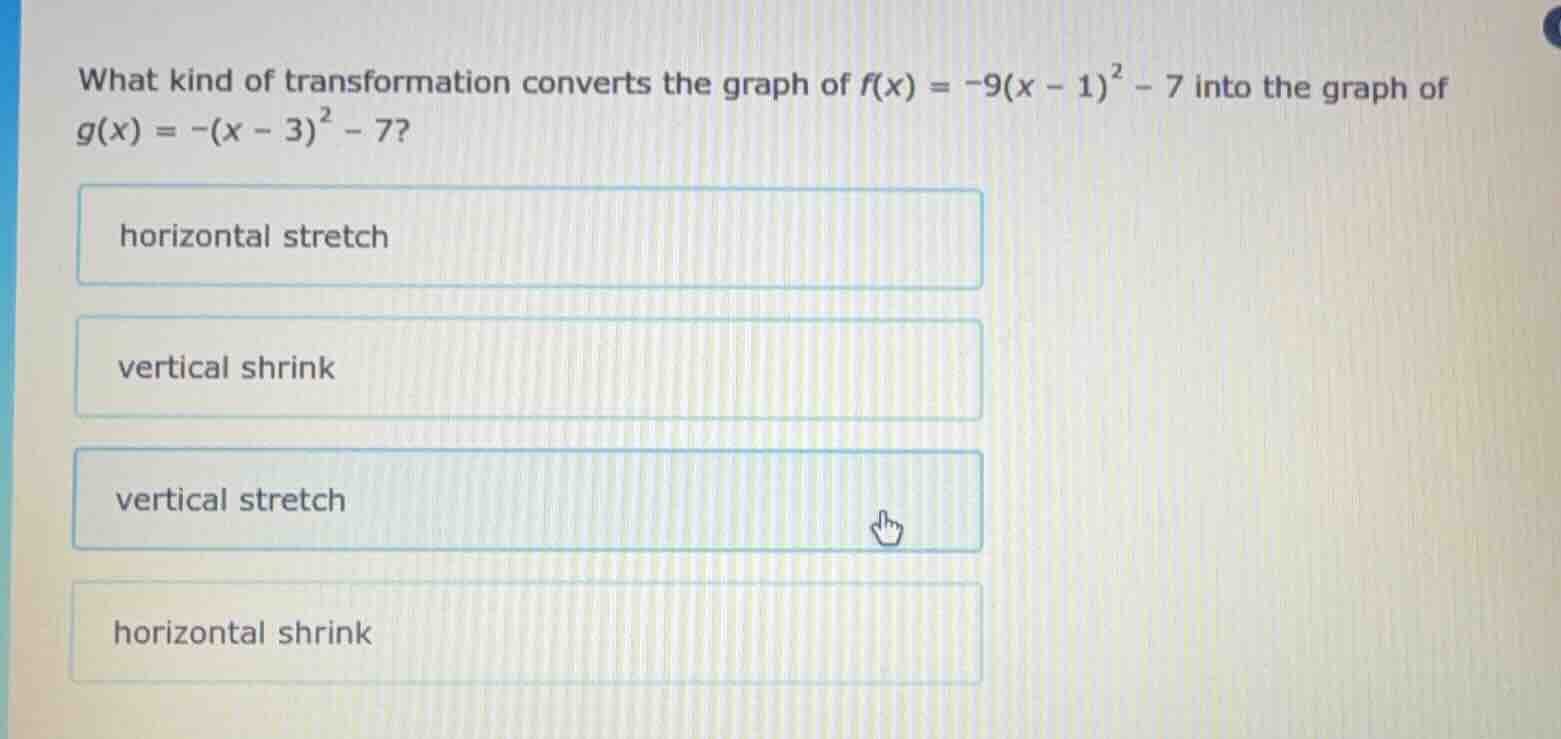
what kind of transformation converts the graph of $f(x) = -9(x - 1)^{2} - 7$ into the graph of $g(x) = -(x - 3)^{2} - 7$? horizontal stretch vertical shrink vertical stretch horizontal shrink
Step1: Recall transformation rules
For a quadratic function in the form \( y = a(x - h)^2 + k \), the coefficient \( a \) affects vertical stretching/shrinking, and changes in \( h \) affect horizontal shifts. Here, we focus on the coefficient \( a \) for vertical transformations and the horizontal/vertical stretch/shrink rules. A vertical stretch/shrink is determined by the absolute value of \( a \): if \( |a_1| > |a_2| \), it's a vertical shrink from \( f \) to \( g \), and vice versa for stretch. For horizontal stretch/shrink, the transformation involves the coefficient inside the parentheses, but here we look at the vertical coefficient first.
Step2: Analyze coefficients of \( f(x) \) and \( g(x) \)
For \( f(x) = -9(x - 1)^2 - 7 \), the coefficient \( a_f = -9 \), so \( |a_f| = 9 \). For \( g(x) = -(x - 3)^2 - 7 \), the coefficient \( a_g = -1 \), so \( |a_g| = 1 \). Since \( |a_g|=\frac{|a_f|}{9} \) (because \( 9\times\frac{1}{9}=1 \)), this means we are reducing the vertical stretch factor from 9 to 1, which is a vertical shrink (since we're making the graph "flatter" vertically, reducing the vertical scaling factor). Wait, no—wait, vertical stretch/shrink: if \( |a| > 1 \), it's a vertical stretch; if \( 0 < |a| < 1 \), it's a vertical shrink. So from \( |a| = 9 \) (stretched) to \( |a| = 1 \) (less stretched, i.e., shrunk vertically). Wait, but also, let's check horizontal: no, the horizontal shift is from \( x - 1 \) to \( x - 3 \), which is a horizontal shift, not stretch/shrink. The stretch/shrink is about the coefficient of the squared term. Wait, the question is about the transformation from \( f \) to \( g \). Let's write \( g(x) \) in terms of \( f(x) \)'s structure. Let's see: \( f(x) = -9(x - 1)^2 - 7 \), \( g(x) = -1(x - 3)^2 - 7 \). To get from \( f \) to \( g \), we can think of changing the coefficient from -9 to -1 (vertical) and the horizontal shift, but the options are about stretch/shrink. Wait, maybe I made a mistake. Wait, vertical stretch/shrink: when you have \( y = a f(x) \), vertical stretch by factor \( |a| \) if \( |a| > 1 \), shrink if \( 0 < |a| < 1 \). Here, \( f(x) \) has a vertical stretch factor of 9, \( g(x) \) has 1. So to go from \( f(x) \) to \( g(x) \), we divide the function by 9 (since \( -9(x - 1)^2 - 7 \) to \( -(x - 3)^2 - 7 \) is like multiplying \( f(x) \) by \( \frac{1}{9} \) in the vertical direction? Wait, no, the horizontal stretch/shrink is when the transformation is inside the function, like \( f(kx) \) for horizontal. Wait, no, the standard form for horizontal stretch/shrink is \( y = f(kx) \), which is a horizontal stretch by \( \frac{1}{k} \) if \( 0 < k < 1 \), shrink if \( k > 1 \). But here, the function is \( (x - h) \), so the horizontal stretch/shrink would be if we have \( (kx - h) \), but here we have \( (x - 1) \) to \( (x - 3) \), which is a shift, not a stretch. Wait, maybe the question is about the vertical coefficient. Wait, the options are horizontal stretch, vertical shrink, vertical stretch, horizontal shrink. Wait, let's re-express:
Wait, \( f(x) = -9(x - 1)^2 - 7 \), \( g(x) = -1(x - 3)^2 - 7 \). Let's factor out the coefficient of the squared term. To get from \( f(x) \) to \( g(x) \), we can write \( g(x) = \frac{1}{9} \times [-9(x - 3)^2 - 63] \)? No, that's not right. Wait, maybe the horizontal stretch/shrink is when the coefficient inside the parentheses changes, but here the inside is \( (x - 1) \) to \( (x - 3) \), which is a shift. Wait, no, the stretch/shrink is about the coefficient of the \( (x - h) \) term? No, the standard form for a qu…

Snap & solve any problem in the app
Get step-by-step solutions on Sovi AI
Photo-based solutions with guided steps
Explore more problems and detailed explanations
vertical shrink (the option labeled "vertical shrink")