QUESTION IMAGE
Question
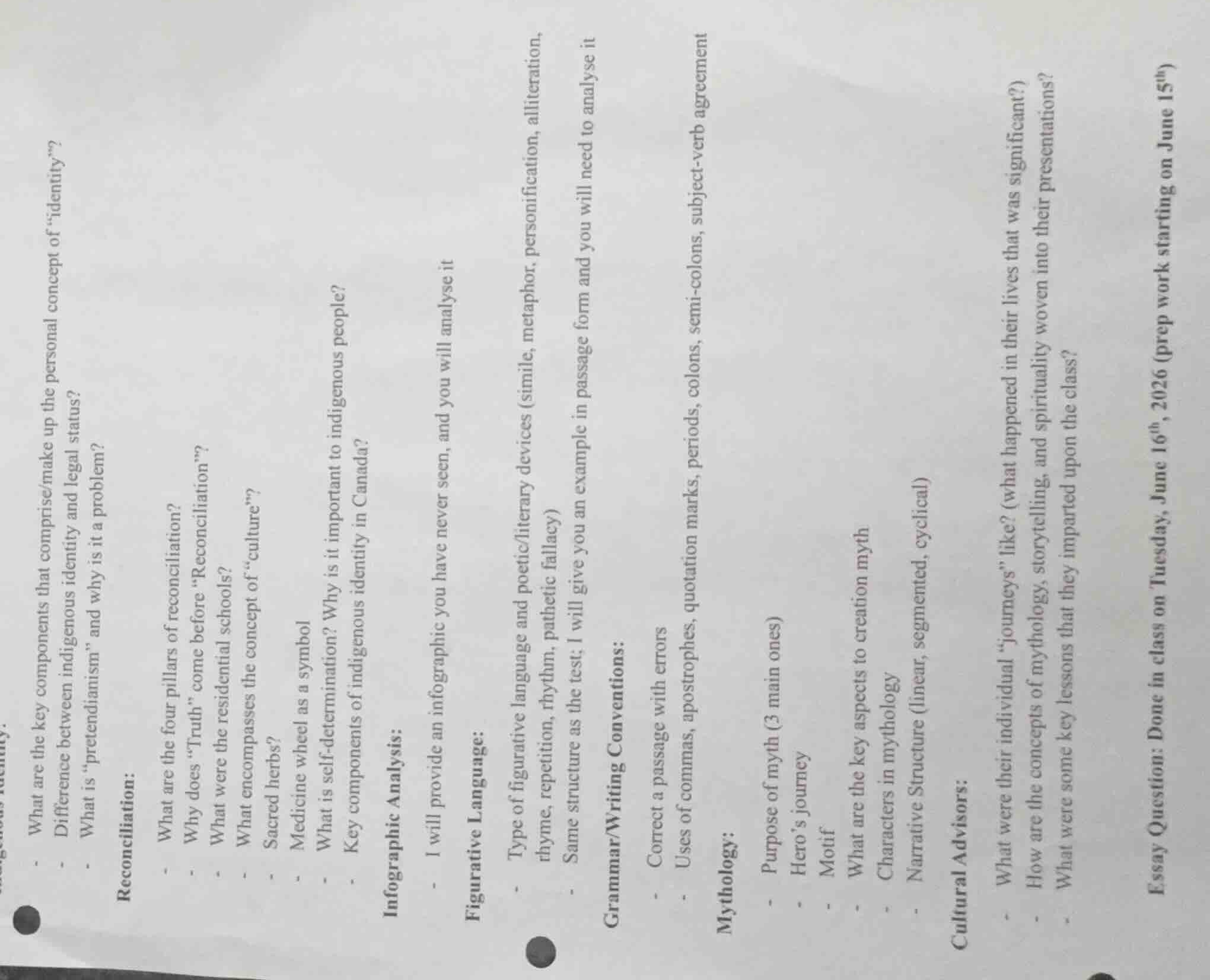
what are the key components that comprise/make up the personal concept of \identity\?
- difference between indigenous identity and legal status?
- what is \pretendianism\ and why is it a problem?
reconciliation:
- what are the four pillars of reconciliation?
- why does \truth\ come before
econciliation\?
- what were the residential schools?
- what encompasses the concept of \culture\?
- sacred herbs?
- medicine wheel as a symbol
- what is self-determination? why is it important to indigenous people?
- key components of indigenous identity in canada?
infographic analysis:
- i will provide an infographic you have never seen, and you will analyse it
figurative language:
- type of figurative language and poetic/literary devices (simile, metaphor, personification, alliteration, rhyme, repetition, rhythm, pathetic fallacy)
- same structure as the test; i will give you an example in passage form and you will need to analyse it
grammar/writing conventions:
- correct a passage with errors
- uses of commas, apostrophes, quotation marks, periods, colons, semi-colons, subject-verb agreement
mythology:
- purpose of myth (3 main ones)
- heros journey
- motif
- what are the key aspects to creation myth
- characters in mythology
- narrative structure (linear, segmented, cyclical)
cultural advisors:
- what were their individual \journeys\ like? (what happened in their lives that was significant?)
- how are the concepts of mythology, storytelling, and spirituality woven into their presentations?
- what were some key lessons that they imparted upon the class?
essay question: done in class on tuesday, june 16th, 2026 (prep work starting on june 15th)
Analyze the study guide structure
The provided image is a comprehensive study guide or review sheet for a high school course focusing on Indigenous studies, literature, and cultural concepts. It is divided into several thematic sections: Indigenous Identity, Reconciliation, Infographic Analysis, Figurative Language, Grammar/Writing Conventions, Mythology, and Cultural Advisors. To help master these topics, we will systematically address the core conceptual questions presented in the first two major sections: Indigenous Identity and Reconciliation.
Define key components of Indigenous Identity
Indigenous identity in Canada is multi-faceted, encompassing personal, cultural, and legal dimensions.
- Personal & Cultural Identity: This is shaped by connection to ancestral lands, community relationships, oral traditions, languages, and traditional practices.
- Legal Status: Under the Indian Act in Canada, "Status" is a legal definition regulated by the federal government, which historically and currently dictates who is recognized as a "Status Indian." This legal definition often conflicts with traditional, self-determined community understandings of identity.
- Pretendianism: This term refers to individuals who falsely claim Indigenous ancestry or identity for personal, academic, or professional advancement. It is highly problematic because it appropriates resources, opportunities, and voices meant for Indigenous people, undermining Indigenous Identity and sovereignty.
- Self-Determination: Using the Self-Determination knowledge point, this refers to the inherent right of Indigenous nations to freely determine their political status and freely pursue their economic, social, and cultural development, including the right to define their own membership and identity.
Explain the foundations of Reconciliation
Reconciliation is an ongoing process of establishing and maintaining mutually respectful relationships between Indigenous and non-Indigenous peoples in Canada.
- Why "Truth" comes before "Reconciliation": One cannot repair a relationship without first acknowledging the harms committed. The truth of historical injustices, particularly the legacy of residential schools, must be fully exposed and accepted before meaningful healing and reconciliation can occur.
- Residential Schools: A government-funded, church-run school system established to assimilate Indigenous children into Euro-Canadian culture, systematically disrupting families, languages, and cultures, and causing widespread abuse and intergenerational trauma.
- Four Pillars of Reconciliation: While frameworks vary, they generally center on:
- Awareness and Education: Understanding the true history and legacy of colonization.
- Acknowledgment: Recognizing the harms done and the ongoing systemic inequities.
- Atonement/Action: Taking concrete steps to address injustices (such as implementing the Truth and Reconciliation Commission's Calls to Action).…

Snap & solve any problem in the app
Get step-by-step solutions on Sovi AI
Photo-based solutions with guided steps
Explore more problems and detailed explanations
Based on the study guide provided in the image, here is a comprehensive review of the core concepts under Indigenous Identity and Reconciliation:
1. Indigenous Identity
- Key Components of Identity: Comprised of ancestral lineage, connection to traditional territories, community belonging, language, and cultural practices.
- Indigenous Identity vs. Legal Status: Legal status (such as "Status Indian" under the Canadian Indian Act) is a government-imposed classification that regulates rights and benefits, whereas cultural identity is rooted in community, kinship, and self-location.
- Pretendianism: The act of falsely claiming Indigenous identity. It is a serious issue because it appropriates resources, misrepresents cultural perspectives, and undermines genuine Indigenous representation.
- Self-Determination: The inherent right of Indigenous peoples to govern themselves, control their lands, and define their own identities and futures.
2. Reconciliation
- Truth Before Reconciliation: Healing and structural change cannot occur without first acknowledging and understanding the historical and ongoing truths of colonization.
- Residential Schools: A state-sponsored, church-run school system designed to assimilate Indigenous children, resulting in profound cultural loss and intergenerational trauma.
- Four Pillars of Reconciliation: Typically focused on Education/Awareness, Acknowledgment of Harm, Action/Atonement, and Relationship/Alliance Building.
- Medicine Wheel: A holistic symbol representing balance, interconnectedness, the four directions, and the physical, mental, emotional, and spiritual dimensions of life.
- Sacred Herbs: The four sacred medicines used in many ceremonies are tobacco, sage, cedar, and sweetgrass.