QUESTION IMAGE
Question
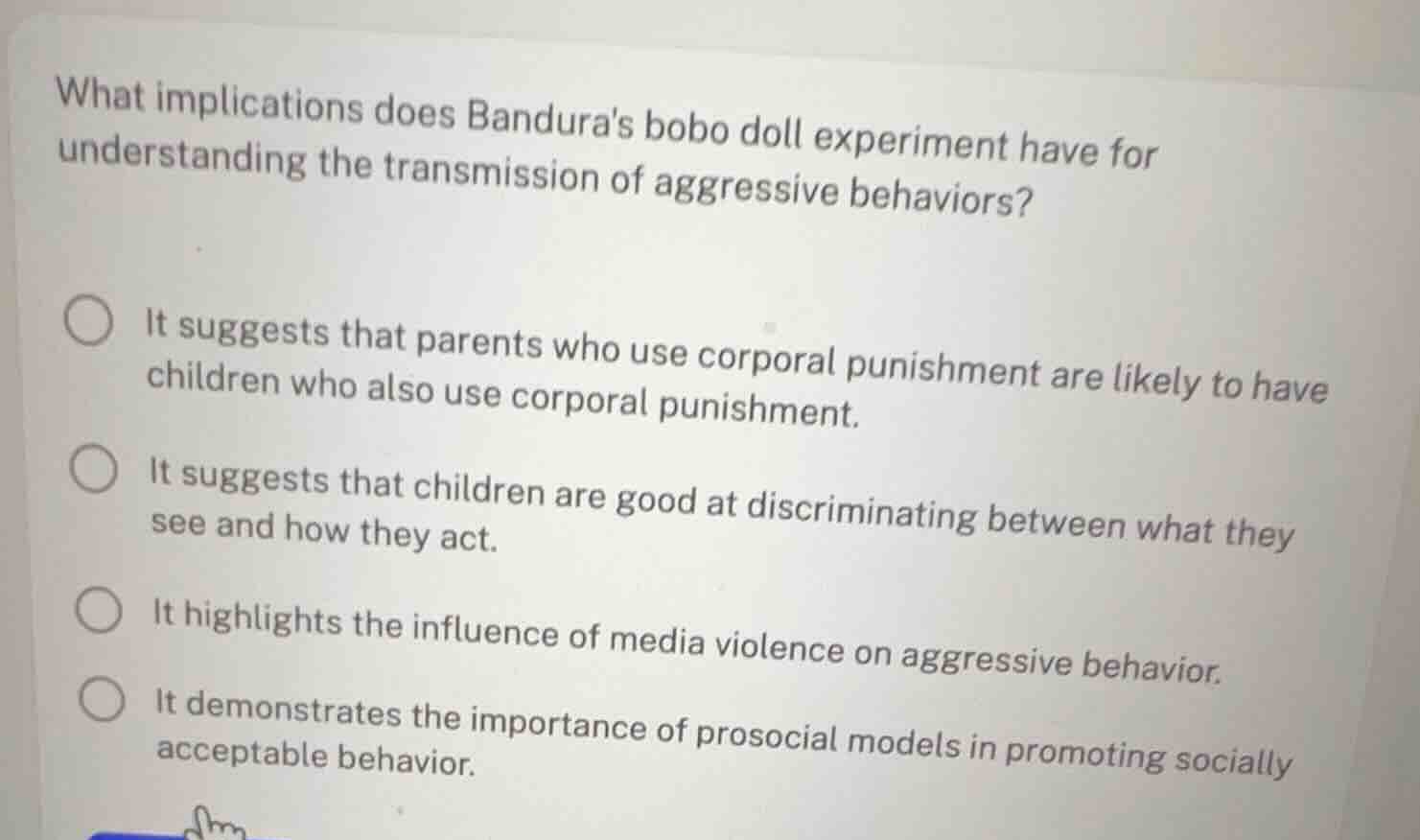
what implications does banduras bobo doll experiment have for understanding the transmission of aggressive behaviors?
it suggests that parents who use corporal punishment are likely to have children who also use corporal punishment.
it suggests that children are good at discriminating between what they see and how they act.
it highlights the influence of media violence on aggressive behavior.
it demonstrates the importance of prosocial models in promoting socially acceptable behavior.
<pre_analysis>
{
"quality": "clear",
"question_count": 1,
"skills_matched": [
"direct_cot",
"multiple_choice_formatter",
"explain_then_answer",
"tutor",
"mastery_adaptive_brevity"
],
"needs_drawing": false,
"concepts_used": [
"Bobo Doll Experiment",
"Albert Bandura Theory",
"Observational Learning"
],
"new_concepts": [],
"current_concepts": [
"Bobo Doll Experiment",
"Albert Bandura Theory",
"Observational Learning",
"Modeling Process Steps"
]
}
</pre_analysis>
<reasoning>
Analyze the core experiment
Using the Bobo Doll Experiment and Albert Bandura Theory knowledge points
Albert Bandura's 1961 Bobo doll experiment investigated how children acquire behaviors through observation without direct reinforcement. Children watched an adult model behave aggressively (hitting, kicking, and shouting) toward an inflatable Bobo doll. When later left alone with the doll, children who observed the aggressive model imitated these specific behaviors, demonstrating the transmission of aggression through observation.
Evaluate the first option
Using the Observational Learning knowledge point
The first option states: "It suggests that parents who use corporal punishment are likely to have children who also use corporal punishment." While observational learning explains how children might model aggressive parenting behaviors, the Bobo doll experiment itself specifically demonstrated how children imitate observed physical and verbal aggression from models, which directly links to how aggressive behaviors are transmitted and reproduced. This option is a specific real-world application of modeling rather than the direct primary implication of the experiment's design regarding the transmission of novel aggressive acts.
Evaluate the remaining options
Using the Bobo Doll Experiment knowledge point
- Option 2 ("children are good at discriminating between what they see and how they act") is incorrect because children directly imitated the aggressive actions they saw, showing a strong link between observation and behavior rather than discrimination.
- Option 3 ("highlights the influence of media violence") is incorrect because the primary experiment involved live adult models, though later variations used filmed models.
- Option 4 ("importance of prosocial models") is incorrect because the experiment focused on the transmission of aggressive (antisocial) behaviors, not prosocial behaviors.
Thus, the first option best captures the broader implication of how aggressive behaviors (such as corporal punishment) are transmitted across generations through observational modeling.
</reasoning>
<answer>
<mcq-correct>(A) It suggests that parents who use corporal punishment are likely to have children who also use corporal punishment.</mcq-correct>
<mcq-option>(B) It suggests that children are good at discriminating between what they see and how they act.</mcq-option>
<mcq-option>(C) It highlights the influence of media violence on aggressive behavior.</mcq-option>
<mcq-option>(D) It demonstrates the importance of prosocial models in promoting socially acceptable behavior.</mcq-option>
</answer>
<post_analysis>
{
"subject": "Social Science",
"question_type": "Multiple Choice",
"knowledge_point": [
"Social Science",
"Psychology",
"Observational Learning"
]
}
</post_analysis>
Snap & solve any problem in the app
Get step-by-step solutions on Sovi AI
Photo-based solutions with guided steps
Explore more problems and detailed explanations
<pre_analysis>
{
"quality": "clear",
"question_count": 1,
"skills_matched": [
"direct_cot",
"multiple_choice_formatter",
"explain_then_answer",
"tutor",
"mastery_adaptive_brevity"
],
"needs_drawing": false,
"concepts_used": [
"Bobo Doll Experiment",
"Albert Bandura Theory",
"Observational Learning"
],
"new_concepts": [],
"current_concepts": [
"Bobo Doll Experiment",
"Albert Bandura Theory",
"Observational Learning",
"Modeling Process Steps"
]
}
</pre_analysis>
<reasoning>
Analyze the core experiment
Using the Bobo Doll Experiment and Albert Bandura Theory knowledge points
Albert Bandura's 1961 Bobo doll experiment investigated how children acquire behaviors through observation without direct reinforcement. Children watched an adult model behave aggressively (hitting, kicking, and shouting) toward an inflatable Bobo doll. When later left alone with the doll, children who observed the aggressive model imitated these specific behaviors, demonstrating the transmission of aggression through observation.
Evaluate the first option
Using the Observational Learning knowledge point
The first option states: "It suggests that parents who use corporal punishment are likely to have children who also use corporal punishment." While observational learning explains how children might model aggressive parenting behaviors, the Bobo doll experiment itself specifically demonstrated how children imitate observed physical and verbal aggression from models, which directly links to how aggressive behaviors are transmitted and reproduced. This option is a specific real-world application of modeling rather than the direct primary implication of the experiment's design regarding the transmission of novel aggressive acts.
Evaluate the remaining options
Using the Bobo Doll Experiment knowledge point
- Option 2 ("children are good at discriminating between what they see and how they act") is incorrect because children directly imitated the aggressive actions they saw, showing a strong link between observation and behavior rather than discrimination.
- Option 3 ("highlights the influence of media violence") is incorrect because the primary experiment involved live adult models, though later variations used filmed models.
- Option 4 ("importance of prosocial models") is incorrect because the experiment focused on the transmission of aggressive (antisocial) behaviors, not prosocial behaviors.
Thus, the first option best captures the broader implication of how aggressive behaviors (such as corporal punishment) are transmitted across generations through observational modeling.
</reasoning>
<answer>
<mcq-correct>(A) It suggests that parents who use corporal punishment are likely to have children who also use corporal punishment.</mcq-correct>
<mcq-option>(B) It suggests that children are good at discriminating between what they see and how they act.</mcq-option>
<mcq-option>(C) It highlights the influence of media violence on aggressive behavior.</mcq-option>
<mcq-option>(D) It demonstrates the importance of prosocial models in promoting socially acceptable behavior.</mcq-option>
</answer>
<post_analysis>
{
"subject": "Social Science",
"question_type": "Multiple Choice",
"knowledge_point": [
"Social Science",
"Psychology",
"Observational Learning"
]
}
</post_analysis>