QUESTION IMAGE
Question
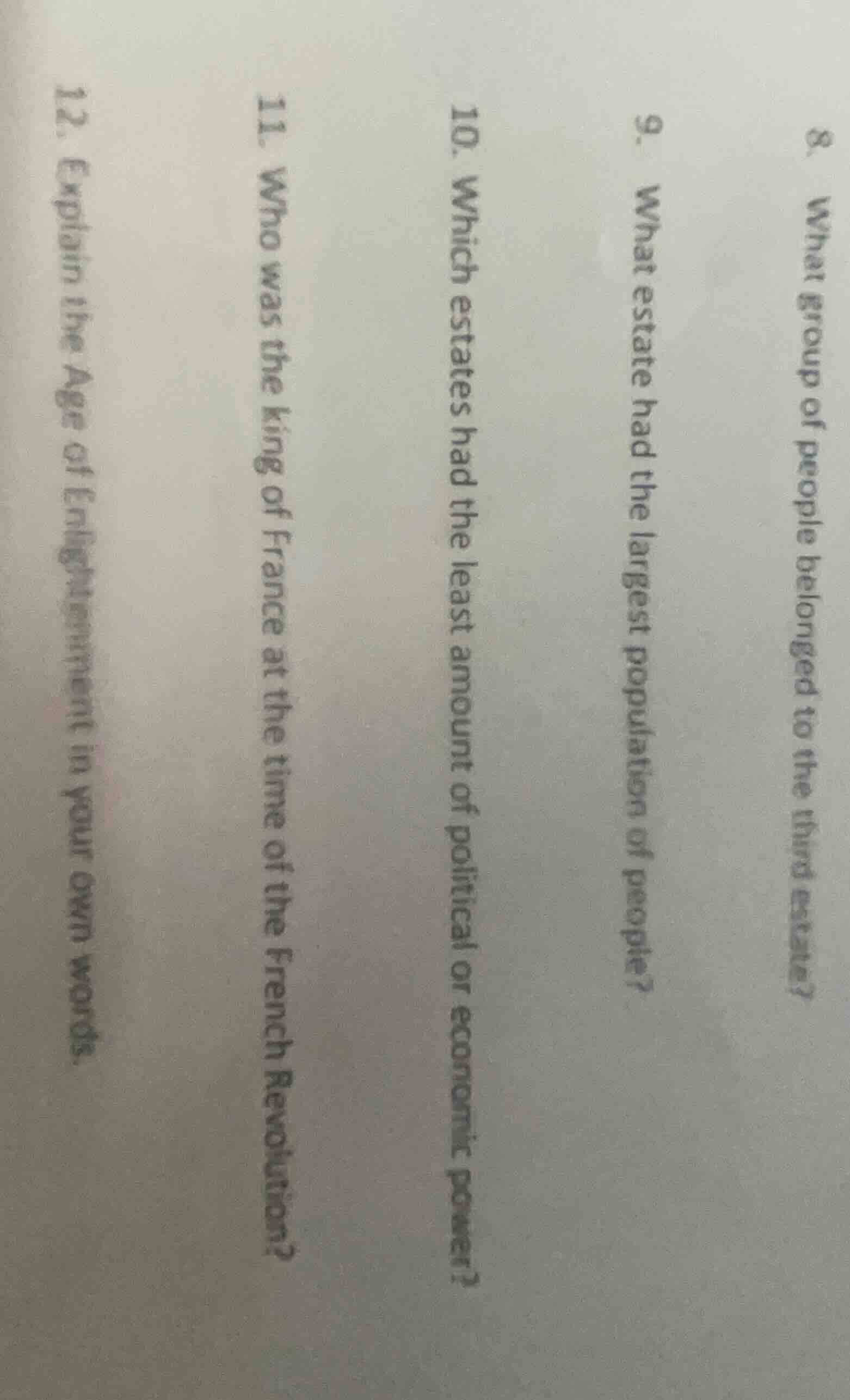
- what group of people belonged to the third estate?
- what estate had the largest population of people?
- which estates had the least amount of political or economic power?
- who was the king of france at the time of the french revolution?
- explain the age of enlightenment in your own words.
🆕 New Concept Discovered: Historical Analysis of Social Hierarchies
Understanding how pre-revolutionary societies structured power and class.
Step 1: Identify the Third Estate (Question 8)
In pre-revolutionary France, the population was divided into three social classes called "Estates."
- The First Estate was the clergy (church leaders).
- The Second Estate was the nobility (wealthy landowners and aristocrats).
- The Third Estate made up the vast majority of the population (about 98%). This group included:
- Peasants (farmers and agricultural laborers)
- Artisans and urban workers (city laborers, shopkeepers)
- The Bourgeoisie (the educated middle class, such as merchants, doctors, lawyers, and bankers)
Step 2: Determine the Largest Estate by Population (Question 9)
The Third Estate was by far the largest, representing approximately 97% to 98% of the total French population. The First and Second Estates combined made up only about 2% to 3% of the population.
Step 3: Identify the Estate with the Least Power (Question 10)
Despite making up nearly the entire population, the Third Estate had the least amount of political and economic power:
- Political power: In the Estates-General (the representative assembly), each Estate got only one vote. This meant the First and Second Estates could always outvote the Third Estate 2-to-1, leaving them with virtually no say in government decisions.
- Economic power: The Third Estate bore almost the entire tax burden of the nation, while the wealthy First and Second Estates were largely exempt from paying taxes.
Step 4: Identify the King of France (Question 11)
The monarch ruling France when the French Revolution began in 1789 was King Louis XVI (along with his queen, Marie Antoinette). His inability to resolve France's severe financial crisis led directly to the outbreak of the revolution.
Step 5: Define the Age of Enlightenment (Question 12)
The Age of Enlightenment was an intellectual and philosophical movement in Europe during the 17th and 18th centuries.
- In simple terms: It was a time when thinkers began to emphasize reason, science, and individual liberty over traditional authority, religious dogma, and the absolute rule of monarchs.
- Impact: Thinkers like John Locke, Voltaire, and Jean-Jacques Rousseau argued that governments should protect people's natural rights. These ideas directly inspired both the American and French Revolutions by challenging the belief that kings ruled by divine right.
---

Snap & solve any problem in the app
Get step-by-step solutions on Sovi AI
Photo-based solutions with guided steps
Explore more problems and detailed explanations
8. What group of people belonged to the third estate?
The Third Estate consisted of the commoners, which included peasants, urban workers, artisans, and the bourgeoisie (the educated middle class, such as merchants, lawyers, and doctors).
9. What estate had the largest population of people?
The Third Estate (making up about 98% of the population).
10. Which estates had the least amount of political or economic power?
The Third Estate had the least power. They had very little political representation and bore almost the entire burden of paying taxes, while the First and Second Estates held all the privileges.
11. Who was the king of France at the time of the French Revolution?
King Louis XVI (Louis the 16th).
12. Explain the Age of Enlightenment in your own words.
The Age of Enlightenment was an intellectual movement in the 1700s where people started using reason, logic, and science rather than traditional religious beliefs or the absolute authority of kings to understand the world. It promoted ideas like individual liberty, equality, and the concept that governments should protect the natural rights of their citizens.