QUESTION IMAGE
Question
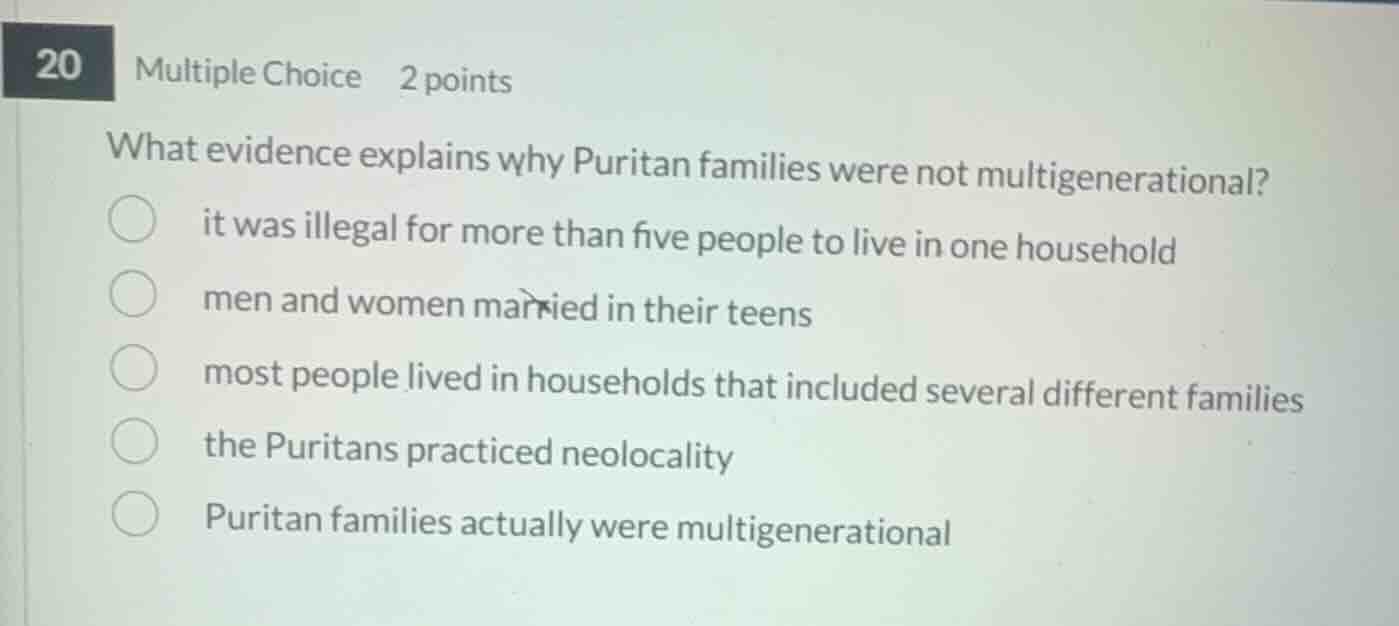
what evidence explains why puritan families were not multigenerational?
it was illegal for more than five people to live in one household
men and women married in their teens
most people lived in households that included several different families
the puritans practiced neolocality
puritan families actually were multigenerational
Analyze historical evidence on Puritan family structure
Demographic and historical evidence shows that Puritan families in colonial New England typically lived in nuclear households rather than multigenerational ones.
Evaluate the concept of neolocality
Neolocality is the practice where a newly married couple establishes an independent household separate from both sets of parents, which directly explains why their families were not multigenerational.
Rule out incorrect options
- There was no law limiting household size to five people.
- Puritans generally married in their mid-to-late twenties, not their teens.
- Most households contained a single nuclear family, not several different families.
- While some grandparents lived with family, the structural norm was nuclear, making the claim that they "actually were multigenerational" as a rule incorrect.

Snap & solve any problem in the app
Get step-by-step solutions on Sovi AI
Photo-based solutions with guided steps
Explore more problems and detailed explanations
- it was illegal for more than five people to live in one household
- men and women married in their teens
- most people lived in households that included several different families
- the Puritans practiced neolocality (Correct answer)
- Puritan families actually were multigenerational