QUESTION IMAGE
Question
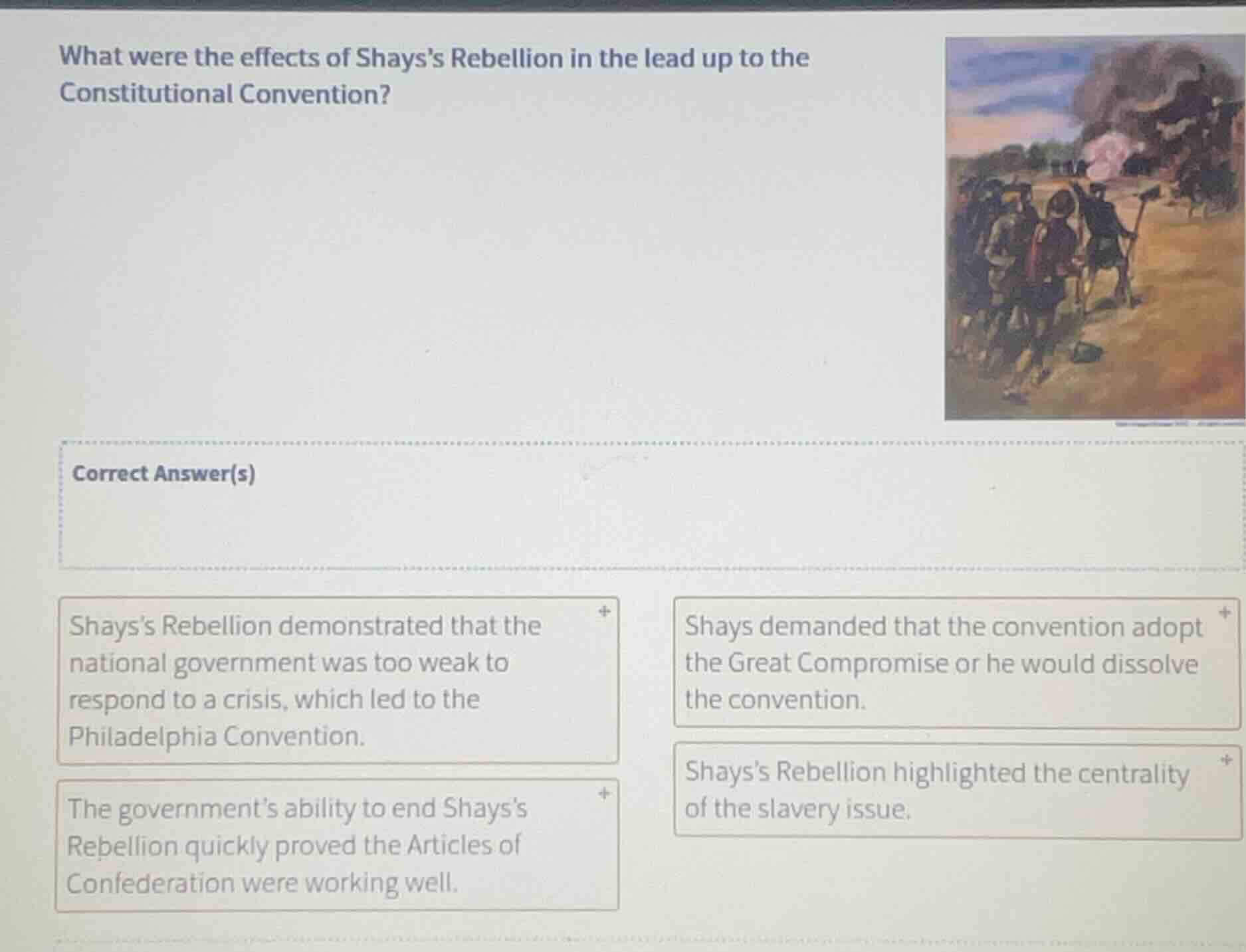
what were the effects of shayss rebellion in the lead up to the constitutional convention?
correct answer(s)
shayss rebellion demonstrated that the national government was too weak to respond to a crisis, which led to the philadelphia convention.
shays demanded that the convention adopt the great compromise or he would dissolve the convention.
the governments ability to end shayss rebellion quickly proved the articles of confederation were working well.
shayss rebellion highlighted the centrality of the slavery issue.
Analyze the impact of Shays's Rebellion
Shays's Rebellion (1786–1787) exposed the severe weaknesses of the Articles of Confederation, particularly the national government's inability to raise an army, collect taxes, or maintain public order.
Evaluate the given options
- Option 1 correctly states that the rebellion demonstrated the weakness of the national government under the Articles of Confederation, prompting leaders to gather at the Philadelphia (Constitutional) Convention to revise the system.
- Option 2 is incorrect because the government could not end the rebellion quickly, which proved the Articles were failing, not working well.
- Option 3 is historically incorrect; Daniel Shays did not dictate terms or threaten to dissolve the Constitutional Convention.
- Option 4 is incorrect because Shays's Rebellion was primarily an economic uprising of indebted farmers, not an event centered on the issue of slavery.

Snap & solve any problem in the app
Get step-by-step solutions on Sovi AI
Photo-based solutions with guided steps
Explore more problems and detailed explanations
- Shays's Rebellion demonstrated that the national government was too weak to respond to a crisis, which led to the Philadelphia Convention. (Correct answer)
- The government's ability to end Shays's Rebellion quickly proved the Articles of Confederation were working well.
- Shays demanded that the convention adopt the Great Compromise or he would dissolve the convention.
- Shays's Rebellion highlighted the centrality of the slavery issue.