QUESTION IMAGE
Question
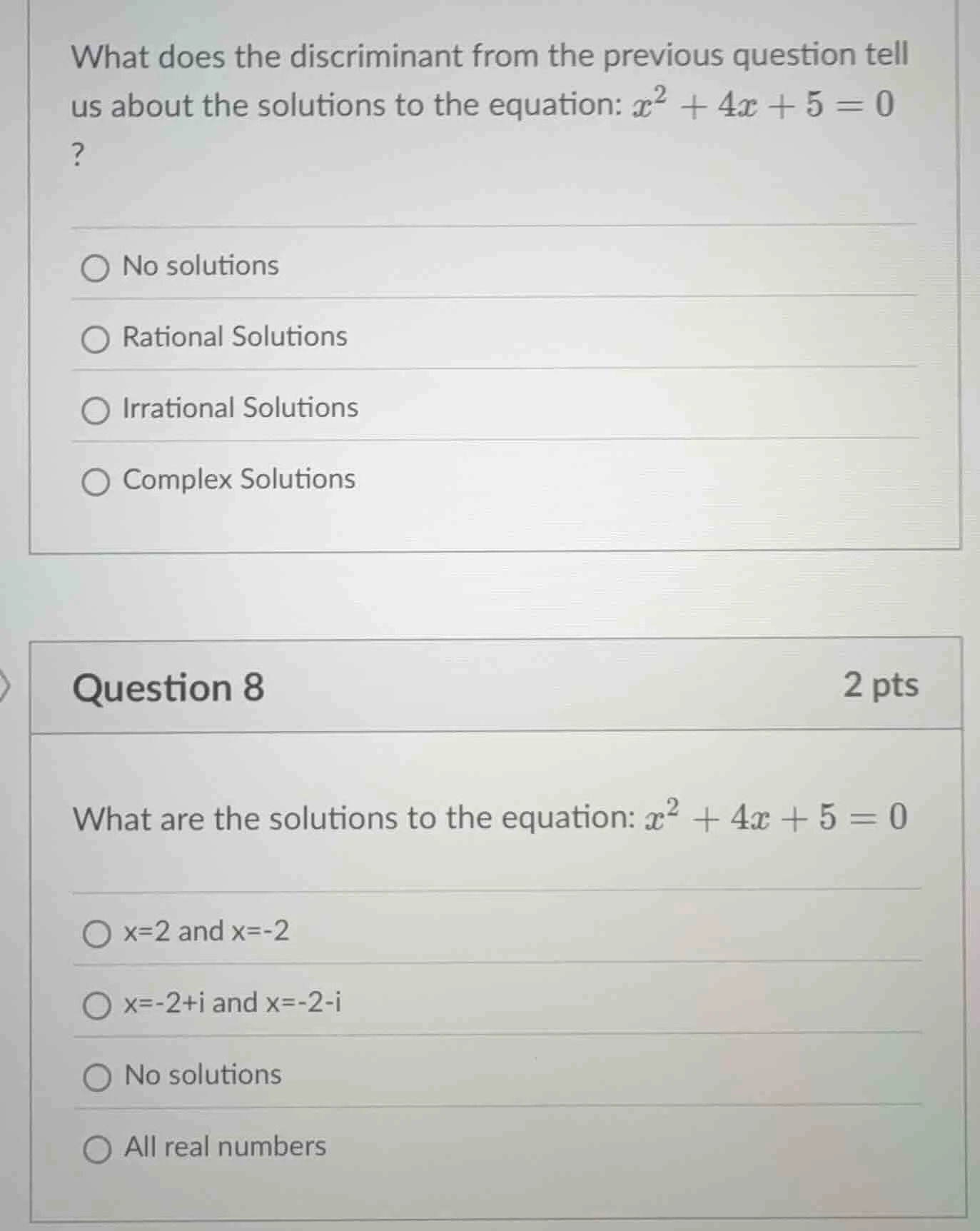
what does the discriminant from the previous question tell us about the solutions to the equation: $x^2 + 4x + 5 = 0$?
○ no solutions
○ rational solutions
○ irrational solutions
○ complex solutions
question 8 2 pts
what are the solutions to the equation: $x^2 + 4x + 5 = 0$
○ x=2 and x=-2
○ x=-2+i and x=-2-i
○ no solutions
○ all real numbers
First Question (Discriminant Analysis)
Step1: Recall discriminant formula
For quadratic \(ax^2 + bx + c = 0\), discriminant \(D = b^2 - 4ac\).
Here, \(a = 1\), \(b = 4\), \(c = 5\).
Step2: Calculate discriminant
\(D = 4^2 - 4(1)(5) = 16 - 20 = -4\).
Since \(D < 0\), the equation has complex (non - real) solutions (in the form \(a+bi\), \(b
eq0\)). So it's not "No solutions" (quadratic always has 2 solutions in complex plane), not rational/irrational (those are real).
Step1: Use quadratic formula
Quadratic formula: \(x=\frac{-b\pm\sqrt{D}}{2a}\). We know \(D=-4\), so \(\sqrt{D}=\sqrt{-4}=2i\).
Step2: Substitute values
\(x=\frac{-4\pm2i}{2(1)}=\frac{-4\pm2i}{2}=-2\pm i\). So solutions are \(x = - 2 + i\) and \(x=-2 - i\).

Snap & solve any problem in the app
Get step-by-step solutions on Sovi AI
Photo-based solutions with guided steps
Explore more problems and detailed explanations
D. Complex Solutions