QUESTION IMAGE
Question
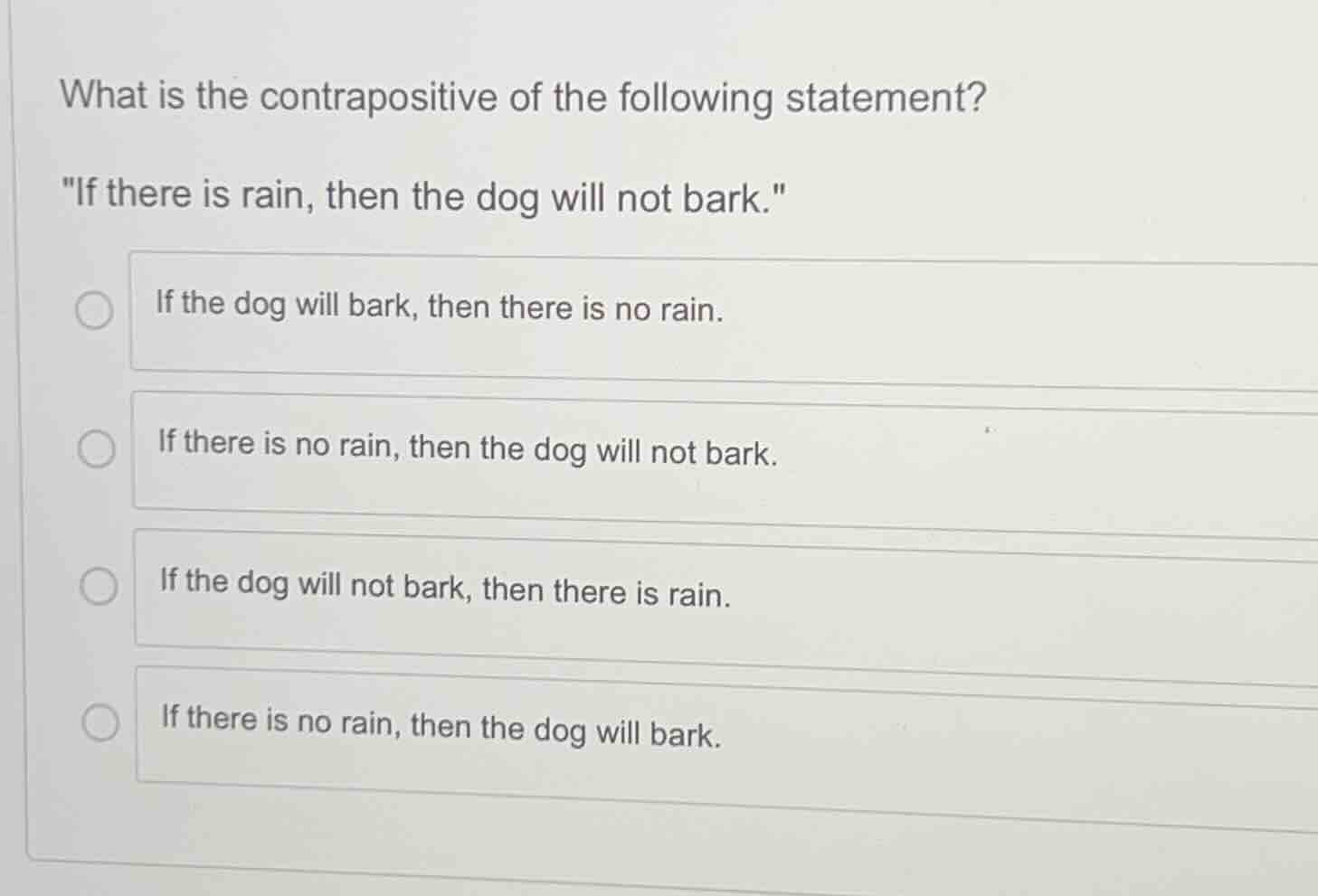
what is the contrapositive of the following statement?
\if there is rain, then the dog will not bark.\
- if the dog will bark, then there is no rain.
- if there is no rain, then the dog will not bark.
- if the dog will not bark, then there is rain.
- if there is no rain, then the dog will bark.
Identify the hypothesis and conclusion
The original statement is a conditional statement.
Using Conditional Logic, we identify the components:
- Hypothesis \(p\): "there is rain"
- Conclusion \(q\): "the dog will not bark"
Define the contrapositive operation
The contrapositive of a conditional statement \(p
ightarrow q\) is \(
eg q
ightarrow
eg p\).
This means we negate both parts and swap their order.
Negate the components
- Negation of conclusion \(
eg q\): "the dog will bark"
- Negation of hypothesis \(
eg p\): "there is no rain"
Formulate the contrapositive statement
Combine the negated components into an "If..., then..." structure:
"If the dog will bark, then there is no rain."
Match with the given options
Compare our formulated statement with the choices:
- Option 1: "If the dog will bark, then there is no rain." (Matches)
- Option 2: "If there is no rain, then the dog will not bark." (Inverse)
- Option 3: "If the dog will not bark, then there is rain." (Converse)
- Option 4: "If there is no rain, then the dog will bark." (Negated converse)

Snap & solve any problem in the app
Get step-by-step solutions on Sovi AI
Photo-based solutions with guided steps
Explore more problems and detailed explanations
- (A) If the dog will bark, then there is no rain. (Correct answer)
- (B) If there is no rain, then the dog will not bark.
- (C) If the dog will not bark, then there is rain.
- (D) If there is no rain, then the dog will bark.