Sovi.AI - AI Math Tutor

Scan to solve math questions

QUESTION IMAGE

what conclusion did oswald avery reach that advanced human understandin…

Question

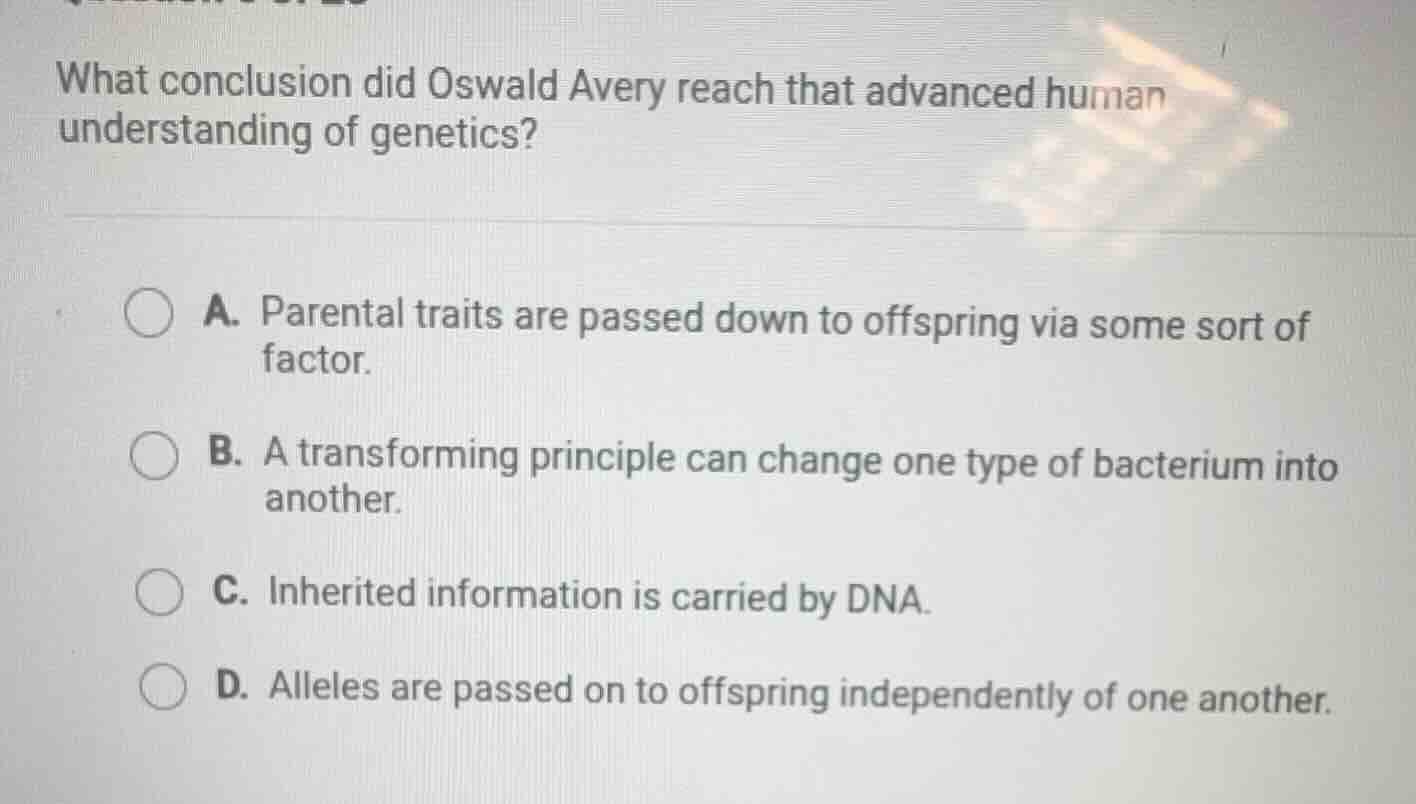
what conclusion did oswald avery reach that advanced human understanding of genetics?

a. parental traits are passed down to offspring via some sort of factor.
b. a transforming principle can change one type of bacterium into another.
c. inherited information is carried by dna.
d. alleles are passed on to offspring independently of one another.

Explanation:

Response

<pre_analysis>
{
"quality": "clear",
"question_count": 1,
"skills_matched": [
"direct_cot",
"multiple_choice_formatter",
"explain_then_answer",
"tutor"
],
"needs_drawing": false,
"concepts_used": [
"History of DNA Discovery"
],
"new_concepts": [
"Avery-MacLeod-McCarty Experiment"
],
"current_concepts": [
"History of DNA Discovery",
"Avery-MacLeod-McCarty Experiment"
]
}
</pre_analysis>

<reasoning>

Identify the historical context

Oswald Avery, along with Colin MacLeod and Maclyn McCarty, built upon Frederick Griffith's 1928 discovery of a "transforming principle" in bacteria. We will apply our understanding of the History of DNA Discovery to evaluate his specific contribution.

Analyze Avery's experiment

In 1944, Avery and his colleagues isolated different macromolecules (proteins, RNA, DNA, lipids, and carbohydrates) from heat-killed virulent bacteria. They treated these extracts with specific enzymes that selectively destroyed each type of molecule before mixing them with harmless bacteria.

Determine the key conclusion

Only the destruction of DNA (using deoxyribonuclease) prevented the transformation of the harmless bacteria into the virulent form. This demonstrated that the "transforming principle" was DNA, leading to the groundbreaking conclusion that inherited genetic information is carried by DNA rather than proteins.

Evaluate the given options

  • Option A refers generally to Gregor Mendel's early work on hereditary factors.
  • Option B describes Frederick Griffith's initial observation of transformation, which Avery set out to explain chemically.
  • Option C correctly identifies Avery's conclusion that DNA is the molecule carrying inherited information.
  • Option D refers to Mendel's Law of Independent Assortment.

</reasoning>

<answer>
<mcq-option>(A) Parental traits are passed down to offspring via some sort of factor.</mcq-option>
<mcq-option>(B) A transforming principle can change one type of bacterium into another.</mcq-option>
<mcq-correct>(C) Inherited information is carried by DNA.</mcq-correct>
<mcq-option>(D) Alleles are passed on to offspring independently of one another.</mcq-option>
</answer>

<post_analysis>
{
"subject": "Natural Science",
"question_type": "Multiple Choice",
"knowledge_point": [
"Natural Science",
"Biology",
"History of DNA Discovery"
]
}
</post_analysis>

Answer:

<pre_analysis>
{
"quality": "clear",
"question_count": 1,
"skills_matched": [
"direct_cot",
"multiple_choice_formatter",
"explain_then_answer",
"tutor"
],
"needs_drawing": false,
"concepts_used": [
"History of DNA Discovery"
],
"new_concepts": [
"Avery-MacLeod-McCarty Experiment"
],
"current_concepts": [
"History of DNA Discovery",
"Avery-MacLeod-McCarty Experiment"
]
}
</pre_analysis>

<reasoning>

Identify the historical context

Oswald Avery, along with Colin MacLeod and Maclyn McCarty, built upon Frederick Griffith's 1928 discovery of a "transforming principle" in bacteria. We will apply our understanding of the History of DNA Discovery to evaluate his specific contribution.

Analyze Avery's experiment

In 1944, Avery and his colleagues isolated different macromolecules (proteins, RNA, DNA, lipids, and carbohydrates) from heat-killed virulent bacteria. They treated these extracts with specific enzymes that selectively destroyed each type of molecule before mixing them with harmless bacteria.

Determine the key conclusion

Only the destruction of DNA (using deoxyribonuclease) prevented the transformation of the harmless bacteria into the virulent form. This demonstrated that the "transforming principle" was DNA, leading to the groundbreaking conclusion that inherited genetic information is carried by DNA rather than proteins.

Evaluate the given options

  • Option A refers generally to Gregor Mendel's early work on hereditary factors.
  • Option B describes Frederick Griffith's initial observation of transformation, which Avery set out to explain chemically.
  • Option C correctly identifies Avery's conclusion that DNA is the molecule carrying inherited information.
  • Option D refers to Mendel's Law of Independent Assortment.

</reasoning>

<answer>
<mcq-option>(A) Parental traits are passed down to offspring via some sort of factor.</mcq-option>
<mcq-option>(B) A transforming principle can change one type of bacterium into another.</mcq-option>
<mcq-correct>(C) Inherited information is carried by DNA.</mcq-correct>
<mcq-option>(D) Alleles are passed on to offspring independently of one another.</mcq-option>
</answer>

<post_analysis>
{
"subject": "Natural Science",
"question_type": "Multiple Choice",
"knowledge_point": [
"Natural Science",
"Biology",
"History of DNA Discovery"
]
}
</post_analysis>