QUESTION IMAGE
Question
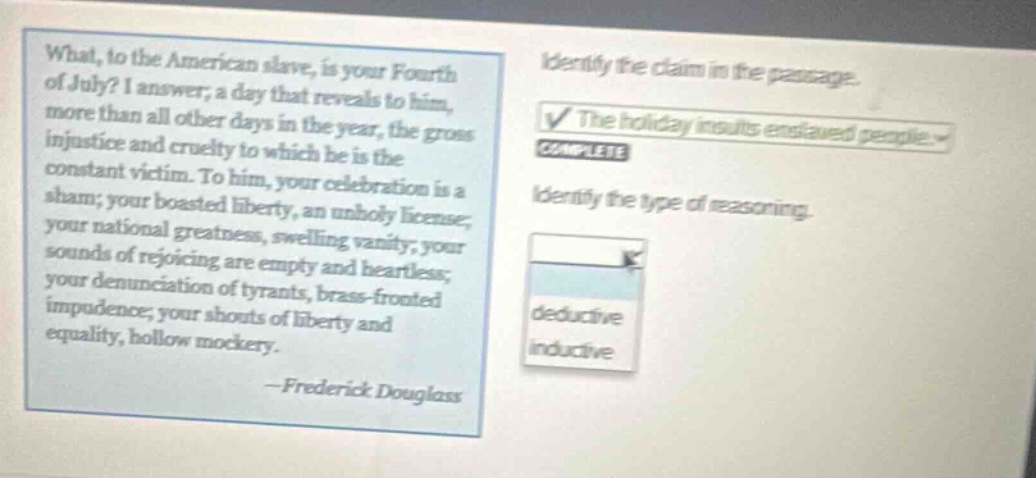
what, to the american slave, is your fourth of july? i answer; a day that reveals to him, more than all other days in the year, the gross injustice and cruelty to which he is the constant victim. to him, your celebration is a sham; your boasted liberty, an unholy license; your national greatness, swelling vanity; your sounds of rejoicing are empty and heartless; your denunciation of tyrants, brass-fronted impudence; your shouts of liberty and equality, hollow mockery.
—frederick douglass
identify the claim in the passage.
the holiday insults enslaved people.
complete
identify the type of reasoning.
deductive / inductive
🆕 New Concept Discovered: Types of Logical Reasoning
Moving from specific examples to a general conclusion, or vice versa.
Step 1: Understand the definitions of reasoning types
To determine whether the passage uses deductive or inductive reasoning, we must look at how the argument is structured:
- Deductive reasoning starts with a general rule, premise, or theory and applies it to a specific case to reach a guaranteed, logical conclusion (top-down logic).
- Inductive reasoning gathers specific observations, facts, or examples first, and uses them to build toward a broader, generalized conclusion (bottom-up logic).
Step 2: Analyze the structure of Frederick Douglass's argument
Let's look at how Douglass builds his argument in the passage:
- General Claim (Premise): He begins with his main, general conclusion: to the American slave, the Fourth of July is a day that reveals the gross injustice and cruelty of which he is a constant victim.
- Specific Evidence (Support): He then supports this general claim by listing specific, concrete examples of the holiday's celebrations and explaining how they contrast with the reality of slavery:
- "your celebration" $
ightarrow$ "a sham"
- "your boasted liberty" $
ightarrow$ "an unholy license"
- "your national greatness" $
ightarrow$ "swelling vanity"
- "your sounds of rejoicing" $
ightarrow$ "empty and heartless"
- "your shouts of liberty and equality" $
ightarrow$ "hollow mockery"
Because he starts with a general claim/premise about the holiday and then systematically applies it to dissect these specific elements of the celebration, he is using a top-down approach to show how the general truth manifests in each specific instance. This is a classic application of deductive reasoning.

Snap & solve any problem in the app
Get step-by-step solutions on Sovi AI
Photo-based solutions with guided steps
Explore more problems and detailed explanations
deductive