QUESTION IMAGE
Question
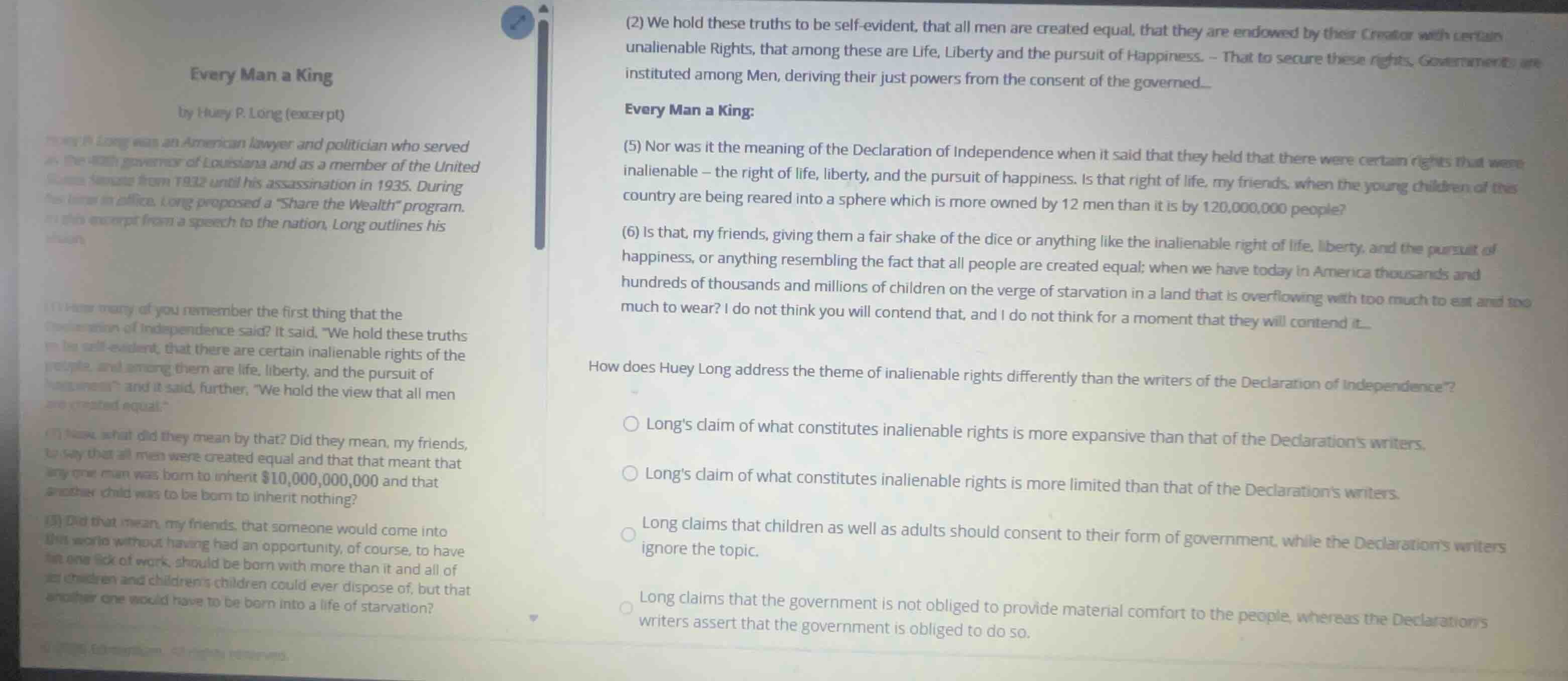
(2) we hold these truths to be self-evident, that all men are created equal, that they are endowed by their creator with certain unalienable rights, that among these are life, liberty and the pursuit of happiness. - that to secure these rights, governments are instituted among men, deriving their just powers from the consent of the governed...
every man a king:
(5) nor was it the meaning of the declaration of independence when it said that they held that there were certain rights that were inalienable - the right of life, liberty, and the pursuit of happiness. is that right of life, my friends, when the young children of this country are being reared into a sphere which is more owned by 12 men than it is by 120,000,000 people?
(6) is that, my friends, giving them a fair shake of the dice or anything like the inalienable right of life, liberty, and the pursuit of happiness, or anything resembling the fact that all people are created equal; when we have today in america thousands and hundreds of thousands and millions of children on the verge of starvation in a land that is overflowing with too much to eat and too much to wear? i do not think you will contend that, and i do not think for a moment that they will contend it...
how does huey long address the theme of inalienable rights differently than the writers of the declaration of independence?
longs claim of what constitutes inalienable rights is more expansive than that of the declarations writers.
longs claim of what constitutes inalienable rights is more limited than that of the declarations writers.
long claims that children as well as adults should consent to their form of government, while the declarations writers ignore the topic.
long claims that the government is not obliged to provide material comfort to the people, whereas the declarations writers assert that the government is obliged to do so.
Analyze the Declaration of Independence's definition of inalienable rights
The Declaration of Independence defines inalienable rights as "Life, Liberty and the pursuit of Happiness." It focuses on these abstract, foundational political and individual liberties.
Analyze Huey Long's interpretation of inalienable rights
Huey Long quotes the Declaration but argues that these rights are violated when children are "on the verge of starvation in a land that is overflowing with too much to eat and too much to wear." He expands the definition of "life, liberty, and the pursuit of happiness" to include economic security, adequate food, and clothing, arguing that extreme wealth inequality deprives people of these basic rights.
Compare the two perspectives to evaluate the options
Long's interpretation includes material and economic necessities (food, clothing, opportunity) as part of what constitutes "life, liberty, and the pursuit of happiness," making his claim of what constitutes these rights more expansive than the original political focus of the Declaration's writers.

Snap & solve any problem in the app
Get step-by-step solutions on Sovi AI
Photo-based solutions with guided steps
Explore more problems and detailed explanations
- (A) Long's claim of what constitutes inalienable rights is more expansive than that of the Declaration's writers. (Correct answer)
- (B) Long's claim of what constitutes inalienable rights is more limited than that of the Declaration's writers.
- (C) Long claims that children as well as adults should consent to their form of government, while the Declaration's writers ignore the topic.
- (D) Long claims that the government is not obliged to provide material comfort to the people, whereas the Declaration's writers assert that the government is obliged to do so.