QUESTION IMAGE
Question
warm-up
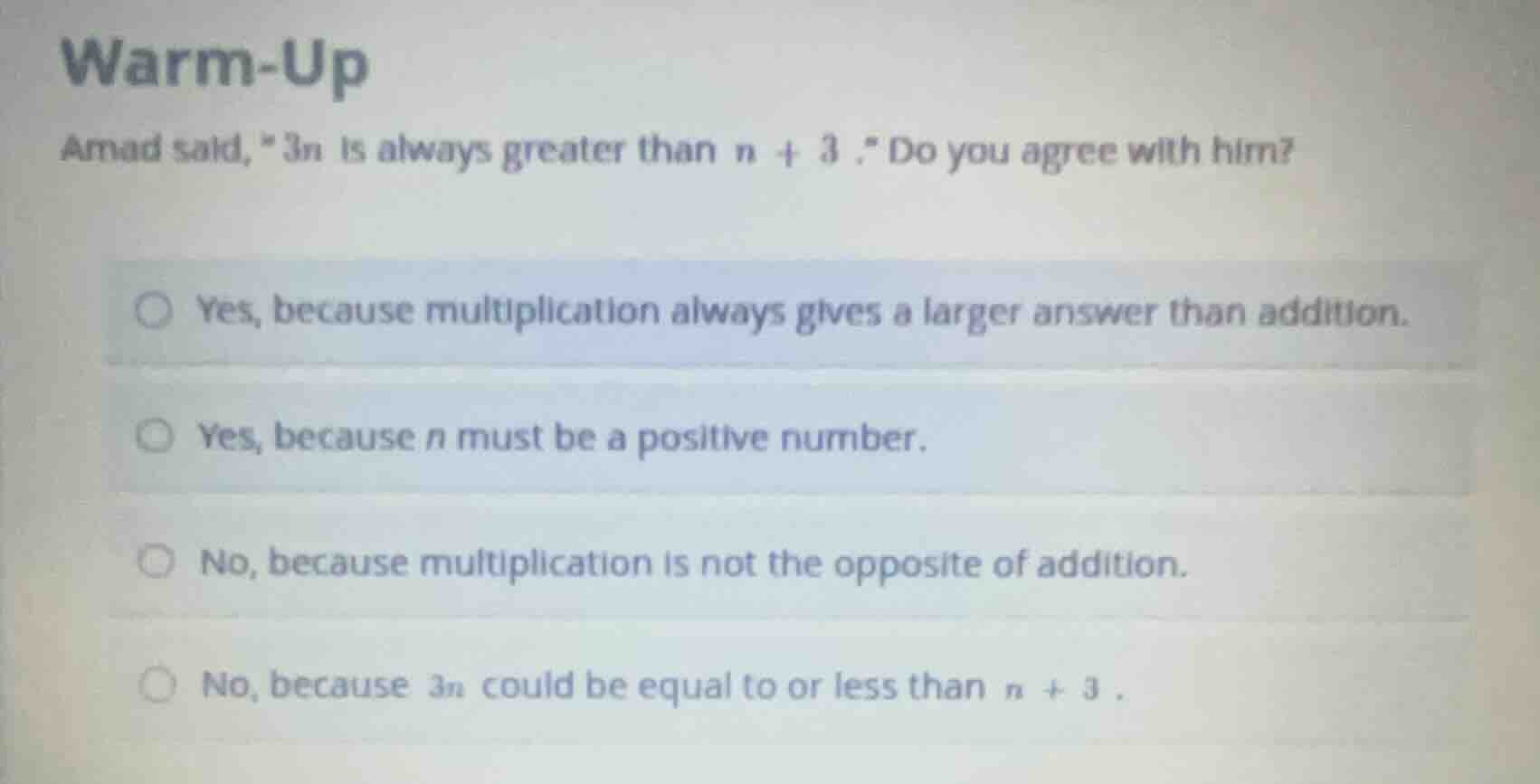
amad said, \\\(3n\\) is always greater than \\(n + 3\\).\ do you agree with him?
- yes, because multiplication always gives a larger answer than addition.
- yes, because \\(n\\) must be a positive number.
- no, because multiplication is not the opposite of addition.
- no, because \\(3n\\) could be equal to or less than \\(n + 3\\).
Analyze the statement
The statement claims that \(3n\) is always greater than \(n + 3\) for any value of \(n\). To test this claim, we set up the inequality:
$$3n > n + 3$$
Solve the inequality
We solve the inequality to find the range of values for which the statement is true:
$$
LATEXBLOCK0
$$
This shows that the statement is only true when \(n > 1.5\).
Find counterexamples
If \(n \le 1.5\), the statement is false. Let's test a few values:
- If \(n = 1\): \(3(1) = 3\) and \(1 + 3 = 4\). Here, \(3 < 4\), so \(3n\) is less than \(n + 3\).
- If \(n = 0\): \(3(0) = 0\) and \(0 + 3 = 3\). Here, \(0 < 3\), so \(3n\) is less than \(n + 3\).
Evaluate the options
- "Yes, because multiplication always gives a larger answer than addition." (Incorrect, as shown by counterexamples).
- "Yes, because n must be a positive number." (Incorrect, even for positive \(n = 1\), the statement is false).
- "No, because multiplication is not the opposite of addition." (Incorrect reasoning).
- "No, because \(3n\) could be equal to or less than \(n + 3\)." (Correct, since \(3n \le n + 3\) when \(n \le 1.5\)).

Snap & solve any problem in the app
Get step-by-step solutions on Sovi AI
Photo-based solutions with guided steps
Explore more problems and detailed explanations
- Yes, because multiplication always gives a larger answer than addition.
- Yes, because n must be a positive number.
- No, because multiplication is not the opposite of addition.
- No, because \(3n\) could be equal to or less than \(n + 3\). (Correct answer)