QUESTION IMAGE
Question
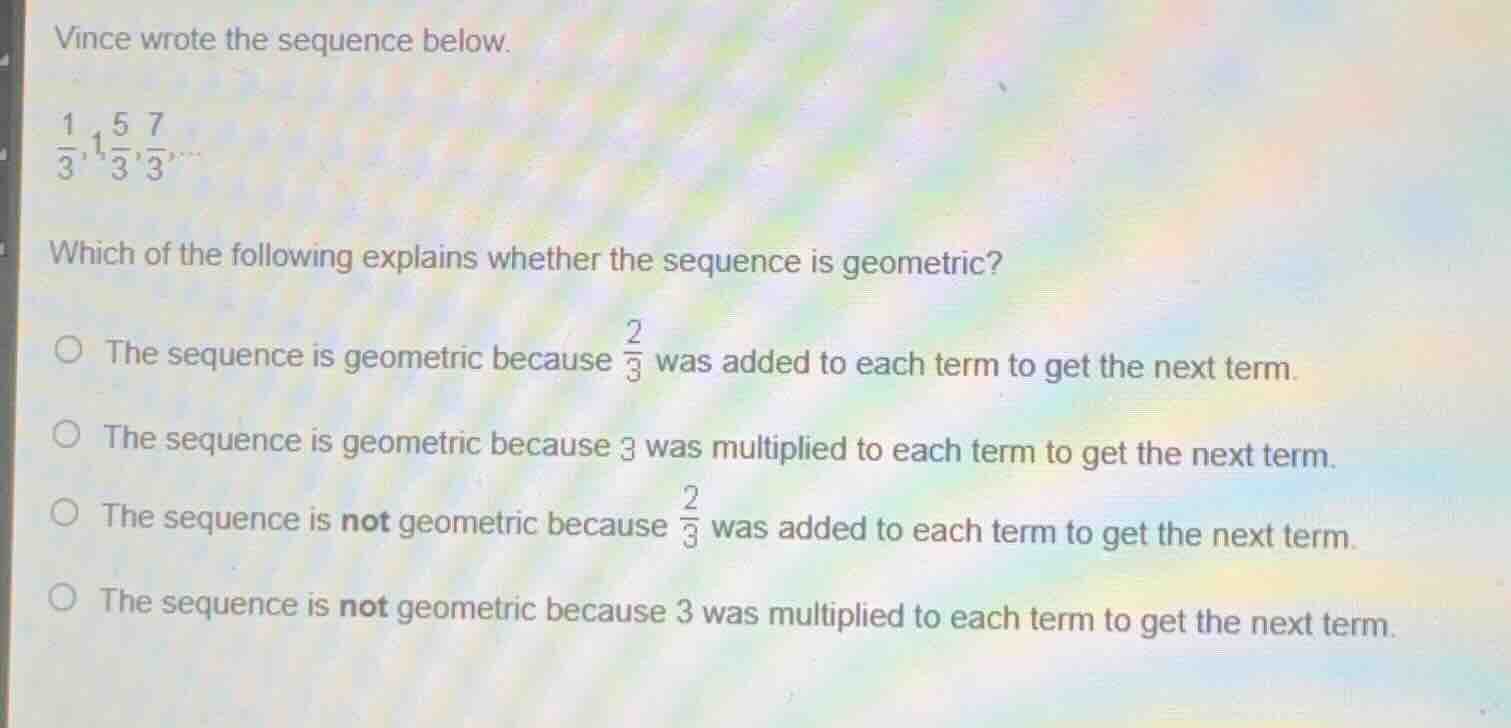
vince wrote the sequence below.
\\(\frac{1}{3}, 1, \frac{5}{3}, \frac{7}{3}, \dots\\)
which of the following explains whether the sequence is geometric?
- the sequence is geometric because \\(\frac{2}{3}\\) was added to each term to get the next term.
- the sequence is geometric because 3 was multiplied to each term to get the next term.
- the sequence is not geometric because \\(\frac{2}{3}\\) was added to each term to get the next term.
- the sequence is not geometric because 3 was multiplied to each term to get the next term.
Analyze the given sequence
Using the Geometric Sequences knowledge point
The sequence is:
Rewrite \(1\) as a fraction with a denominator of \(3\):
Test for a common ratio
Using the Common Ratio knowledge point
Calculate the ratios of consecutive terms:
Since \(r_1
eq r_2\), there is no common ratio, so the sequence is not geometric.
Determine the pattern of the sequence
Find the difference between consecutive terms:
The sequence is arithmetic because a constant value of \(\frac{2}{3}\) is added to each term to get the next term. Thus, it is not geometric.

Snap & solve any problem in the app
Get step-by-step solutions on Sovi AI
Photo-based solutions with guided steps
Explore more problems and detailed explanations
- The sequence is geometric because \(\frac{2}{3}\) was added to each term to get the next term.
- The sequence is geometric because 3 was multiplied to each term to get the next term.
- The sequence is not geometric because \(\frac{2}{3}\) was added to each term to get the next term. (Correct answer)
- The sequence is not geometric because 3 was multiplied to each term to get the next term.