QUESTION IMAGE
Question
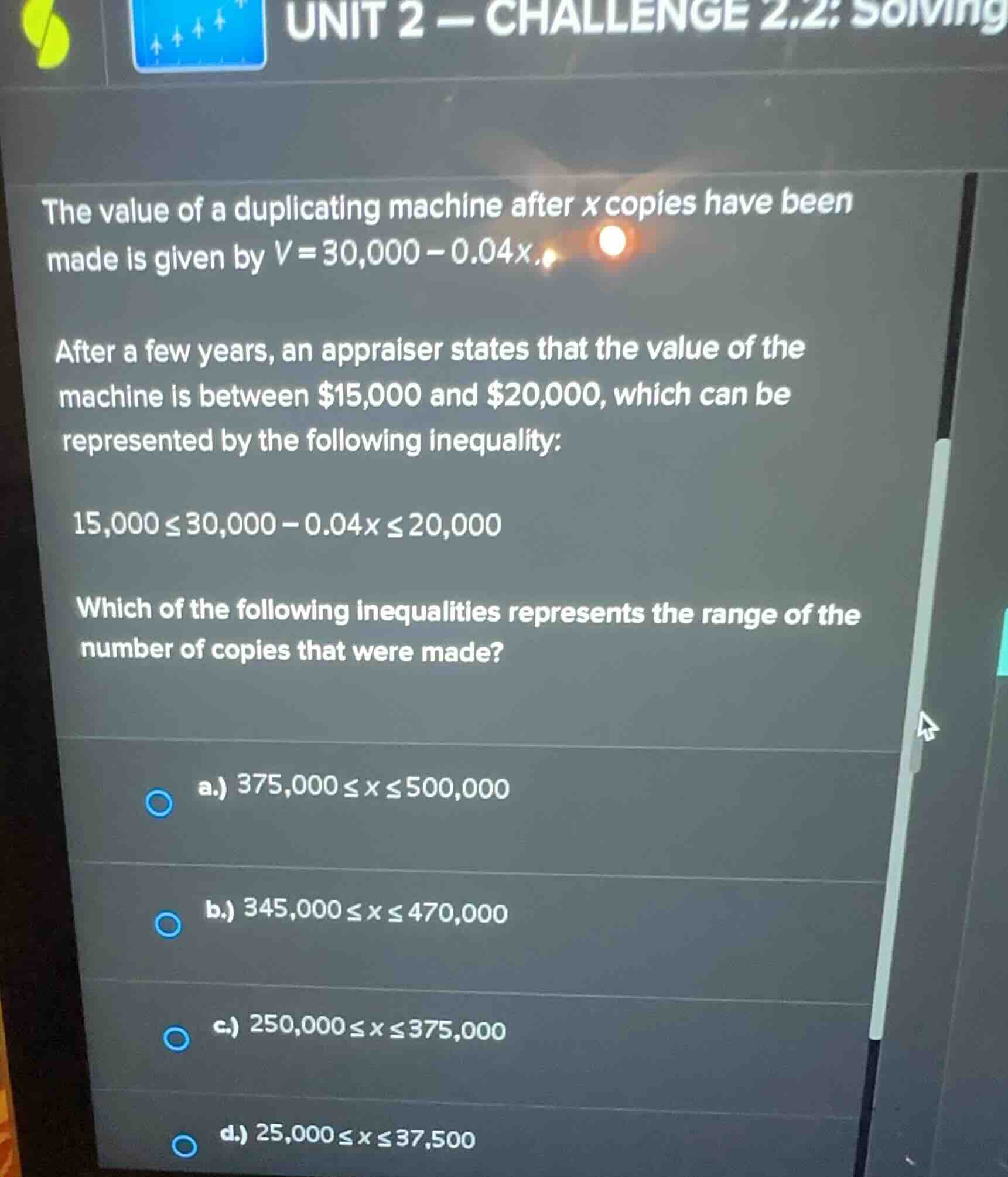
the value of a duplicating machine after \\(x\\) copies have been made is given by \\(v = 30,000 - 0.04x\\).
after a few years, an appraiser states that the value of the machine is between \\$15,000 and \\$20,000, which can be represented by the following inequality:
\\15,000 \le 30,000 - 0.04x \le 20,000\\
which of the following inequalities represents the range of the number of copies that were made?
a.) \\(375,000 \le x \le 500,000\\)
b.) \\(345,000 \le x \le 470,000\\)
c.) \\(250,000 \le x \le 375,000\\)
d.) \\(25,000 \le x \le 37,500\\)
Subtract constant from all parts
Using the Linear Inequalities knowledge point
Divide by negative coefficient
Using the Inequality Sign Reversal knowledge point

Snap & solve any problem in the app
Get step-by-step solutions on Sovi AI
Photo-based solutions with guided steps
Explore more problems and detailed explanations
- a.) \(375,000 \le x \le 500,000\)
- b.) \(345,000 \le x \le 470,000\)
- c.) \(250,000 \le x \le 375,000\) (Correct answer)
- d.) \(25,000 \le x \le 37,500\)