QUESTION IMAGE
Question
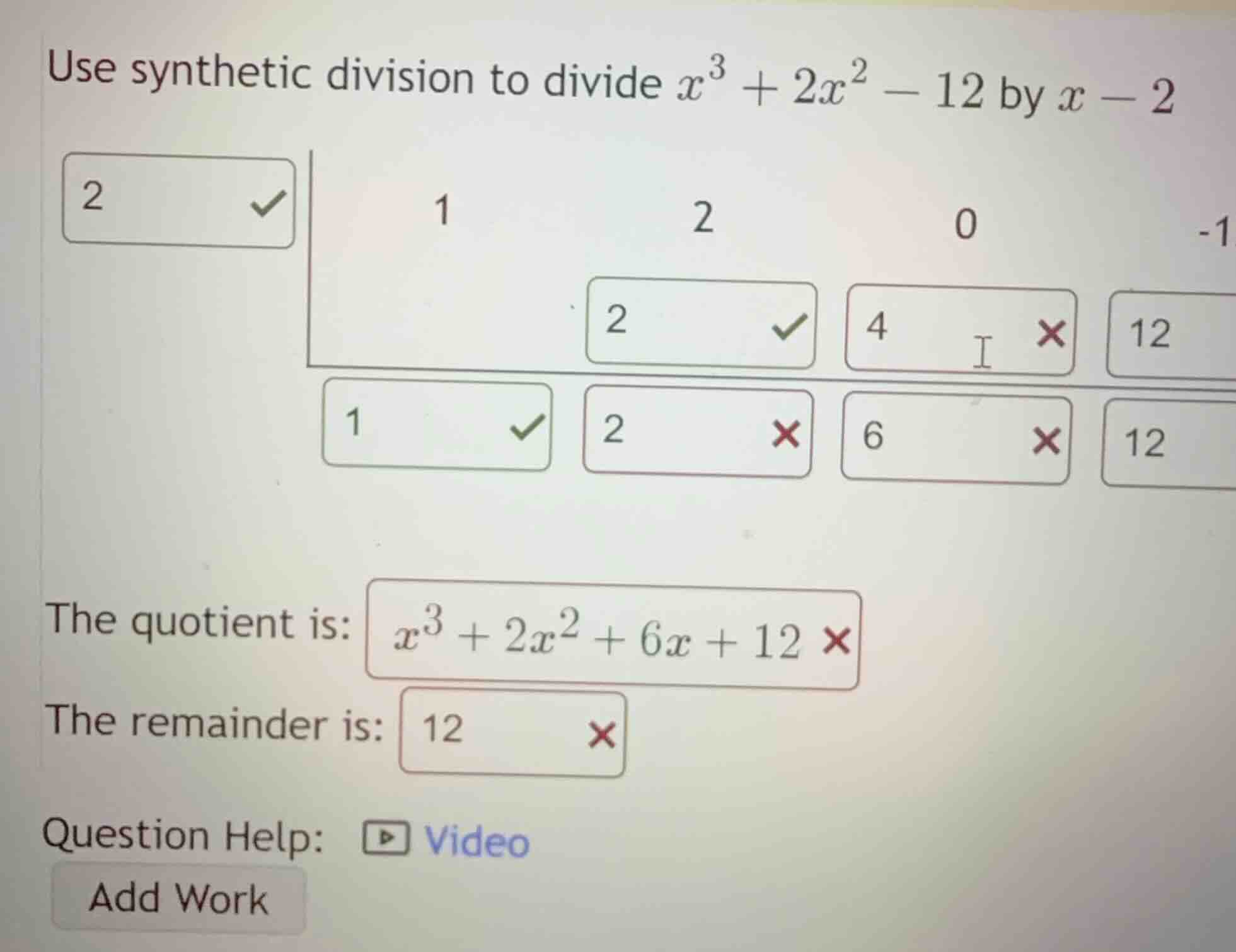
use synthetic division to divide (x^3 + 2x^2 - 12) by (x - 2)
the quotient is:
the remainder is:
🆕 New Concept Discovered: Synthetic Division
A shortcut method to divide polynomials by linear factors.
Step 1: Set up the synthetic division table
To divide \( x^3 + 2x^2 - 12 \) by \( x - 2 \), we first identify the divisor's root and the coefficients of the dividend.
- Find the root of the divisor: Set \( x - 2 = 0 \), which gives \( x = 2 \). This value goes in the box on the left.
- List the coefficients of the dividend: Write down the coefficients of \( x^3 + 2x^2 + 0x - 12 \). Note that we must include a \( 0 \) placeholder for the missing \( x \)-term:
$$
1 \quad 2 \quad 0 \quad -12
$$
Our setup looks like this:
  2 |   1    2    0   -12
    |
    ---------------------
---
Step 2: Perform the synthetic division steps
We follow a pattern of bringing down, multiplying by the root (2), and adding columns:
- Bring down the first coefficient, \( 1 \):
     2 |   1    2    0   -12
       |
       ---------------------
1- Multiply \( 1 \times 2 = 2 \), write it under the second coefficient, and add:
$$
2 + 2 = 4
$$
     2 |   1    2    0   -12
       |        2
       ---------------------
1 4- Multiply \( 4 \times 2 = 8 \), write it under the third coefficient, and add:
$$
0 + 8 = 8
$$
     2 |   1    2    0   -12
       |        2    8
       ---------------------
1 4 8- Multiply \( 8 \times 2 = 16 \), write it under the fourth coefficient, and add:
$$
-12 + 16 = 4
$$
     2 |   1    2    0   -12
       |        2    8    16
       ---------------------
           1    4    8  |  4
---
Step 3: Interpret the results
The numbers at the bottom row represent the coefficients of the quotient and the remainder:
- The bottom row is: \( 1 \quad 4 \quad 8 \quad | \quad 4 \)
- The last number, \( 4 \), is the remainder.
- The remaining numbers, \( 1, 4, 8 \), represent the coefficients of the quotient polynomial, which starts one degree lower than the original dividend (degree 2 instead of 3):
$$
1x^2 + 4x + 8
$$

Snap & solve any problem in the app
Get step-by-step solutions on Sovi AI
Photo-based solutions with guided steps
Explore more problems and detailed explanations
- Synthetic Division Table Values:
- Row 2 values (from left to right):
2,8,16 - Row 3 values (from left to right):
1,4,8,4 - The quotient is: \( x^2 + 4x + 8 \)
- The remainder is: \( 4 \)