QUESTION IMAGE
Question
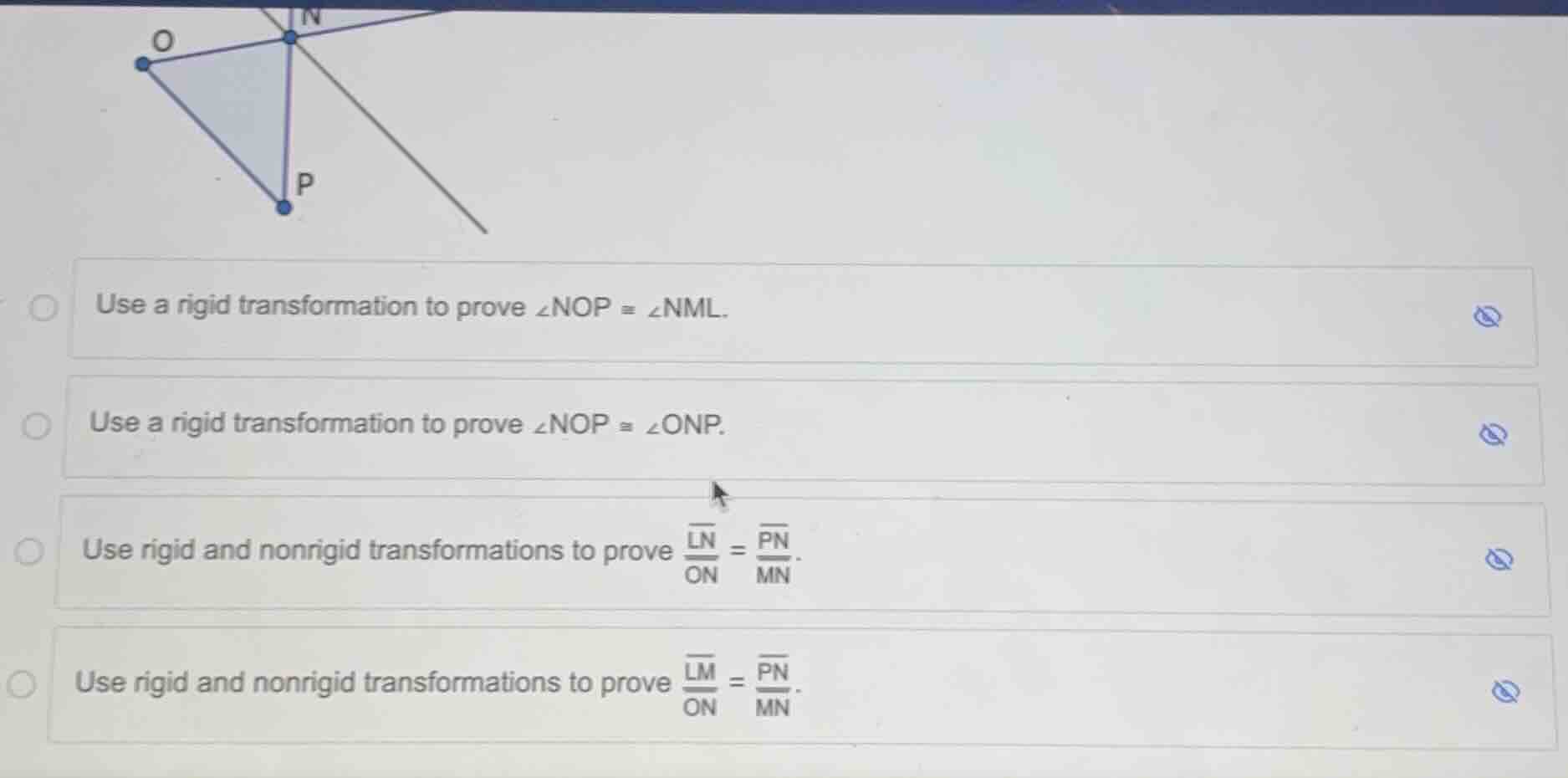
use a rigid transformation to prove \\(\angle nop \cong \angle nml\\).
use a rigid transformation to prove \\(\angle nop \cong \angle onp\\).
use rigid and nonrigid transformations to prove \\(\frac{ln}{on} = \frac{pn}{mn}\\).
use rigid and nonrigid transformations to prove \\(\frac{lm}{on} = \frac{pn}{mn}\\).
Identify the geometric context
The problem involves two triangles, \(\triangle NOP\) and \(\triangle NML\), sharing a vertex \(N\). The options discuss proving relationships using rigid and nonrigid transformations.
Analyze the transformation types
Using Similarity Transformations (which combine rigid transformations like rotations/reflections with nonrigid transformations like dilations), we can map similar figures onto each other.
Evaluate the ratio options
To establish similarity between \(\triangle NOP\) and \(\triangle NML\), corresponding sides must be proportional:
Let's look at the correct correspondence:
If \(\triangle NOP \sim \triangle NML\), then:
Rearranging the correct similarity ratio:
Let's check:
If we perform a similarity transformation mapping \(\triangle NOP\) to \(\triangle NML\), the ratio of corresponding sides is constant.
The correct option is:
"Use rigid and nonrigid transformations to prove \(\frac{LN}{ON} = \frac{PN}{MN}\)" (or the matching option in the list).
Looking closely at the third option:
"Use rigid and nonrigid transformations to prove \(\frac{LN}{ON} = \frac{PN}{MN}\)"
This establishes the proportional relationship between the sides of the two triangles.

Snap & solve any problem in the app
Get step-by-step solutions on Sovi AI
Photo-based solutions with guided steps
Explore more problems and detailed explanations
- Use a rigid transformation to prove \(\angle NOP \cong \angle NML\).
- Use a rigid transformation to prove \(\angle NOP \cong \angle ONP\).
- Use rigid and nonrigid transformations to prove \(\frac{LN}{ON} = \frac{PN}{MN}\). (Correct answer)
- Use rigid and nonrigid transformations to prove \(\frac{LM}{ON} = \frac{PN}{MN}\).