QUESTION IMAGE
Question
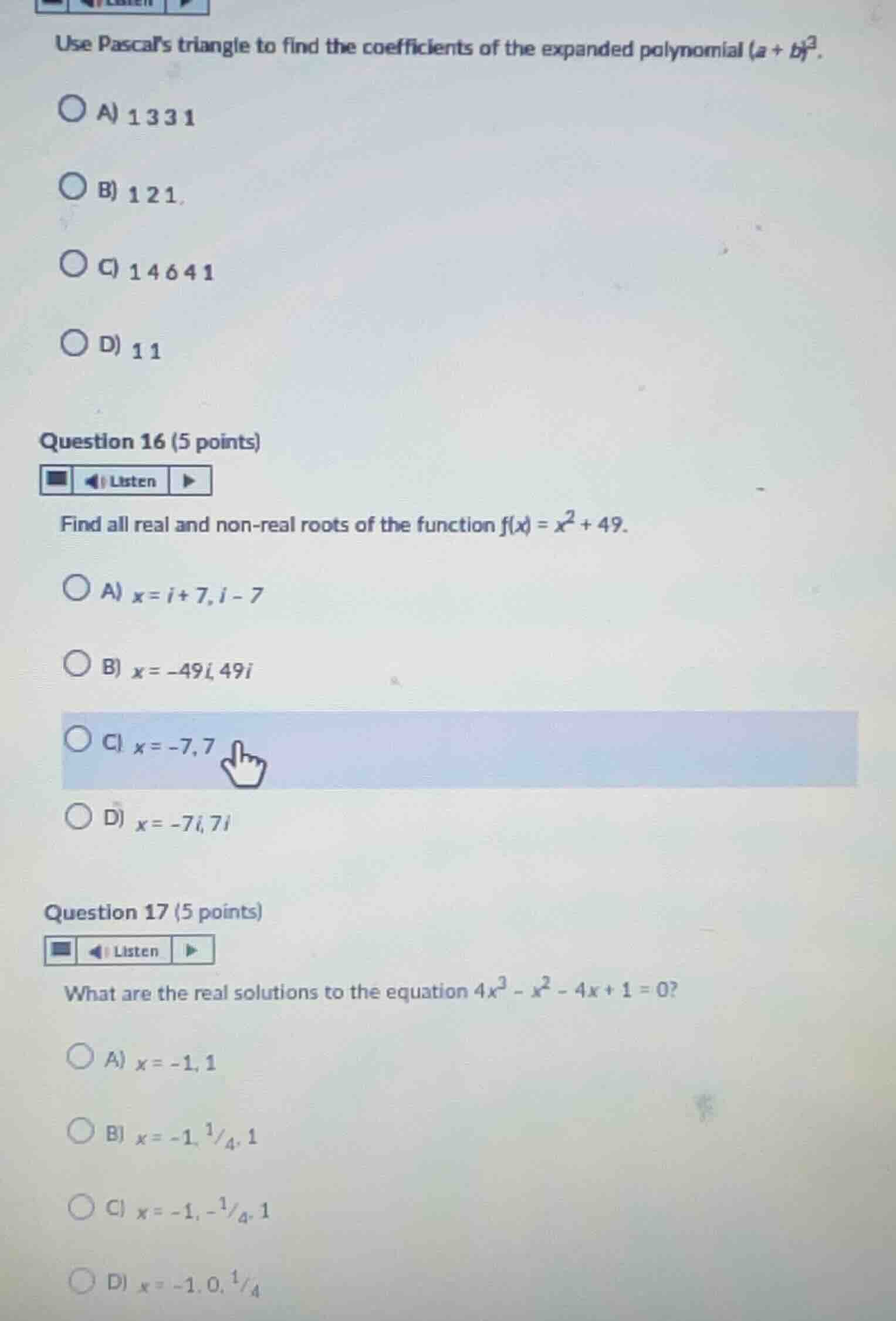
use pascals triangle to find the coefficients of the expanded polynomial \\((a + b)^3\\).
a) 1 3 3 1
b) 1 2 1
c) 1 4 6 4 1
d) 1 1
question 16 (5 points)
find all real and non-real roots of the function \\(f(x) = x^2 + 49\\).
a) \\(x = i + 7, i - 7\\)
b) \\(x = -49i, 49i\\)
c) \\(x = -7, 7\\)
d) \\(x = -7i, 7i\\)
question 17 (5 points)
what are the real solutions to the equation \\(4x^3 - x^2 - 4x + 1 = 0\\)?
a) \\(x = -1, 1\\)
b) \\(x = -1, 1/4, 1\\)
c) \\(x = -1, -1/4, 1\\)
d) \\(x = -1, 0, 1/4\\)
Expand using Pascal's Triangle
Using the Pascals Triangle Expansion knowledge point
Find roots of the quadratic function
Using the Complex Quadratic Solutions knowledge point
Solve the cubic equation
To find the real solutions of \(4x^3 - x^2 - 4x + 1 = 0\), we can group the terms to factor the polynomial:
Factor out common terms from each group:
Factor out the common binomial \((x^2 - 1)\):
Set each factor to zero to find the roots:
Thus, the real solutions are \(x = -1, \frac{1}{4}, 1\).

Snap & solve any problem in the app
Get step-by-step solutions on Sovi AI
Photo-based solutions with guided steps
Explore more problems and detailed explanations
Question 1
- A) 1 3 3 1 (Correct answer)
- B) 1 2 1
- C) 1 4 6 4 1
- D) 1 1
Question 16
- A) \(x = i + 7, i - 7\)
- B) \(x = -49i, 49i\)
- C) \(x = -7, 7\)
- D) \(x = -7i, 7i\) (Correct answer)
Question 17
- A) \(x = -1, 1\)
- B) \(x = -1, \frac{1}{4}, 1\) (Correct answer)
- C) \(x = -1, -\frac{1}{4}, 1\)
- D) \(x = -1, 0, \frac{1}{4}\)