Sovi.AI - AI Math Tutor

Scan to solve math questions

QUESTION IMAGE

use the following information to answer question 22. there is a legend …

Question

use the following information to answer question 22.

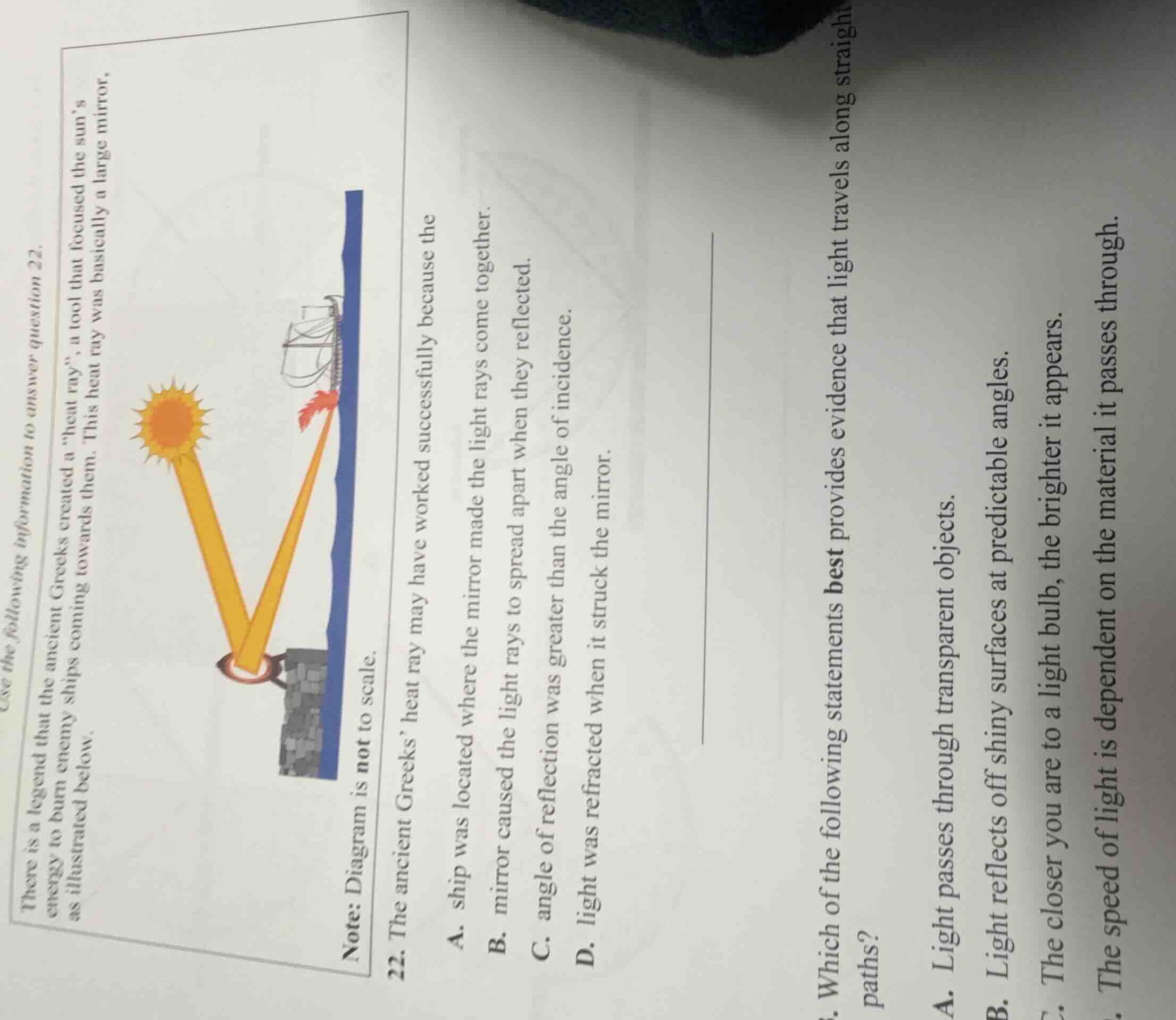
there is a legend that the ancient greeks created a \heat ray\, a tool that focused the suns energy to burn enemy ships coming towards them. this heat ray was basically a large mirror, as illustrated below.

note: diagram is not to scale.

  1. the ancient greeks heat ray may have worked successfully because the

a. ship was located where the mirror made the light rays come together.
b. mirror caused the light rays to spread apart when they reflected.
c. angle of reflection was greater than the angle of incidence.
d. light was refracted when it struck the mirror.

  1. which of the following statements best provides evidence that light travels along straight paths?

a. light passes through transparent objects.
b. light reflects off shiny surfaces at predictable angles.
c. the closer you are to a light bulb, the brighter it appears.
d. the speed of light is dependent on the material it passes through.

Explanation:

Response

<pre_analysis>
{
"quality": "clear",
"question_count": 2,
"skills_matched": [
"direct_cot",
"multiple_choice_formatter",
"explain_then_answer",
"tutor"
],
"needs_drawing": false,
"concepts_used": [
"Properties of Light",
"Reflection and Emission"
],
"new_concepts": [
"Law of Reflection",
"Light Propagation"
],
"current_concepts": [
"Properties of Light",
"Reflection and Emission",
"Law of Reflection",
"Light Propagation"
]
}
</pre_analysis>

<reasoning>

Analyze the heat ray mechanism

The legend describes a "heat ray" tool that focused the sun's energy to burn enemy ships using a large mirror. For a mirror to focus parallel incoming light rays from the sun onto a single target (the ship), the rays must converge at that target. Therefore, the ship must be located at the point where the reflected light rays come together (converge). This corresponds to option A.

Evaluate other options for Question 22

Using our understanding of Properties of Light and Reflection and Emission:

  • Option B suggests the mirror caused rays to spread apart (diverge), which would disperse the energy rather than focus it to burn a ship.
  • Option C contradicts the law of reflection, which states the angle of reflection equals the angle of incidence.
  • Option D mentions refraction, but mirrors reflect light rather than refract it.

Thus, option A is correct.

Analyze evidence for straight-line propagation

Question 23 asks which statement best provides evidence that light travels along straight paths. Let's analyze the options:

  • Option A: Light passing through transparent objects shows transmission, not necessarily straight-line travel.
  • Option B: Light reflecting off shiny surfaces at predictable, equal angles (the law of reflection) relies directly on the fact that the incoming and outgoing rays travel in straight lines to form measurable, predictable angles.
  • Option C: Brightness changing with distance relates to the inverse-square law of light intensity.
  • Option D: The speed of light depending on the medium relates to refraction.

Therefore, predictable reflection angles (Option B) provide excellent geometric evidence of straight-line propagation.
</reasoning>

<answer>

Question 22

<mcq-correct>A. ship was located where the mirror made the light rays come together.</mcq-correct>
<mcq-option>B. mirror caused the light rays to spread apart when they reflected.</mcq-option>
<mcq-option>C. angle of reflection was greater than the angle of incidence.</mcq-option>
<mcq-option>D. light was refracted when it struck the mirror.</mcq-option>

Question 23

<mcq-option>A. Light passes through transparent objects.</mcq-option>
<mcq-correct>B. Light reflects off shiny surfaces at predictable angles.</mcq-correct>
<mcq-option>C. The closer you are to a light bulb, the brighter it appears.</mcq-option>
<mcq-option>D. The speed of light is dependent on the material it passes through.</mcq-option>
</answer>

<post_analysis>
{
"subject": "Natural Science",
"question_type": "Multiple Choice",
"knowledge_point": [
"Natural Science",
"Physics",
"Optics"
]
}
</post_analysis>

Answer:

<pre_analysis>
{
"quality": "clear",
"question_count": 2,
"skills_matched": [
"direct_cot",
"multiple_choice_formatter",
"explain_then_answer",
"tutor"
],
"needs_drawing": false,
"concepts_used": [
"Properties of Light",
"Reflection and Emission"
],
"new_concepts": [
"Law of Reflection",
"Light Propagation"
],
"current_concepts": [
"Properties of Light",
"Reflection and Emission",
"Law of Reflection",
"Light Propagation"
]
}
</pre_analysis>

<reasoning>

Analyze the heat ray mechanism

The legend describes a "heat ray" tool that focused the sun's energy to burn enemy ships using a large mirror. For a mirror to focus parallel incoming light rays from the sun onto a single target (the ship), the rays must converge at that target. Therefore, the ship must be located at the point where the reflected light rays come together (converge). This corresponds to option A.

Evaluate other options for Question 22

Using our understanding of Properties of Light and Reflection and Emission:

  • Option B suggests the mirror caused rays to spread apart (diverge), which would disperse the energy rather than focus it to burn a ship.
  • Option C contradicts the law of reflection, which states the angle of reflection equals the angle of incidence.
  • Option D mentions refraction, but mirrors reflect light rather than refract it.

Thus, option A is correct.

Analyze evidence for straight-line propagation

Question 23 asks which statement best provides evidence that light travels along straight paths. Let's analyze the options:

  • Option A: Light passing through transparent objects shows transmission, not necessarily straight-line travel.
  • Option B: Light reflecting off shiny surfaces at predictable, equal angles (the law of reflection) relies directly on the fact that the incoming and outgoing rays travel in straight lines to form measurable, predictable angles.
  • Option C: Brightness changing with distance relates to the inverse-square law of light intensity.
  • Option D: The speed of light depending on the medium relates to refraction.

Therefore, predictable reflection angles (Option B) provide excellent geometric evidence of straight-line propagation.
</reasoning>

<answer>

Question 22

<mcq-correct>A. ship was located where the mirror made the light rays come together.</mcq-correct>
<mcq-option>B. mirror caused the light rays to spread apart when they reflected.</mcq-option>
<mcq-option>C. angle of reflection was greater than the angle of incidence.</mcq-option>
<mcq-option>D. light was refracted when it struck the mirror.</mcq-option>

Question 23

<mcq-option>A. Light passes through transparent objects.</mcq-option>
<mcq-correct>B. Light reflects off shiny surfaces at predictable angles.</mcq-correct>
<mcq-option>C. The closer you are to a light bulb, the brighter it appears.</mcq-option>
<mcq-option>D. The speed of light is dependent on the material it passes through.</mcq-option>
</answer>

<post_analysis>
{
"subject": "Natural Science",
"question_type": "Multiple Choice",
"knowledge_point": [
"Natural Science",
"Physics",
"Optics"
]
}
</post_analysis>