QUESTION IMAGE
Question
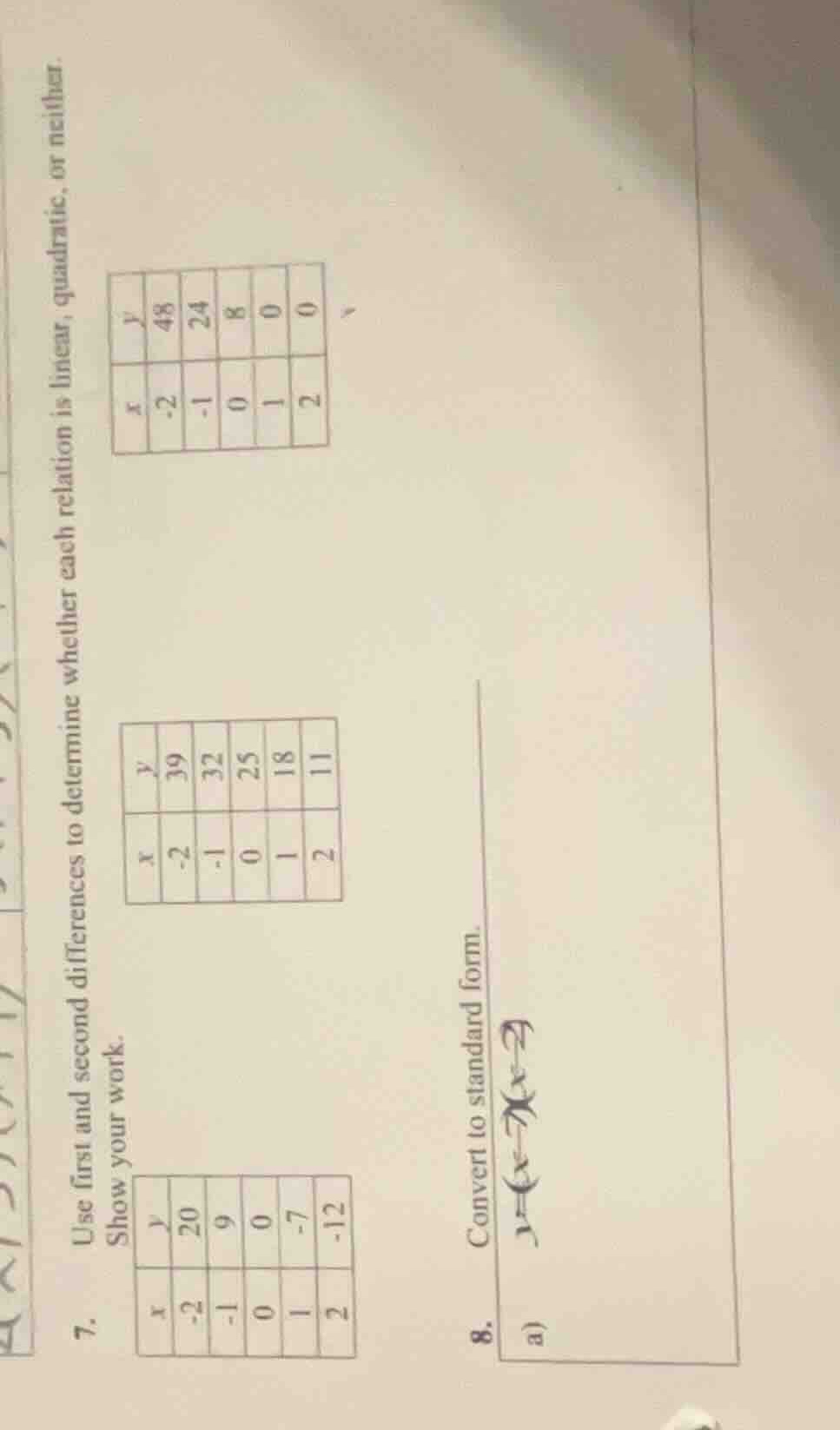
- use first and second differences to determine whether each relation is linear, quadratic, or neither. show your work.
\
\
\
- convert to standard form.
a) \\(y = (x - 7)(x - 2)\\)
Analyze the first table in Question 7
We calculate the first and second differences for the first table:
Since the second differences are constant (\(2\)), this relation is quadratic.
Analyze the second table in Question 7
We calculate the first differences for the second table:
Since the first differences are constant (\(-7\)), this relation is linear.
Analyze the third table in Question 7
We calculate the first and second differences for the third table:
Since the second differences are constant (\(8\)), this relation is quadratic.
Convert the equation in Question 8 to standard form
Using the Polynomial Expansion and Distributive Property concepts, we expand the factored form equation \(y = (x - 7)(x - 2)\):
This represents the quadratic relation in standard form.

Snap & solve any problem in the app
Get step-by-step solutions on Sovi AI
Photo-based solutions with guided steps
Explore more problems and detailed explanations
Question 7
First Table
- First differences: \(-11, -9, -7, -5\)
- Second differences: \(2, 2, 2\)
- Classification: Quadratic
Second Table
- First differences: \(-7, -7, -7, -7\)
- Classification: Linear
Third Table
- First differences: \(-24, -16, -8, 0\)
- Second differences: \(8, 8, 8\)
- Classification: Quadratic
---
Question 8
a) The standard form of the equation \(y = (x - 7)(x - 2)\) is: