QUESTION IMAGE
Question
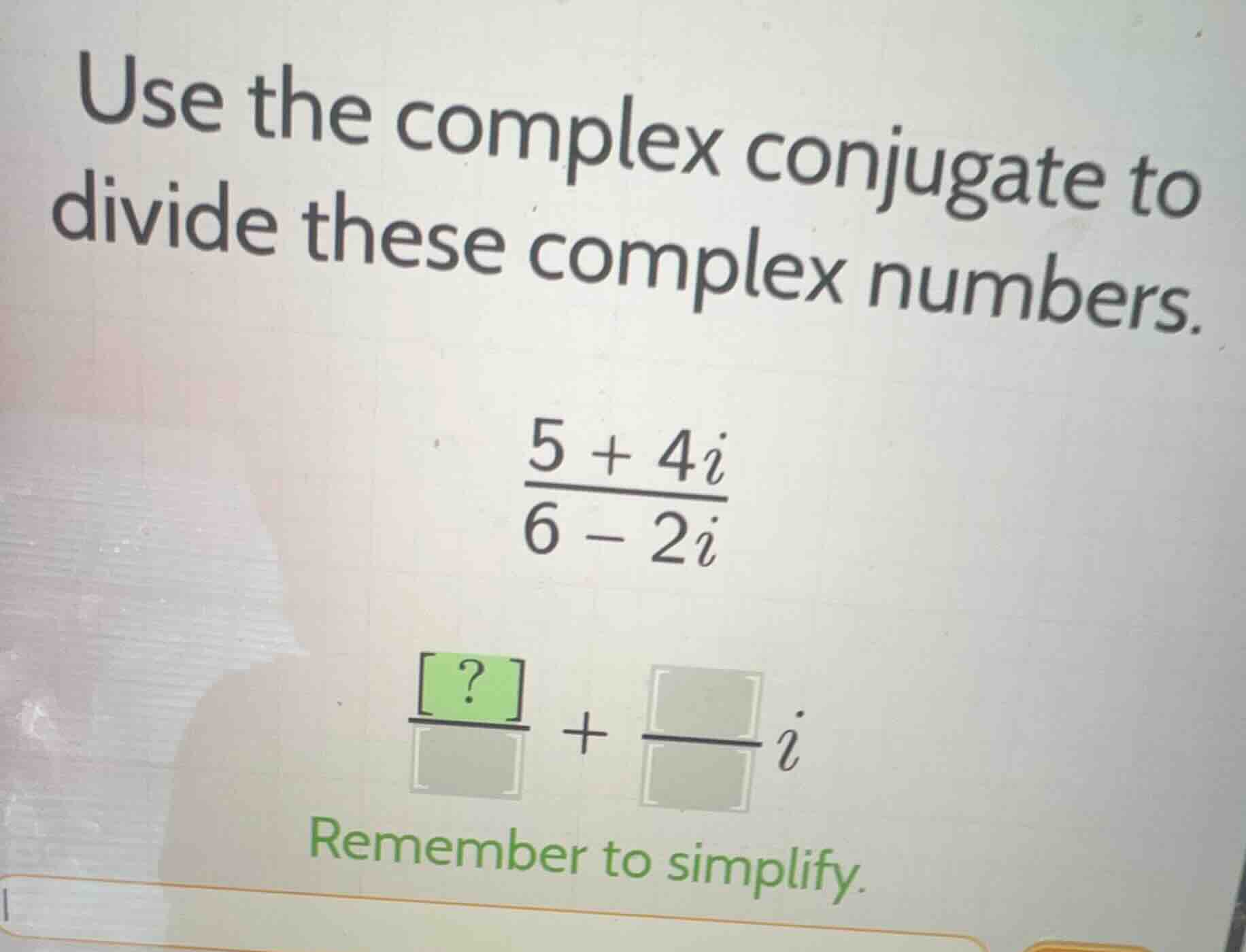
use the complex conjugate to divide these complex numbers.\\(\frac{5 + 4i}{6 - 2i}\\)\\(\frac{?}{\square}+\frac{\square}{\square}i\\)remember to simplify.
Step1: Multiply numerator and denominator by the complex conjugate of the denominator.
The complex conjugate of \(6 - 2i\) is \(6 + 2i\). So we multiply the fraction \(\frac{5 + 4i}{6 - 2i}\) by \(\frac{6 + 2i}{6 + 2i}\):
Step2: Expand the numerator and the denominator.
First, expand the numerator using the distributive property (FOIL method):
Since \(i^2=-1\), we substitute that in:
Now, expand the denominator using the difference of squares formula \((a - b)(a + b)=a^2 - b^2\), where \(a = 6\) and \(b = 2i\):
Substitute \(i^2 = - 1\):
Step3: Write the fraction as a complex number in standard form.
Now our fraction is \(\frac{22 + 34i}{40}\). We can split this into the real and imaginary parts:
Simplify the fractions:

Snap & solve any problem in the app
Get step-by-step solutions on Sovi AI
Photo-based solutions with guided steps
Explore more problems and detailed explanations
\(\frac{11}{20}+\frac{17}{20}i\) (So the real part numerator is \(11\), real part denominator is \(20\), imaginary part numerator is \(17\), imaginary part denominator is \(20\))