QUESTION IMAGE
Question
understanding exponential decay functions
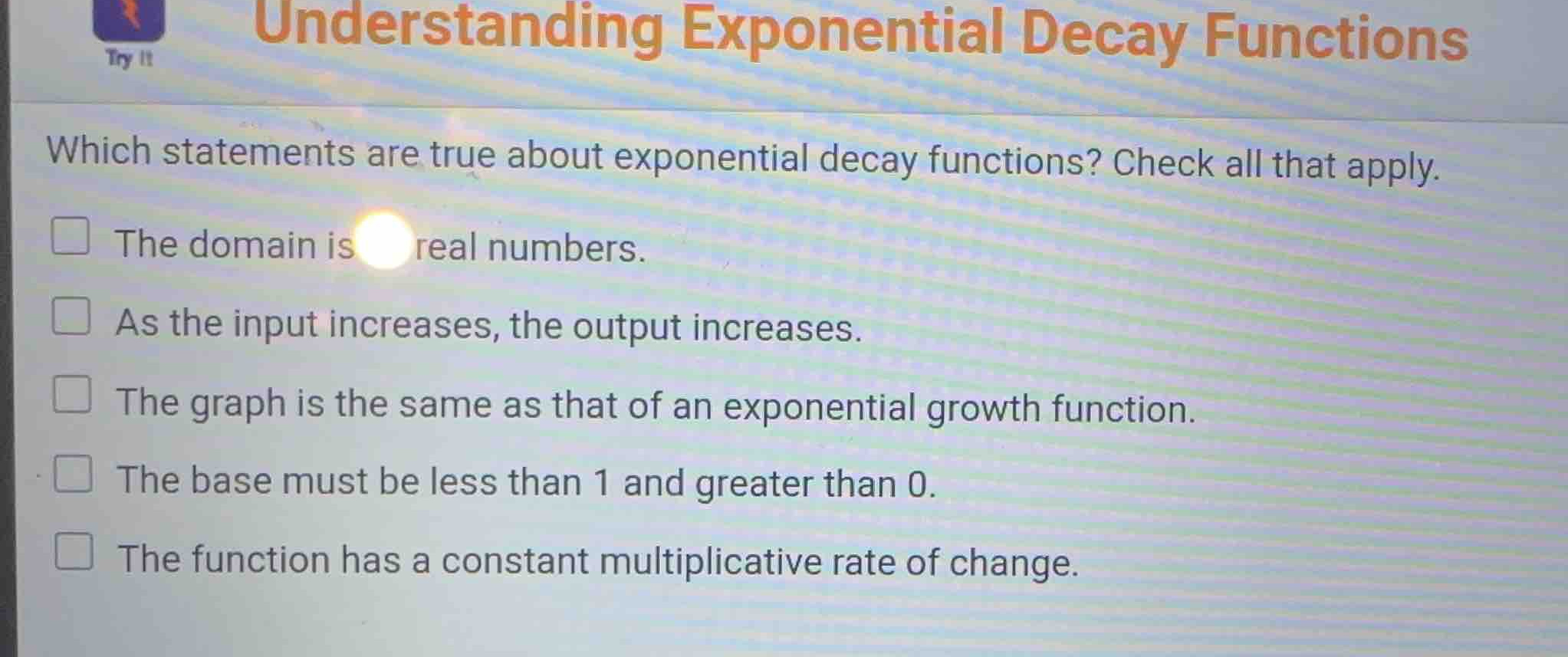
which statements are true about exponential decay functions? check all that apply.
- the domain is all real numbers.
- as the input increases, the output increases.
- the graph is the same as that of an exponential growth function.
- the base must be less than 1 and greater than 0.
- the function has a constant multiplicative rate of change.
Define exponential decay functions
An exponential decay function is of the form \(f(x) = a \cdot b^x\), where \(a > 0\) and \(0 < b < 1\).
Analyze domain and range
Using the Domain and Range concept, the domain of any standard exponential function \(f(x) = a \cdot b^x\) is all real numbers, \((-\infty, \infty)\). Thus, the first statement is true.
Analyze behavior and base
As the input \(x\) increases, the output \(f(x)\) decreases because the base \(b\) is between \(0\) and \(1\). The base must be less than \(1\) and greater than \(0\). Thus, the second statement is false, and the fourth statement is true.
Compare with growth and rate of change
The graph of a decay function decreases, whereas a growth function increases, so they are not the same. Exponential functions change by a constant multiplicative factor (or ratio) over equal intervals, meaning they have a constant multiplicative rate of change. Thus, the third statement is false, and the fifth statement is true.

Snap & solve any problem in the app
Get step-by-step solutions on Sovi AI
Photo-based solutions with guided steps
Explore more problems and detailed explanations
- The domain is all real numbers. (Correct answer)
- As the input increases, the output increases.
- The graph is the same as that of an exponential growth function.
- The base must be less than 1 and greater than 0. (Correct answer)
- The function has a constant multiplicative rate of change. (Correct answer)