QUESTION IMAGE
Question
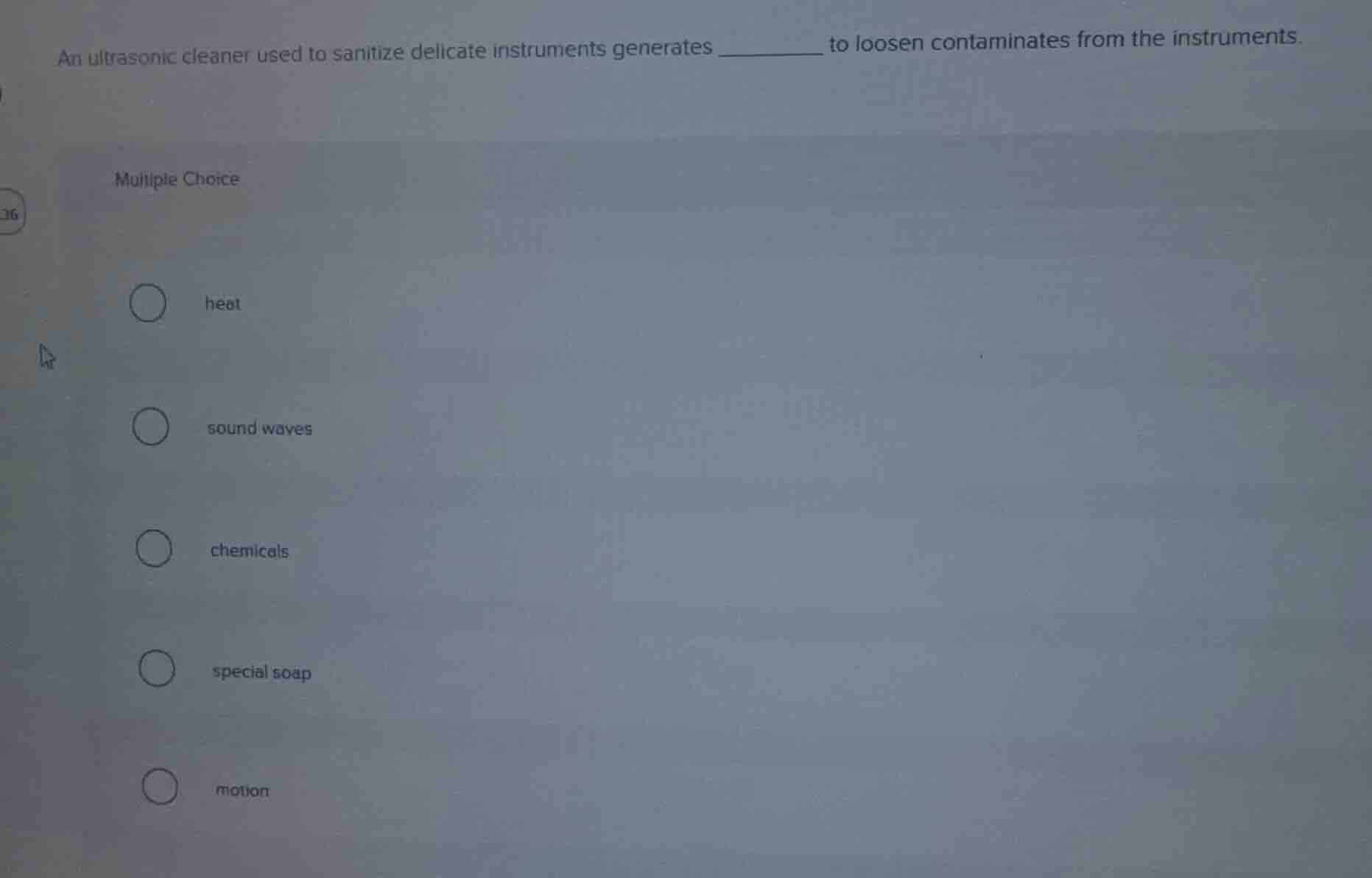
an ultrasonic cleaner used to sanitize delicate instruments generates ______ to loosen contaminates from the instruments.
multiple choice
- heat
- sound waves
- chemicals
- special soap
- motion
Identify the mechanism of an ultrasonic cleaner
An ultrasonic cleaner is a device used in medical and dental offices to sanitize delicate instruments before sterilization. It operates by utilizing high-frequency Ultrasonic Cleaning Protocols to clean the surfaces of these instruments.
Understand how the waves loosen contaminants
The device generates high-frequency sound waves that travel through a liquid cleaning solution. These sound waves create microscopic bubbles in a process called cavitation. When these bubbles collapse or implode against the surfaces of the instruments, they generate tiny, powerful shockwaves that physically dislodge and loosen contaminants, debris, and organic matter from hard-to-reach areas without damaging delicate components.
Evaluate the given options
- heat: While some ultrasonic cleaners have heating elements to warm the solution, heat itself is not the primary mechanism generated by the cleaner to loosen contaminants.
- sound waves: This is the correct mechanism. High-frequency sound waves (ultrasound) drive the cavitation process that cleans the instruments.
- chemicals: The cleaner uses a liquid solution (which may contain enzymatic detergents), but the machine itself generates physical energy, not chemicals.
- special soap: Soap is an additive to the tank, not something generated by the machine.
- motion: While cavitation involves microscopic fluid movement, the primary physical phenomenon generated by the transducer is high-frequency sound waves.

Snap & solve any problem in the app
Get step-by-step solutions on Sovi AI
Photo-based solutions with guided steps
Explore more problems and detailed explanations
- heat
- sound waves (Correct answer)
- chemicals
- special soap
- motion