QUESTION IMAGE
Question
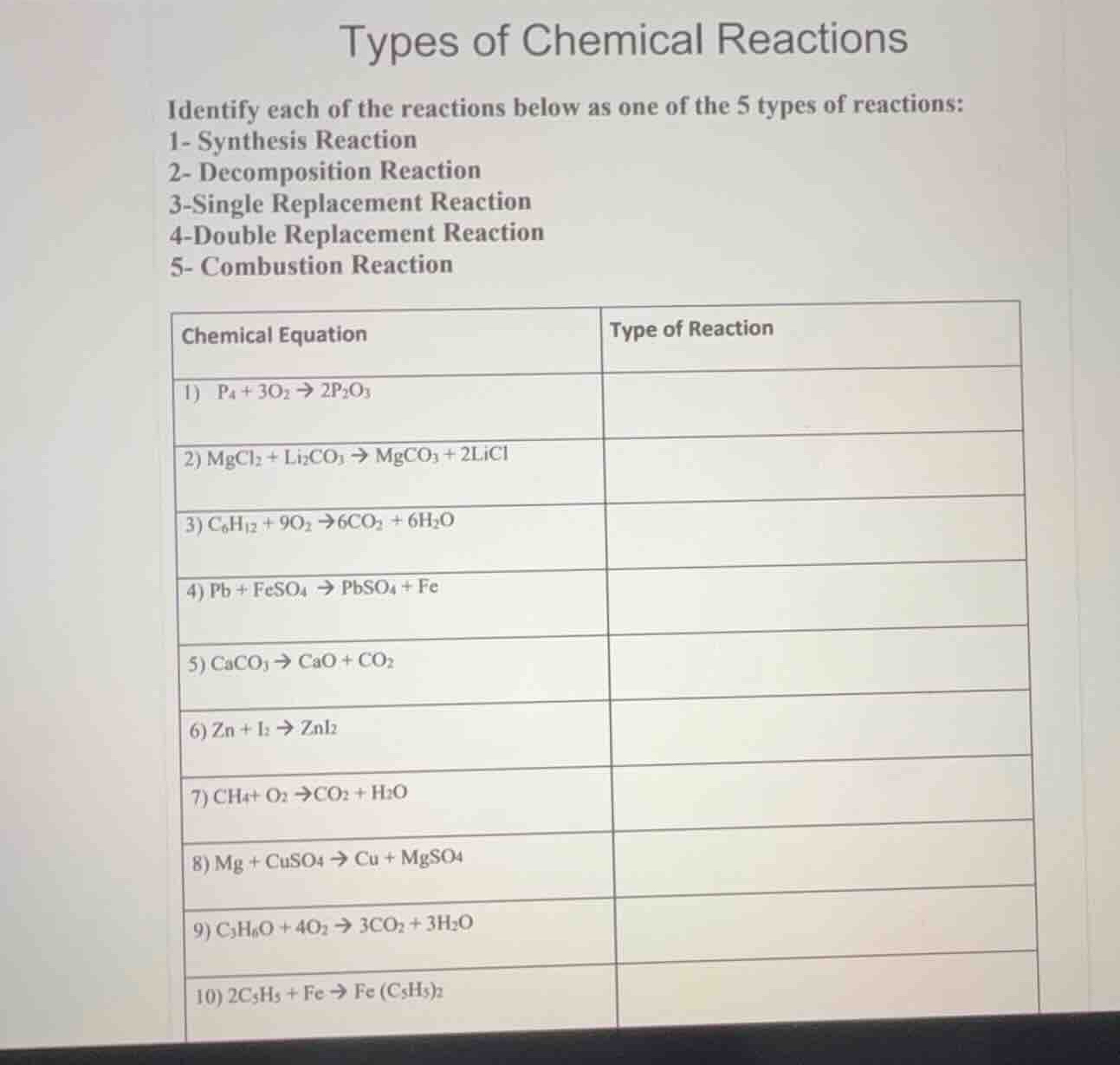
types of chemical reactions
identify each of the reactions below as one of the 5 types of reactions:
1- synthesis reaction
2- decomposition reaction
3-single replacement reaction
4-double replacement reaction
5- combustion reaction
\
Identify synthesis reactions
Using the Synthesis Reactions knowledge point, we look for reactions where multiple reactants combine to form a single product:
- Reaction 1: \(\text{P}_4 + 3\text{O}_2
ightarrow 2\text{P}_2\text{O}_3\) combines phosphorus and oxygen into one compound.
- Reaction 6: \(\text{Zn} + \text{I}_2
ightarrow \text{ZnI}_2\) combines zinc and iodine into one compound.
- Reaction 10: \(2\text{C}_5\text{H}_5 + \text{Fe}
ightarrow \text{Fe}(\text{C}_5\text{H}_5)_2\) combines cyclopentadiene and iron into ferrocene.
Identify decomposition reactions
Using the Decomposition Reactions knowledge point, we look for reactions where a single reactant breaks down into multiple products:
- Reaction 5: \(\text{CaCO}_3
ightarrow \text{CaO} + \text{CO}_2\) shows calcium carbonate breaking down.
Identify single replacement reactions
Using the Single Displacement Reactions knowledge point, we look for reactions where an element reacts with a compound, displacing another element:
- Reaction 4: \(\text{Pb} + \text{FeSO}_4
ightarrow \text{PbSO}_4 + \text{Fe}\) shows lead replacing iron.
- Reaction 8: \(\text{Mg} + \text{CuSO}_4
ightarrow \text{Cu} + \text{MgSO}_4\) shows magnesium replacing copper.
Identify double replacement reactions
Using the Double Displacement Reactions knowledge point, we look for reactions where two ionic compounds exchange ions to form two new compounds:
- Reaction 2: \(\text{MgCl}_2 + \text{Li}_2\text{CO}_3
ightarrow \text{MgCO}_3 + 2\text{LiCl}\) shows exchange of chloride and carbonate ions.
Identify combustion reactions
Using the Combustion Reactions knowledge point, we look for reactions where a hydrocarbon or organic compound reacts with oxygen gas (\(\text{O}_2\)) to produce carbon dioxide (\(\text{CO}_2\)) and water (\(\text{H}_2\text{O}\)):
- Reaction 3: \(\text{C}_6\text{H}_{12} + 9\text{O}_2
ightarrow 6\text{CO}_2 + 6\text{H}_2\text{O}\)
- Reaction 7: \(\text{CH}_4 + \text{O}_2
ightarrow \text{CO}_2 + \text{H}_2\text{O}\) (unbalanced, but fits the combustion pattern)
- Reaction 9: \(\text{C}_3\text{H}_6\text{O} + 4\text{O}_2
ightarrow 3\text{CO}_2 + 3\text{H}_2\text{O}\)

Snap & solve any problem in the app
Get step-by-step solutions on Sovi AI
Photo-based solutions with guided steps
Explore more problems and detailed explanations
| No. | Chemical Equation | Type of Reaction |
|---|
| 1 | \(\text{P}_4 + 3\text{O}_2
ightarrow 2\text{P}_2\text{O}_3\) | Synthesis Reaction |
| 2 | \(\text{MgCl}_2 + \text{Li}_2\text{CO}_3
ightarrow \text{MgCO}_3 + 2\text{LiCl}\) | Double Replacement Reaction |
| 3 | \(\text{C}_6\text{H}_{12} + 9\text{O}_2
ightarrow 6\text{CO}_2 + 6\text{H}_2\text{O}\) | Combustion Reaction |
| 4 | \(\text{Pb} + \text{FeSO}_4
ightarrow \text{PbSO}_4 + \text{Fe}\) | Single Replacement Reaction |
| 5 | \(\text{CaCO}_3
ightarrow \text{CaO} + \text{CO}_2\) | Decomposition Reaction |
| 6 | \(\text{Zn} + \text{I}_2
ightarrow \text{ZnI}_2\) | Synthesis Reaction |
| 7 | \(\text{CH}_4 + \text{O}_2
ightarrow \text{CO}_2 + \text{H}_2\text{O}\) | Combustion Reaction |
| 8 | \(\text{Mg} + \text{CuSO}_4
ightarrow \text{Cu} + \text{MgSO}_4\) | Single Replacement Reaction |
| 9 | \(\text{C}_3\text{H}_6\text{O} + 4\text{O}_2
ightarrow 3\text{CO}_2 + 3\text{H}_2\text{O}\) | Combustion Reaction |
| 10 | \(2\text{C}_5\text{H}_5 + \text{Fe}
ightarrow \text{Fe}(\text{C}_5\text{H}_5)_2\) | Synthesis Reaction |