QUESTION IMAGE
Question
type your response in the box.
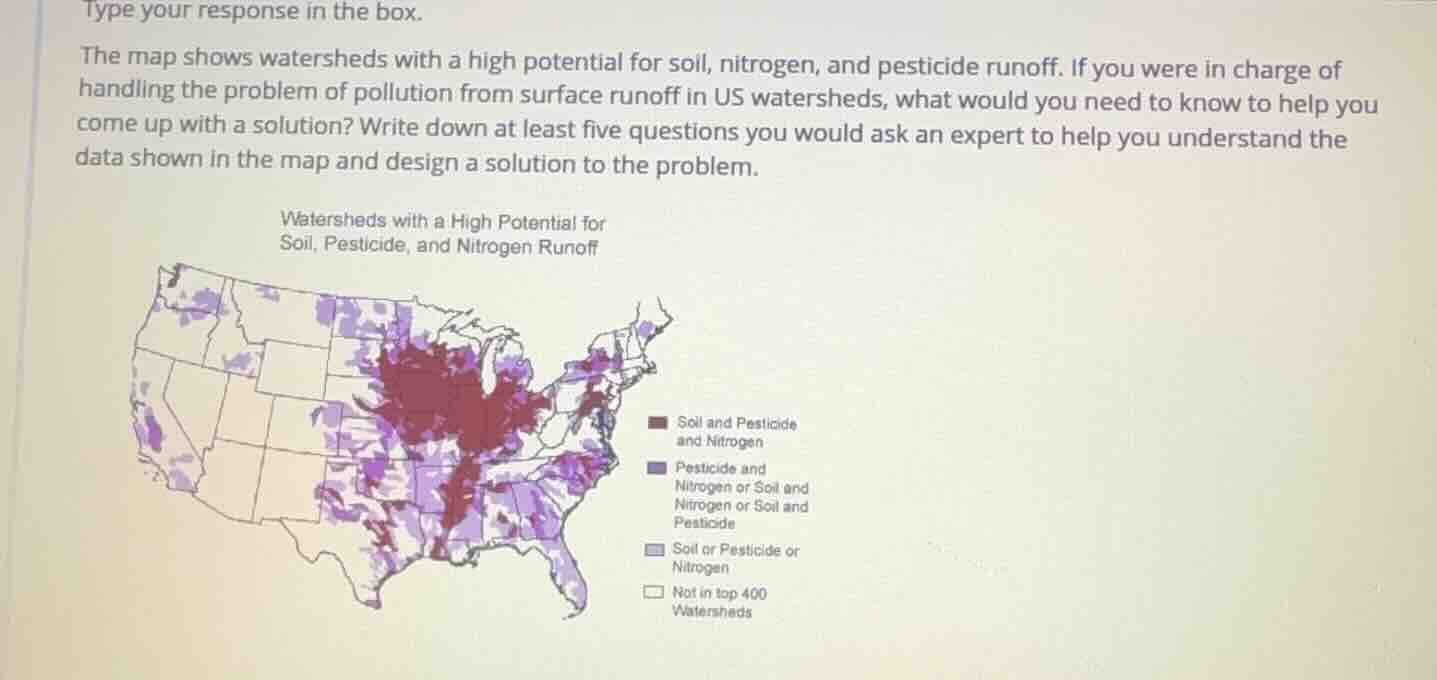
the map shows watersheds with a high potential for soil, nitrogen, and pesticide runoff. if you were in charge of handling the problem of pollution from surface runoff in us watersheds, what would you need to know to help you come up with a solution? write down at least five questions you would ask an expert to help you understand the data shown in the map and design a solution to the problem.
Analyze the map data
The map displays US watersheds categorized by their potential for soil, pesticide, and nitrogen runoff. The highest concentration of high-potential runoff (all three factors combined) is heavily clustered in the Midwest (the Mississippi River Basin / Corn Belt). Other regions show combinations of one or two factors, while large portions of the West are not in the top 400 watersheds.
Identify key information gaps
To design an effective pollution management solution, we need to understand the underlying causes of these patterns, the local agricultural practices, the ecological impacts downstream, the current regulatory frameworks, and the feasibility of mitigation strategies.
Formulate expert questions
We need to draft five distinct, targeted questions for an environmental expert. These questions should cover:
- The primary drivers of the geographic distribution (e.g., specific crops or soil types).
- The downstream ecological consequences (e.g., hypoxia in the Gulf of Mexico).
- Current agricultural practices and mitigation techniques (e.g., cover crops, buffer strips).
- Economic and policy barriers to implementing solutions.
- Monitoring and data collection methods to track progress.

Snap & solve any problem in the app
Get step-by-step solutions on Sovi AI
Photo-based solutions with guided steps
Explore more problems and detailed explanations
To understand the data shown in the map and design an effective solution for surface runoff pollution in US watersheds, here are five critical questions to ask an environmental expert:
- What specific agricultural practices or regional soil characteristics explain the heavy concentration of high-potential runoff for all three pollutants (soil, pesticide, and nitrogen) in the Midwest compared to other regions?
- What are the primary downstream ecological and public health impacts of this concentrated runoff, particularly regarding the hypoxic zone in the Gulf of Mexico and local drinking water sources?
- Which best management practices (BMPs)—such as cover crops, riparian buffer zones, or restored wetlands—have proven most effective at reducing nitrogen and pesticide runoff simultaneously?
- What economic incentives or policy frameworks currently exist, or need to be created, to encourage farmers in high-risk watersheds to adopt runoff-reduction practices?
- How is runoff water quality currently monitored in these top 400 watersheds, and what additional data-tracking infrastructure is needed to measure the success of implemented solutions over time?