QUESTION IMAGE
Question
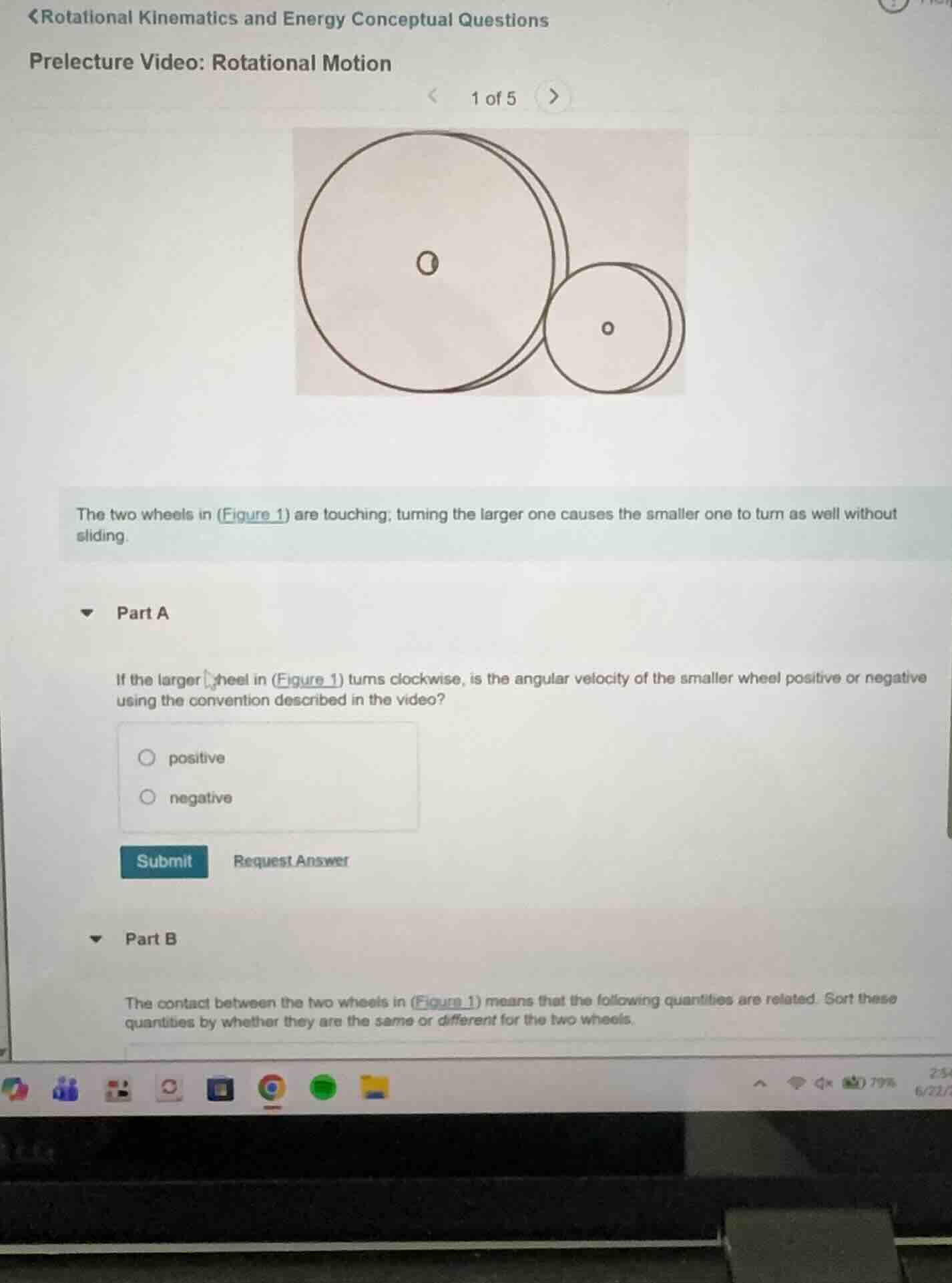
the two wheels in (figure 1) are touching; turning the larger one causes the smaller one to turn as well without sliding.
part a
if the larger wheel in (figure 1) turns clockwise, is the angular velocity of the smaller wheel positive or negative using the convention described in the video?
positive
negative
part b
the contact between the two wheels in (figure 1) means that the following quantities are related. sort these quantities by whether they are the same or different for the two wheels.
Determine the rotation direction of the smaller wheel
Using the Rotational Kinematics knowledge point
The two wheels touch and turn without sliding. When the larger wheel turns clockwise, the friction at the point of contact forces the smaller wheel to rotate in the opposite direction, which is counterclockwise.
Apply the standard sign convention for angular velocity
Using the Rotational Kinematics knowledge point
By standard physics convention (the right-hand rule), counterclockwise rotation is defined as positive, while clockwise rotation is defined as negative. Since the smaller wheel rotates counterclockwise, its angular velocity is positive.
Analyze the physical quantities in nonslip contact
Using the Rotational Kinematics knowledge point
For two wheels in contact without sliding:
- The tangential speed \(v = \omega r\) at the outer rims must be equal.
- The tangential acceleration \(a_t = \alpha r\) at the outer rims must be equal.
- The angular speed \(\omega\) and angular acceleration \(\alpha\) are different because the wheels have different radii \(r\).

Snap & solve any problem in the app
Get step-by-step solutions on Sovi AI
Photo-based solutions with guided steps
Explore more problems and detailed explanations
Question 1
- positive (Correct answer)
- negative