Sovi.AI - AI Math Tutor

Scan to solve math questions

QUESTION IMAGE

if the two triangles are congruent, state how you know. if not, state o…

Question

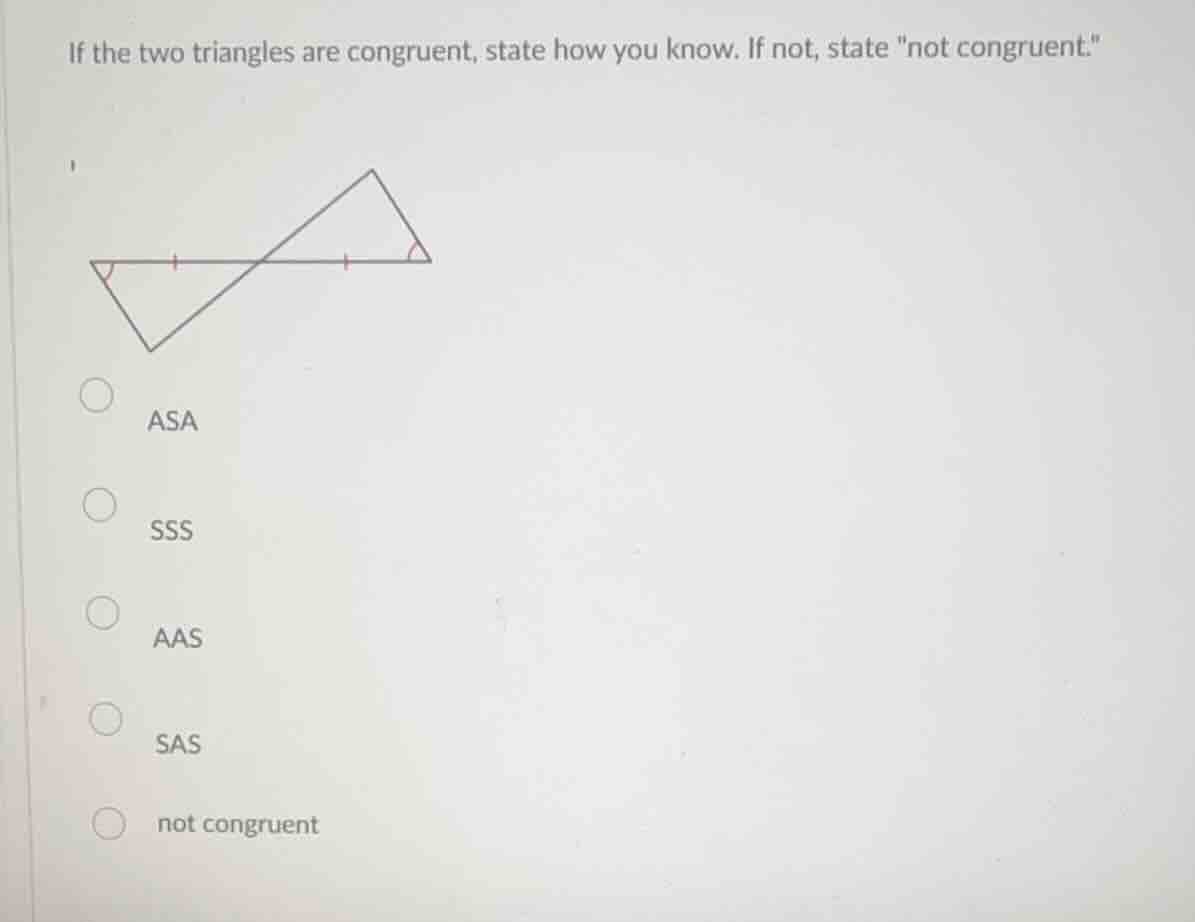
if the two triangles are congruent, state how you know. if not, state
ot congruent.\

asa
sss
aas
sas
not congruent

Explanation:

Response

<pre_analysis>
{
"quality": "clear",
"question_count": 1,
"skills_matched": [
"step_cot",
"multiple_choice_formatter",
"explain_then_answer",
"tutor"
],
"needs_drawing": false,
"concepts_used": [
"Triangle Congruence Postulates",
"ASA Congruence"
],
"new_concepts": [
"Vertical Angles Theorem"
],
"current_concepts": [
"Triangle Congruence Postulates",
"ASA Congruence",
"Vertical Angles Theorem"
]
}
</pre_analysis>

<reasoning>

Identify given congruent parts

The diagram shows two triangles sharing a vertex.
We observe tick marks indicating one pair of congruent sides.
We also observe arc marks indicating one pair of congruent angles.
Using the Triangle Congruence Postulates concept, we list:

  • One pair of congruent angles (marked with red arcs).
  • One pair of congruent adjacent sides (marked with red tick marks).

Identify additional congruent parts

The two triangles intersect to form vertical angles at the central shared vertex.
By the Vertical Angles Theorem, these vertical angles are congruent.
This gives us a second pair of congruent angles.

Determine the congruence postulate

We now have:

  • An angle (marked arc).
  • An included side (marked tick).
  • An angle (vertical angle).

Using the ASA Congruence postulate, two angles and the included side of one triangle are congruent to two angles and the included side of another triangle.
Therefore, the triangles are congruent by ASA.
</reasoning>

<answer>
<mcq-correct>(A) ASA</mcq-correct>
<mcq-option>(B) SSS</mcq-option>
<mcq-option>(C) AAS</mcq-option>
<mcq-option>(D) SAS</mcq-option>
<mcq-option>(E) not congruent</mcq-option>
</answer>

<post_analysis>
{
"subject": "Mathematics",
"question_type": "Multiple Choice",
"knowledge_point": [
"Mathematics",
"Geometry",
"Triangle Congruence Postulates"
]
}
</post_analysis>

Answer:

<pre_analysis>
{
"quality": "clear",
"question_count": 1,
"skills_matched": [
"step_cot",
"multiple_choice_formatter",
"explain_then_answer",
"tutor"
],
"needs_drawing": false,
"concepts_used": [
"Triangle Congruence Postulates",
"ASA Congruence"
],
"new_concepts": [
"Vertical Angles Theorem"
],
"current_concepts": [
"Triangle Congruence Postulates",
"ASA Congruence",
"Vertical Angles Theorem"
]
}
</pre_analysis>

<reasoning>

Identify given congruent parts

The diagram shows two triangles sharing a vertex.
We observe tick marks indicating one pair of congruent sides.
We also observe arc marks indicating one pair of congruent angles.
Using the Triangle Congruence Postulates concept, we list:

  • One pair of congruent angles (marked with red arcs).
  • One pair of congruent adjacent sides (marked with red tick marks).

Identify additional congruent parts

The two triangles intersect to form vertical angles at the central shared vertex.
By the Vertical Angles Theorem, these vertical angles are congruent.
This gives us a second pair of congruent angles.

Determine the congruence postulate

We now have:

  • An angle (marked arc).
  • An included side (marked tick).
  • An angle (vertical angle).

Using the ASA Congruence postulate, two angles and the included side of one triangle are congruent to two angles and the included side of another triangle.
Therefore, the triangles are congruent by ASA.
</reasoning>

<answer>
<mcq-correct>(A) ASA</mcq-correct>
<mcq-option>(B) SSS</mcq-option>
<mcq-option>(C) AAS</mcq-option>
<mcq-option>(D) SAS</mcq-option>
<mcq-option>(E) not congruent</mcq-option>
</answer>

<post_analysis>
{
"subject": "Mathematics",
"question_type": "Multiple Choice",
"knowledge_point": [
"Mathematics",
"Geometry",
"Triangle Congruence Postulates"
]
}
</post_analysis>