QUESTION IMAGE
Question
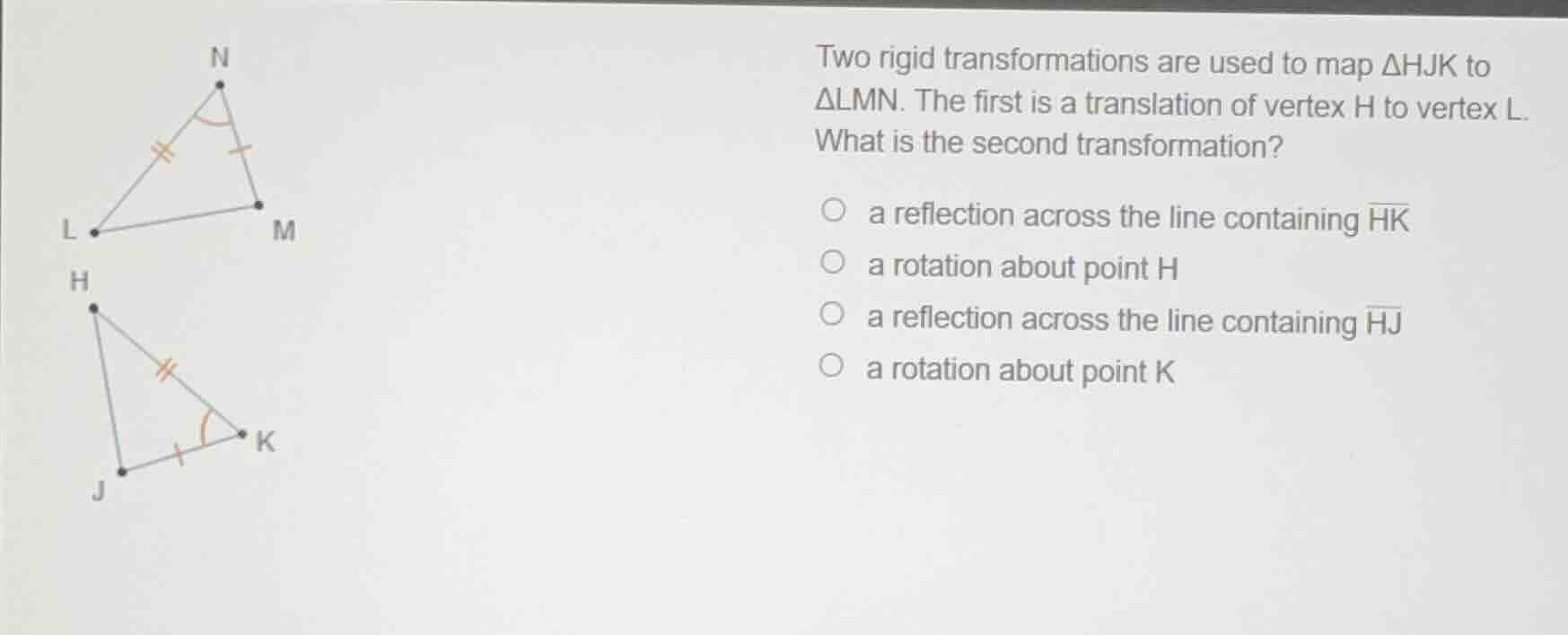
two rigid transformations are used to map \\(\delta hjk\\) to \\(\delta lmn\\). the first is a translation of vertex h to vertex l. what is the second transformation?
a reflection across the line containing \\(\overline{hk}\\)
a rotation about point h
a reflection across the line containing \\(\overline{hj}\\)
a rotation about point k
Analyze the mapping of vertices
Using the Congruence Mapping knowledge point
- The problem states that two rigid transformations map \(\Delta HJK\) to \(\Delta LMN\).
- This implies the vertex correspondences are:
- \(H \to L\)
- \(J \to M\)
- \(K \to N\)
Analyze the first transformation
Using the Rigid Transformations knowledge point
- The first transformation is a translation mapping vertex \(H\) to vertex \(L\).
- Let \(\Delta H'J'K'\) be the image of \(\Delta HJK\) after this translation.
- Since \(H\) is translated to \(L\), we have \(H' = L\).
- The segment \(H'K'\) is now parallel to \(HK\), starting at \(L\).
Determine the second transformation
Using the Rigid Transformations knowledge point
- After the translation, the image \(\Delta H'J'K'\) shares vertex \(H' = L\) with \(\Delta LMN\).
- To complete the mapping to \(\Delta LMN\), we must rotate the triangle about the shared vertex.
- Since the shared vertex is \(H' = L\) (which corresponds to the original point \(H\)), the rotation must be centered at this point.
- Therefore, the second transformation is a rotation about point \(H\).

Snap & solve any problem in the app
Get step-by-step solutions on Sovi AI
Photo-based solutions with guided steps
Explore more problems and detailed explanations
- a reflection across the line containing \(\overline{HK}\)
- a rotation about point \(H\) (Correct answer)
- a reflection across the line containing \(\overline{HJ}\)
- a rotation about point \(K\)