QUESTION IMAGE
Question
the two major political parties formed near the end of the second party system remain in existence today. additionally, third parties began to develop. most were former southern whigs focused on a single issue. the anti-masons were a protectionist party whose policies limited its popularity. the liberty party opposed slavery. the free soil party likewise opposed the extension of slavery into western states, as well as the increase in immigration from other countries.
review
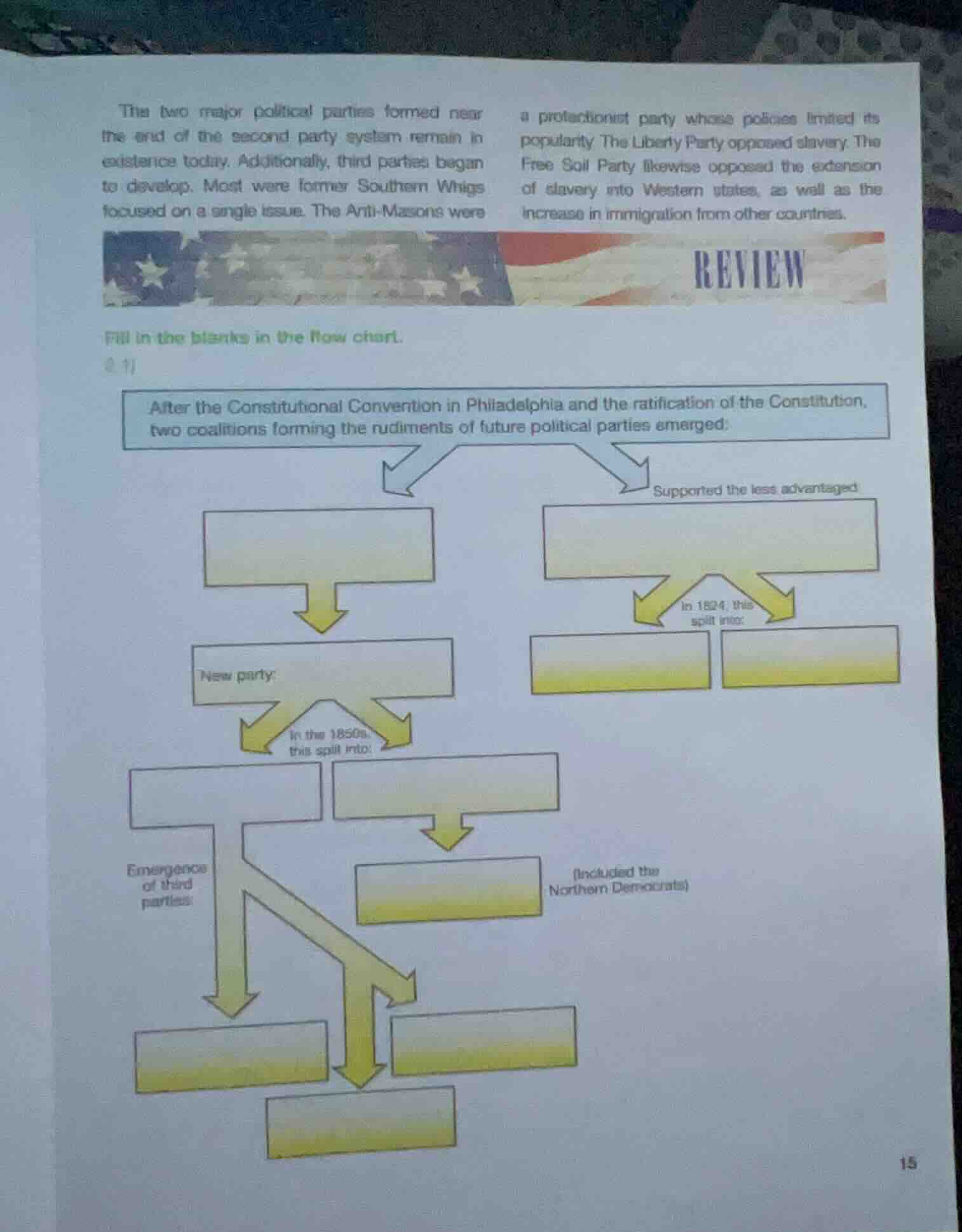
fill in the blanks in the flow chart.
after the constitutional convention in philadelphia and the ratification of the constitution, two coalitions forming the rudiments of future political parties emerged:
supported the less advantaged
in 1824, this split into:
new party:
in the 1850s, this split into:
emergence of third parties:
(included the northern democrats)
Identify the initial coalitions of the First Party System
Following the Constitutional Convention and ratification, the first two opposing coalitions (the First Party System) were the Federalists and the Democratic-Republicans. The right-hand side is labeled "Supported the less advantaged," which historically describes the Democratic-Republicans (Jeffersonians). Therefore, the left-hand side represents the Federalists.
Trace the evolution of the Democratic-Republicans
The Democratic-Republicans (right side) split in 1824. This split led to the creation of the Democratic Party (led by Andrew Jackson, representing the "less advantaged" coalition) and the National Republican Party (which later merged into the Whigs).
Trace the evolution of the Federalists and Whigs
On the left side, the Federalists faded, and a "New party" emerged to oppose the Democrats: the Whig Party. In the 1850s, the Whig Party split over the issue of slavery. This split led to the emergence of third parties (such as the Free Soil Party, Know-Nothings, and Constitutional Union Party) and the formation of the modern Republican Party (which opposed the extension of slavery) and the Democratic Party (specifically including the Northern Democrats and Southern Democrats).

Snap & solve any problem in the app
Get step-by-step solutions on Sovi AI
Photo-based solutions with guided steps
Explore more problems and detailed explanations
Fill in the blanks in the flow chart.
After the Constitutional Convention in Philadelphia and the ratification of the Constitution, two coalitions forming the rudiments of future political parties emerged:
- Left initial box: <blank>Federalists</blank>
- Right initial box ("Supported the less advantaged"): <blank>Democratic-Republicans</blank>
The Democratic-Republicans split in 1824 into:
- Left split box: <blank>National Republicans</blank>
- Right split box: <blank>Democrats</blank>
On the left side, the "New party" that emerged is:
- New party box: <blank>Whigs</blank>
In the 1850s, this party split into:
- Left box ("Emergence of third parties"): <blank>Republicans</blank>
- Right box ("Included the Northern Democrats"): <blank>Democrats</blank>
Under the "Emergence of third parties" branch, the three bottom boxes represent:
- Bottom left box: <blank>Free Soil Party</blank>
- Bottom middle box: <blank>Anti-Masons</blank>
- Bottom right box: <blank>Liberty Party</blank>