QUESTION IMAGE
Question
your turn
- your friend incorrectly claims that \\(\delta abc\\) is similar to \\(\delta fgh\\) by sas similarity triangle theorem. explain or show your friend their misunderstanding of sas similarity theorem.
Identify the given geometric information
We are given two triangles:
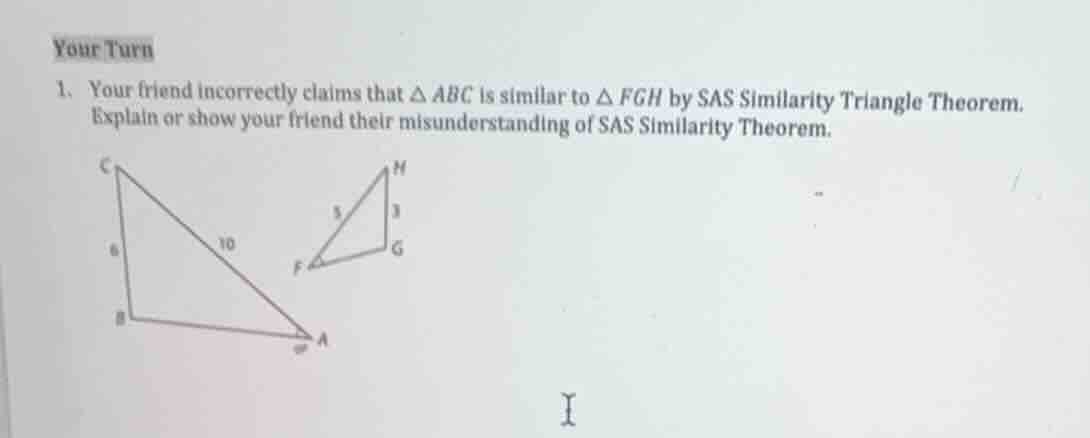
- \(\triangle ABC\) with side lengths \(BC = 6\), \(AC = 10\), and an indicated angle \(\angle A = 30^\circ\).
- \(\triangle FGH\) with side lengths \(GH = 3\), \(FH = 5\), and an indicated angle \(\angle F = 30^\circ\).
Compare the ratios of corresponding sides
Using the Geometric Similarity Applications knowledge point
$$
\frac{BC}{GH} = \frac{6}{3} = 2,\quad \frac{AC}{FH} = \frac{10}{5} = 2
$$
Analyze the position of the given angles
- In \(\triangle ABC\), the given angle \(\angle A\) is opposite to side \(BC\). It is not the included angle between sides \(BC\) and \(AC\).
- In \(\triangle FGH\), the given angle \(\angle F\) is opposite to side \(GH\). It is not the included angle between sides \(GH\) and \(FH\).
- The SAS (Side-Angle-Side) Similarity Theorem strictly requires the congruent angles to be the included angles between the two pairs of proportional sides.
- The included angles are \(\angle C\) for \(\triangle ABC\) and \(\angle H\) for \(\triangle FGH\), which are not given.

Snap & solve any problem in the app
Get step-by-step solutions on Sovi AI
Photo-based solutions with guided steps
Explore more problems and detailed explanations
The misunderstanding lies in the placement of the congruent angles.
For the SAS Similarity Theorem to apply, the congruent angles must be the included angles (the angles located directly between the two pairs of proportional sides).
- The two pairs of proportional sides are:
$$\frac{AC}{FH} = \frac{10}{5} = 2 \quad \text{and} \quad \frac{BC}{GH} = \frac{6}{3} = 2$$
- The included angle between sides \(AC\) and \(BC\) is \(\angle C\).
- The included angle between sides \(FH\) and \(GH\) is \(\angle H\).
Since the given congruent angles are \(\angle A\) and \(\angle F\) (\(30^\circ\)) rather than the included angles \(\angle C\) and \(\angle H\), the SAS Similarity Theorem cannot be used to prove that \(\triangle ABC \sim \triangle FGH\).