QUESTION IMAGE
Question
your turn
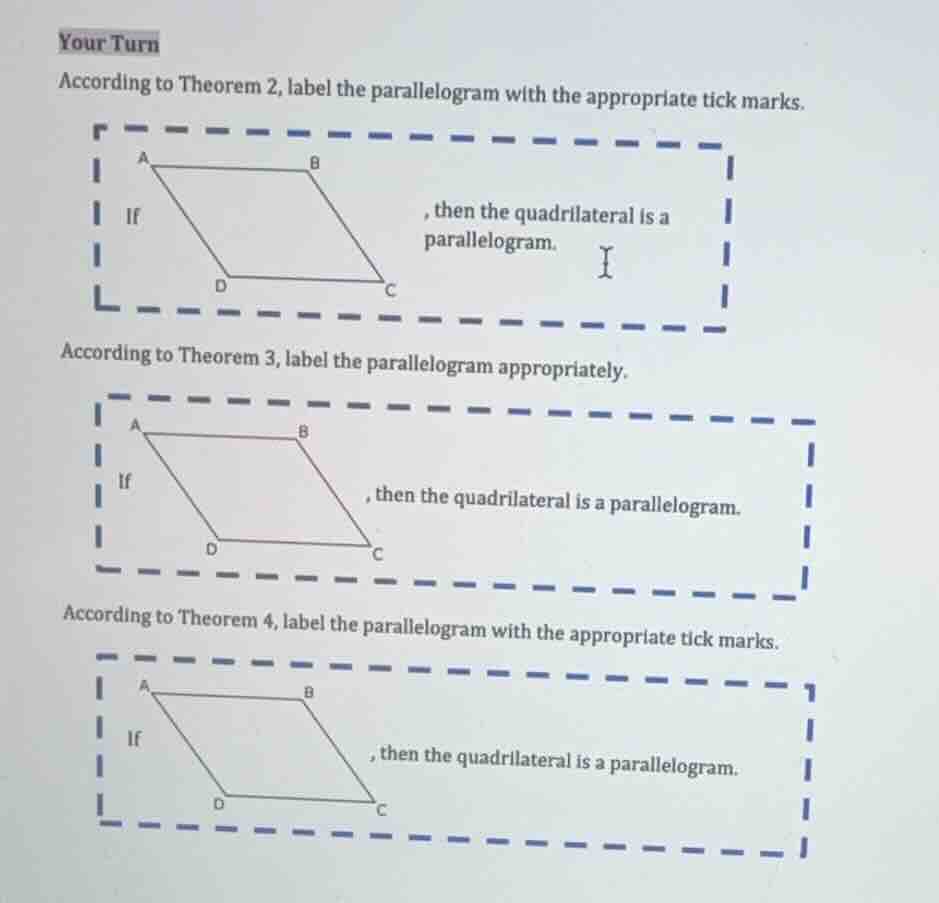
according to theorem 2, label the parallelogram with the appropriate tick marks.
if parallelogram abcd, then the quadrilateral is a parallelogram.
according to theorem 3, label the parallelogram appropriately.
if parallelogram abcd, then the quadrilateral is a parallelogram.
according to theorem 4, label the parallelogram with the appropriate tick marks.
if parallelogram abcd, then the quadrilateral is a parallelogram.
Identify the standard converse theorems for parallelograms
Using the Parallelogram Theorems knowledge point
Standard geometry curricula define the conditions to prove a quadrilateral is a parallelogram:
- Theorem 2 (Converse of Opposite Sides Theorem): If both pairs of opposite sides of a quadrilateral are congruent, then the quadrilateral is a parallelogram.
- Theorem 3 (Converse of Opposite Angles Theorem): If both pairs of opposite angles of a quadrilateral are congruent, then the quadrilateral is a parallelogram.
- Theorem 4 (Converse of Consecutive Angles Theorem / Opposite Sides Parallel and Congruent): If one pair of opposite sides of a quadrilateral is both parallel and congruent, then the quadrilateral is a parallelogram.
Determine the required markings for Theorem 2
Using the Geometric Tick Marks knowledge point
- For Theorem 2, we must show both pairs of opposite sides are congruent.
- Mark side \(AB\) and side \(CD\) with single tick marks: \(AB \cong CD\).
- Mark side \(AD\) and side \(BC\) with double tick marks: \(AD \cong BC\).
- The statement is: "If \(AB \cong CD\) and \(AD \cong BC\), then the quadrilateral is a parallelogram."
Determine the required markings for Theorem 3
Using the Geometric Tick Marks knowledge point
- For Theorem 3, we must show both pairs of opposite angles are congruent.
- Mark angle \(\angle A\) and angle \(\angle C\) with single angle arcs: \(\angle A \cong \angle C\).
- Mark angle \(\angle B\) and angle \(\angle D\) with double angle arcs: \(\angle B \cong \angle D\).
- The statement is: "If \(\angle A \cong \angle C\) and \(\angle B \cong \angle D\), then the quadrilateral is a parallelogram."
Determine the required markings for Theorem 4
Using the Geometric Tick Marks knowledge point
- For Theorem 4, we must show one pair of opposite sides is both parallel and congruent.
- Mark side \(AB\) and side \(CD\) with congruent tick marks and parallel arrows.
- The statement is: "If \(AB \parallel CD\) and \(AB \cong CD\), then the quadrilateral is a parallelogram."

Snap & solve any problem in the app
Get step-by-step solutions on Sovi AI
Photo-based solutions with guided steps
Explore more problems and detailed explanations
Question 1
According to Theorem 2, label the parallelogram with the appropriate tick marks.
- Markings on Diagram: Place a single tick mark on sides \(AB\) and \(CD\) to show they are congruent. Place a double tick mark on sides \(AD\) and \(BC\) to show they are congruent.
- Statement: If <blank>\(AB \cong CD\) and \(AD \cong BC\)</blank>, then the quadrilateral is a parallelogram.
Question 2
According to Theorem 3, label the parallelogram appropriately.
- Markings on Diagram: Place a single arc on opposite angles \(\angle A\) and \(\angle C\) to show they are congruent. Place a double arc on opposite angles \(\angle B\) and \(\angle D\) to show they are congruent.
- Statement: If <blank>\(\angle A \cong \angle C\) and \(\angle B \cong \angle D\)</blank>, then the quadrilateral is a parallelogram.
Question 3
According to Theorem 4, label the parallelogram with the appropriate tick marks.
- Markings on Diagram: Place a single tick mark and a parallel arrow on side \(AB\). Place a matching single tick mark and parallel arrow on side \(CD\).
- Statement: If <blank>\(AB \parallel CD\) and \(AB \cong CD\)</blank>, then the quadrilateral is a parallelogram.