QUESTION IMAGE
Question
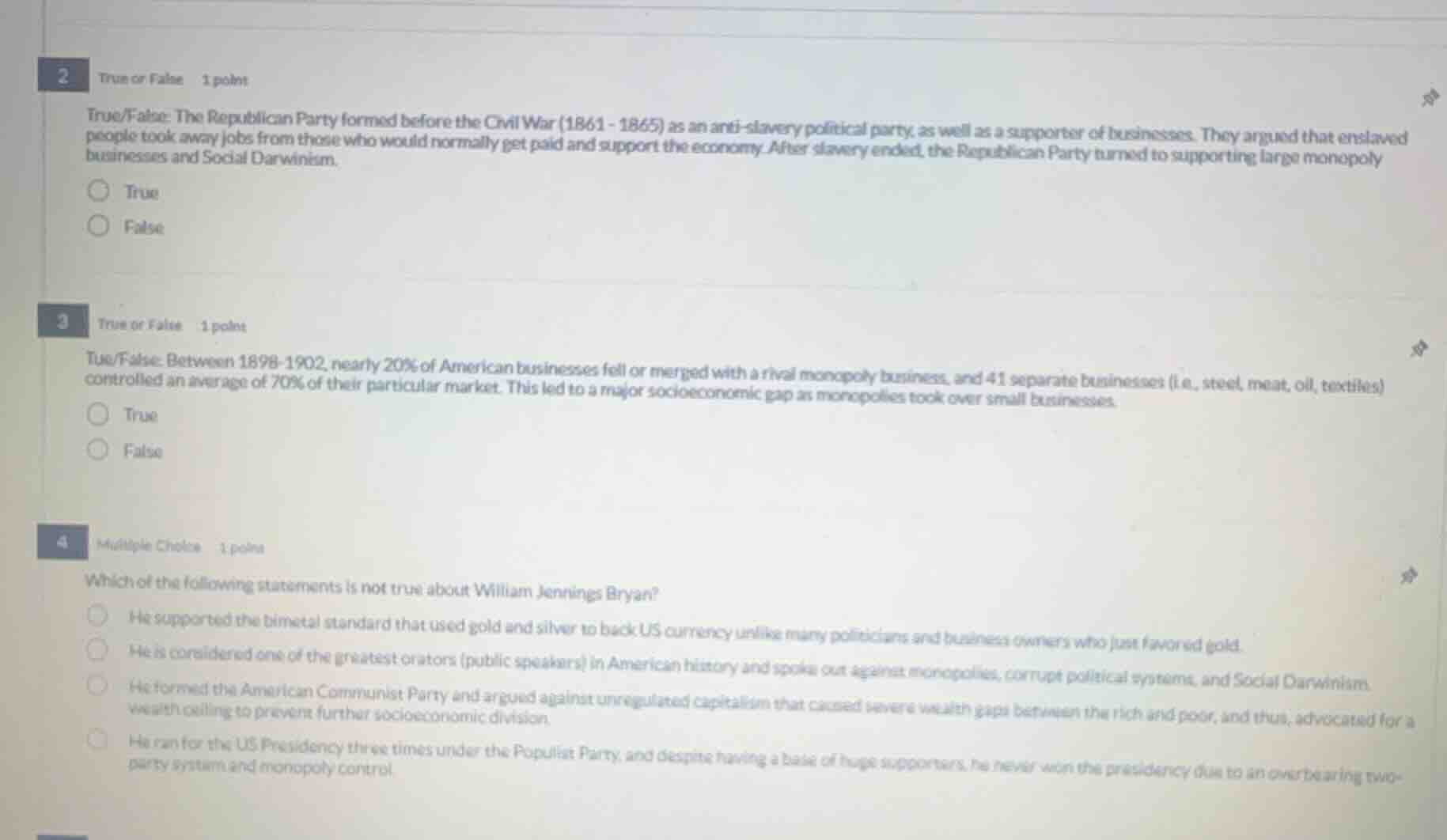
2 true or false 1 point
true/false: the republican party formed before the civil war (1861-1865) as an anti-slavery political party, as well as a supporter of businesses. they argued that enslaved people took away jobs from those who would normally get paid and support the economy. after slavery ended, the republican party turned to supporting large monopoly businesses and social darwinism.
true
false
3 true or false 1 point
true/false: between 1898-1902, nearly 20% of american businesses fell or merged with a rival monopoly business, and 41 separate businesses (i.e., steel, meat, oil, textiles) controlled an average of 70% of their particular market. this led to a major socioeconomic gap as monopolies took over small businesses.
true
false
4 multiple choice 1 point
which of the following statements is not true about william jennings bryan?
he supported the bimetal standard that used gold and silver to back us currency unlike many politicians and business owners who just favored gold.
he is considered one of the greatest orators (public speakers) in american history and spoke out against monopolies, corrupt political systems, and social darwinism.
he formed the american communist party and argued against unregulated capitalism that caused severe wealth gaps between the rich and poor, and thus, advocated for a wealth ceiling to prevent further socioeconomic division.
he ran for the us presidency three times under the populist party, and despite having a base of huge supporters, he never won the presidency due to an overbearing two-party system and monopoly control.
Analyze Question 2
The statement discusses the origins of the Republican Party and its post-Civil War shift.
- The Republican Party was formed in 1854 as an anti-slavery coalition.
- They argued that free labor was superior to slave labor, as slavery depressed wages and restricted economic opportunities for free workers.
- Following the Civil War, during the Gilded Age, the party increasingly aligned with big business, industrialization, protective tariffs, and laissez-faire policies, which were often justified using US Political Parties and Gilded Age Economics concepts like Social Darwinism.
- Therefore, the statement is historically accurate.
Analyze Question 3
The statement describes the consolidation of American businesses between 1898 and 1902.
- This period is historically known as the "Great Merger Movement."
- During this time, massive consolidation occurred, leading to the creation of dominant monopolies and trusts (such as U.S. Steel and Standard Oil) that controlled vast shares of their respective markets.
- This consolidation significantly widened the socioeconomic gap between industrial tycoons and the working class.
- Therefore, the statement is historically accurate.
Analyze Question 4
We need to identify the statement that is NOT true about William Jennings Bryan.
- Option 1: True. Bryan was a famous advocate of "bimetallism" (free silver) to expand the money supply, opposing the gold-only standard.
- Option 2: True. He is renowned for his oratorical skills, notably his "Cross of Gold" speech, where he attacked monopolies and defended the working class.
- Option 3: False. Bryan was a leader of the Democratic Party and the Populist movement, not the American Communist Party. He worked within the mainstream two-party system.
- Option 4: True. He ran for president three times (1896, 1900, 1908) as a nominee of the Democratic Party (with Populist backing), but never won.
- Thus, the third option is the false statement.

Snap & solve any problem in the app
Get step-by-step solutions on Sovi AI
Photo-based solutions with guided steps
Explore more problems and detailed explanations
Question 2
- True (Correct answer)
- False
Question 3
- True (Correct answer)
- False
Question 4
- He supported the bimetal standard that used gold and silver to back US currency unlike many politicians and business owners who just favored gold.
- He is considered one of the greatest orators (public speakers) in American history and spoke out against monopolies, corrupt political systems, and Social Darwinism.
- He formed the American Communist Party and argued against unregulated capitalism that caused severe wealth gaps between the rich and poor, and thus, advocated for a wealth ceiling to prevent further socioeconomic division. (Correct answer)
- He ran for the US Presidency three times under the Populist Party, and despite having a base of huge supporters, he never won the presidency due to an overbearing two-party system and monopoly control.