QUESTION IMAGE
Question
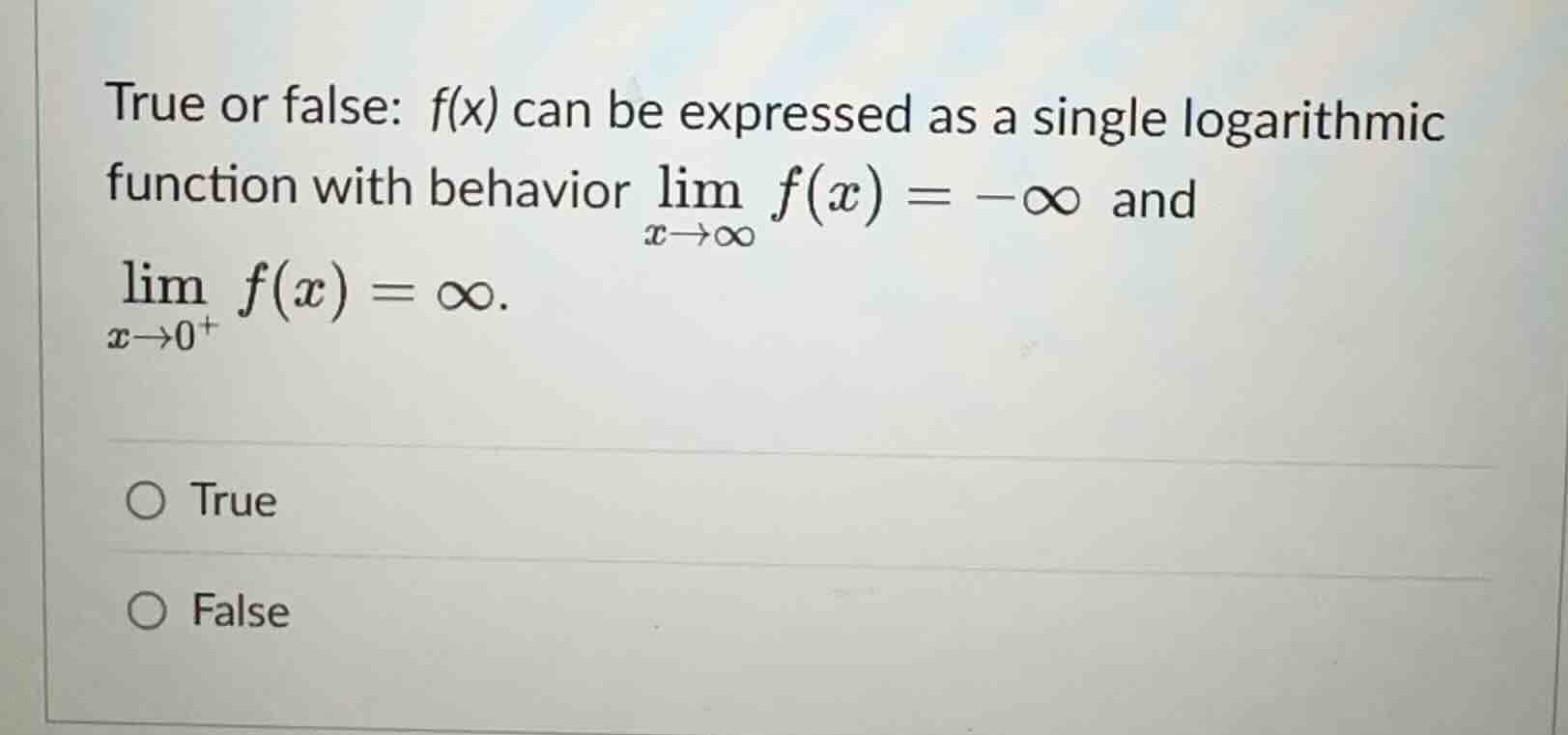
true or false: (f(x)) can be expressed as a single logarithmic function with behavior (lim_{x \to infty} f(x) = -infty) and (lim_{x \to 0^+} f(x) = infty).
true
false
⚡ Using what you learned: understanding exponential functions · Limits Involving Infinity and Asymptotes
Step 1: Analyze the standard logarithmic function
A single logarithmic function in its simplest form is:
For a standard base \( b > 1 \) (such as the natural logarithm \( \ln(x) \) where \( b = e \approx 2.718 \)):
- As \( x \to \infty \), \( \log_b(x) \to \infty \).
- As \( x \to 0^+ \), \( \log_b(x) \to -\infty \).
Step 2: Apply transformations to match the given limits
We want to find if there exists a single logarithmic function \( f(x) = a \log_b(x) \) or \( f(x) = \log_b(x) \) with a base \( 0 < b < 1 \) that satisfies:
- \( \lim_{x \to \infty} f(x) = -\infty \)
- \( \lim_{x \to 0^+} f(x) = \infty \)
Let's test a base \( b \) where \( 0 < b < 1 \) (for example, \( b = \frac{1}{2} \)):
Now we evaluate the limits for this function:
- Limit as \( x \to \infty \):
This matches the first condition.
- Limit as \( x \to 0^+ \):
This matches the second condition.
Since \( f(x) = \log_{1/2}(x) \) is a single logarithmic function that satisfies both conditions, the statement is true.

Snap & solve any problem in the app
Get step-by-step solutions on Sovi AI
Photo-based solutions with guided steps
Explore more problems and detailed explanations
True