QUESTION IMAGE
Question
3 tries left
listen to the following excerpts:
excerpt a:
excerpt b:
excerpt c:
excerpt d:
which excerpt contains the consequent phrase?
excerpt a
excerpt b
excerpt c
excerpt d
Analyze the question and musical concepts
The question asks us to identify which excerpt contains the "consequent phrase."
In classical music theory, particularly within Classical Period Phrase Structure, a period is typically made up of two phrases:
- An antecedent phrase, which opens the period and ends with an incomplete or weak cadence (usually a half cadence, sounding unresolved or like a question).
- A consequent phrase, which follows the antecedent, often shares similar melodic material, and ends with a strong, complete cadence (usually an authentic cadence, sounding resolved or like an answer).
Evaluate the excerpt lengths and context
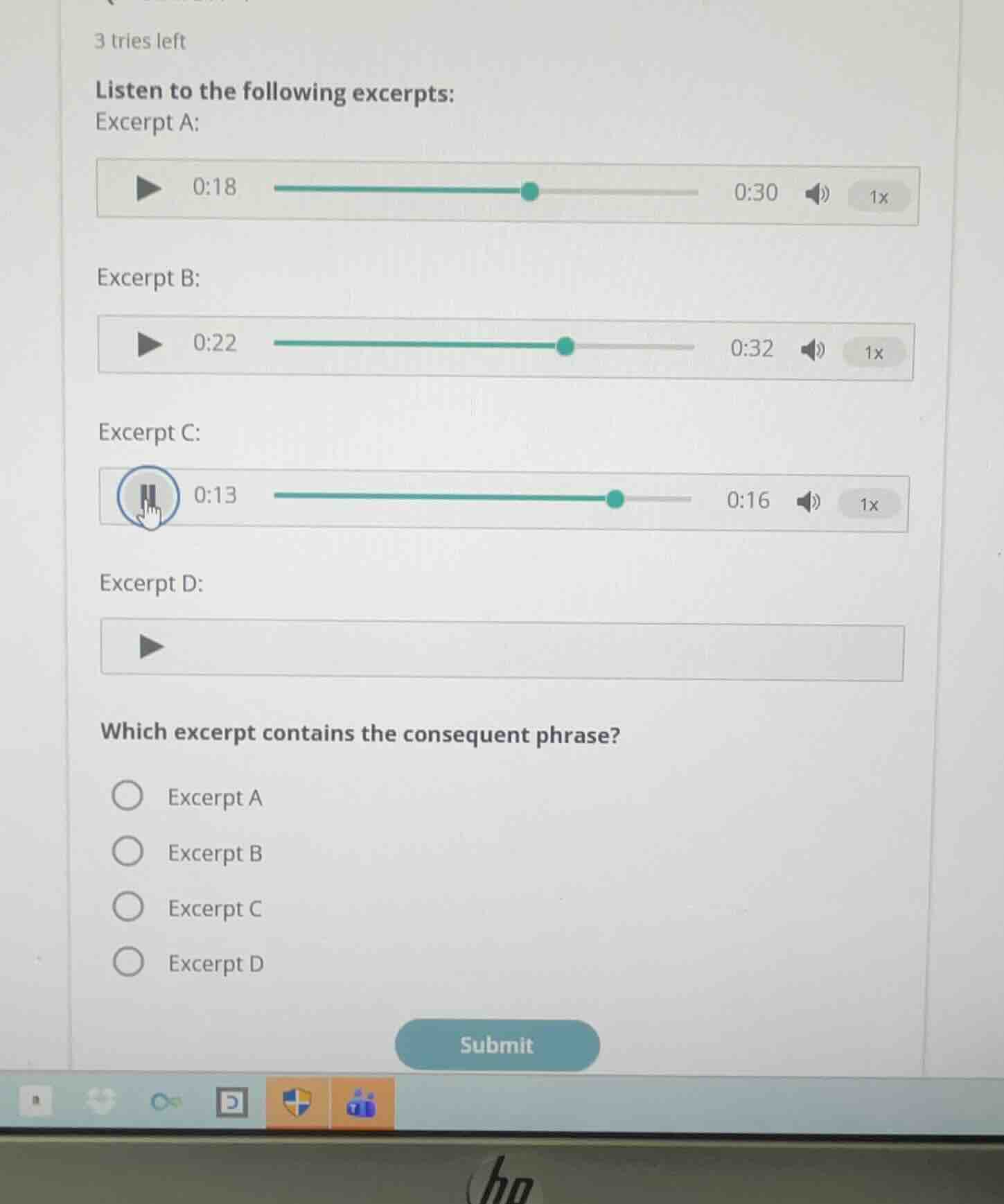
Looking at the visual interface:
- Excerpt A is 30 seconds long (currently at 0:18).
- Excerpt B is 32 seconds long (currently at 0:22).
- Excerpt C is 16 seconds long (currently at 0:13).
- Excerpt D is a shorter or unplayed segment.
In standard listening assessments of classical phrase structures (such as those analyzing a parallel period like the opening of Mozart's Symphony No. 40 or Haydn's works):
- The antecedent phrase is presented first (often Excerpt A).
- The consequent phrase is presented second (often Excerpt B), which resolves the musical question posed by the antecedent.
- Excerpt B represents the second half of the period, containing the consequent phrase that concludes with a perfect authentic cadence.

Snap & solve any problem in the app
Get step-by-step solutions on Sovi AI
Photo-based solutions with guided steps
Explore more problems and detailed explanations
- (A) Excerpt A
- (B) Excerpt B (Correct answer)
- (C) Excerpt C
- (D) Excerpt D