QUESTION IMAGE
Question
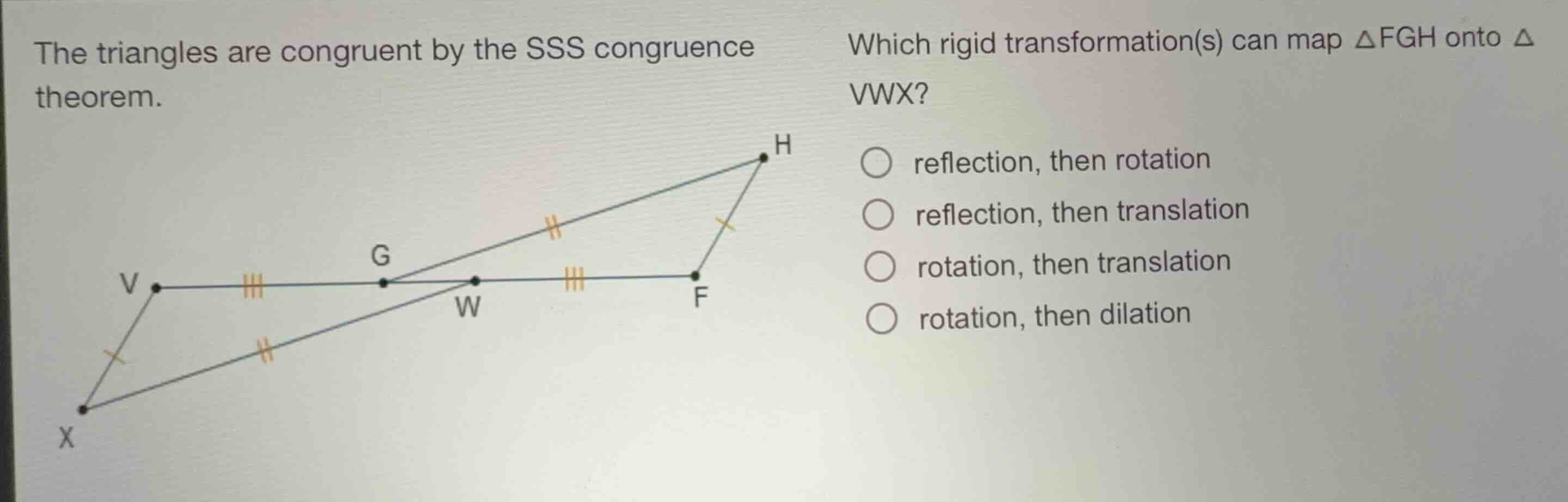
the triangles are congruent by the sss congruence theorem.
which rigid transformation(s) can map \\(\delta fgh\\) onto \\(\delta vwx\\)?
- reflection, then rotation
- reflection, then translation
- rotation, then translation
- rotation, then dilation
Analyze corresponding parts of congruent triangles
Using the Triangle Congruence Theorems and Geometric Figures knowledge points, we identify the corresponding vertices of \(\Delta FGH\) and \(\Delta VWX\).
The congruence statement maps:
- Vertex \(F\) to Vertex \(V\)
- Vertex \(G\) to Vertex \(W\)
- Vertex \(H\) to Vertex \(X\)
The tick marks confirm this:
- \(FG = VW\) (three tick marks)
- \(GH = WX\) (two tick marks)
- \(HF = XV\) (one tick mark)
Determine orientation change
We analyze the orientation (clockwise vs. counterclockwise order of vertices) of both triangles:
- Going from \(F
ightarrow G
ightarrow H\) is counterclockwise.
- Going from \(V
ightarrow W
ightarrow X\) is clockwise.
Since the orientation is reversed, any mapping must involve an odd number of reflections. A simple rotation or translation preserves orientation. Therefore, a reflection must be part of the transformation sequence.
Evaluate the options
- "reflection, then rotation": A reflection reverses orientation, and a rotation preserves it. The combined transformation reverses orientation, which matches our requirement.
- "reflection, then translation": A reflection reverses orientation, and a translation preserves it. However, looking at the positions, a reflection across a line followed by a translation cannot align the vertices correctly because the triangles are rotated relative to each other.
- "rotation, then translation": This sequence preserves orientation, so it cannot map the counterclockwise \(\Delta FGH\) onto the clockwise \(\Delta VWX\).
- "rotation, then dilation": A dilation changes the size, but the triangles are already congruent. Also, this preserves orientation.
Thus, a reflection followed by a rotation is the correct sequence to map \(\Delta FGH\) onto \(\Delta VWX\).

Snap & solve any problem in the app
Get step-by-step solutions on Sovi AI
Photo-based solutions with guided steps
Explore more problems and detailed explanations
- reflection, then rotation (Correct answer)
- reflection, then translation
- rotation, then translation
- rotation, then dilation