QUESTION IMAGE
Question
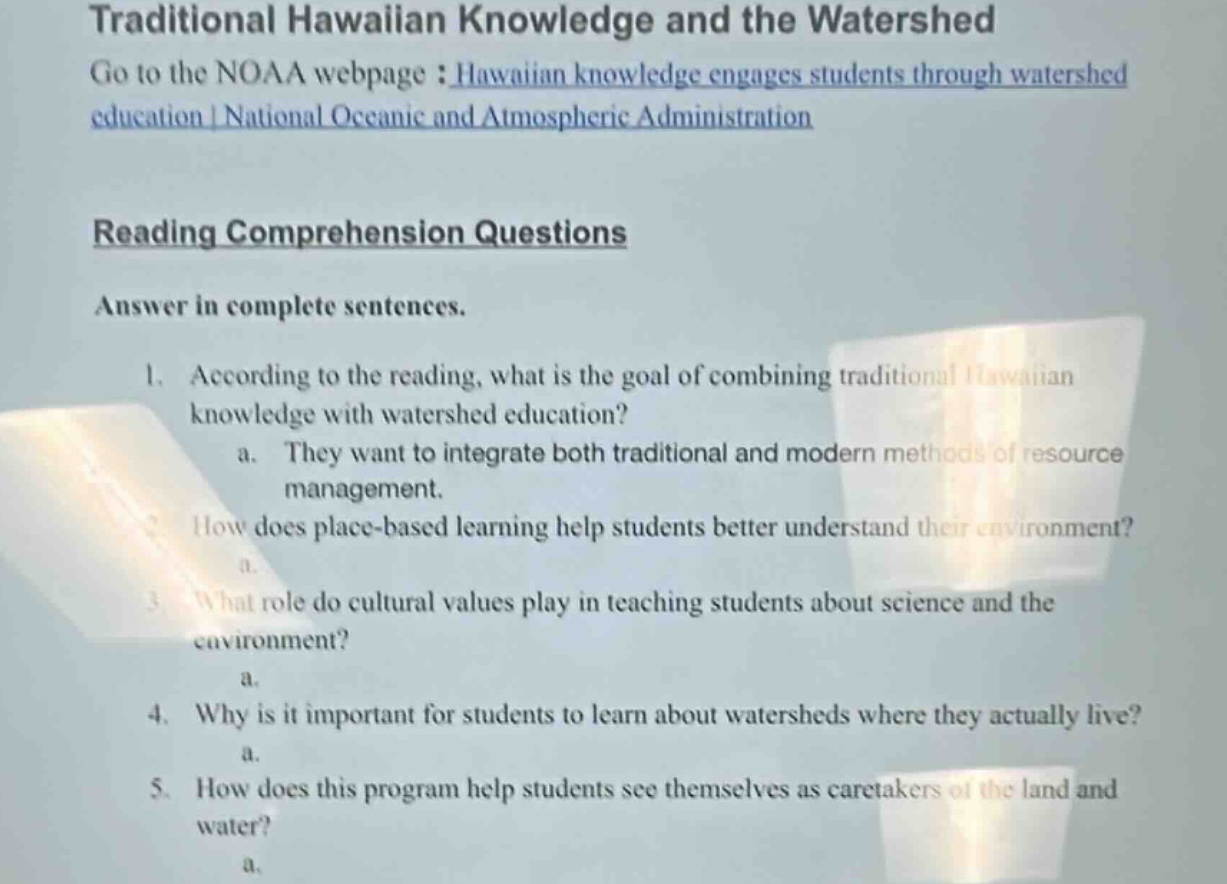
traditional hawaiian knowledge and the watershed
go to the noaa webpage : hawaiian knowledge engages students through watershed
education | national oceanic and atmospheric administration
reading comprehension questions
answer in complete sentences.
- according to the reading, what is the goal of combining traditional hawaiian
knowledge with watershed education?
a. they want to integrate both traditional and modern methods of resource
management.
- how does place - based learning help students better understand their environment?
a.
- what role do cultural values play in teaching students about science and the
environment?
a.
- why is it important for students to learn about watersheds where they actually live?
a.
- how does this program help students see themselves as caretakers of the land and
water?
a.
To answer these reading comprehension questions, we would need to access the content of the linked NOAA webpage ("Hawaiian knowledge engages students through watershed education | National Oceanic and Atmospheric Administration") to gather the relevant information. Since the actual text of the reading is not provided here, I can offer general guidance on how to approach each question once you have the reading:
Question 1:
To answer "what is the goal of combining traditional Hawaiian knowledge with watershed education," look for statements in the reading about the purpose of integrating these two approaches (e.g., resource management, cultural preservation, student engagement, etc.). The provided option (a) suggests integrating traditional and modern resource management methods—you would verify if this matches the reading’s explanation of the goal.
Question 2:
For "How does place - based learning help students better understand their environment?" search the reading for descriptions of place - based learning (learning tied to their local area) and how it enhances environmental understanding (e.g., connecting students to local ecosystems, cultural ties to the land, hands - on experience with local watersheds).
Question 3:
To answer "What role do cultural values play in teaching students about science and the environment?" find sections in the reading that discuss cultural values (like Hawaiian cultural perspectives on nature) and how they inform or enrich science/environmental education (e.g., fostering respect for nature, providing a holistic view of ecosystems).
Question 4:
For "Why is it important for students to learn about watersheds where they actually live?" look for reasons related to personal connection, stewardship, understanding local environmental challenges, or how local watersheds impact their daily lives (e.g., water supply, cultural significance of local waterways).
Question 5:
To answer "How does this program help students see themselves as caretakers of the land and water?" find explanations in the reading about how the program (combining Hawaiian knowledge and watershed education) fosters a sense of responsibility (e.g., through cultural teachings about land stewardship, hands - on conservation activities, or understanding their role in protecting local ecosystems).
If you can share key excerpts from the NOAA webpage or summarize its main points, I can help you craft more specific answers!

Snap & solve any problem in the app
Get step-by-step solutions on Sovi AI
Photo-based solutions with guided steps
Explore more problems and detailed explanations
To answer these reading comprehension questions, we would need to access the content of the linked NOAA webpage ("Hawaiian knowledge engages students through watershed education | National Oceanic and Atmospheric Administration") to gather the relevant information. Since the actual text of the reading is not provided here, I can offer general guidance on how to approach each question once you have the reading:
Question 1:
To answer "what is the goal of combining traditional Hawaiian knowledge with watershed education," look for statements in the reading about the purpose of integrating these two approaches (e.g., resource management, cultural preservation, student engagement, etc.). The provided option (a) suggests integrating traditional and modern resource management methods—you would verify if this matches the reading’s explanation of the goal.
Question 2:
For "How does place - based learning help students better understand their environment?" search the reading for descriptions of place - based learning (learning tied to their local area) and how it enhances environmental understanding (e.g., connecting students to local ecosystems, cultural ties to the land, hands - on experience with local watersheds).
Question 3:
To answer "What role do cultural values play in teaching students about science and the environment?" find sections in the reading that discuss cultural values (like Hawaiian cultural perspectives on nature) and how they inform or enrich science/environmental education (e.g., fostering respect for nature, providing a holistic view of ecosystems).
Question 4:
For "Why is it important for students to learn about watersheds where they actually live?" look for reasons related to personal connection, stewardship, understanding local environmental challenges, or how local watersheds impact their daily lives (e.g., water supply, cultural significance of local waterways).
Question 5:
To answer "How does this program help students see themselves as caretakers of the land and water?" find explanations in the reading about how the program (combining Hawaiian knowledge and watershed education) fosters a sense of responsibility (e.g., through cultural teachings about land stewardship, hands - on conservation activities, or understanding their role in protecting local ecosystems).
If you can share key excerpts from the NOAA webpage or summarize its main points, I can help you craft more specific answers!