QUESTION IMAGE
Question
topic:
class:
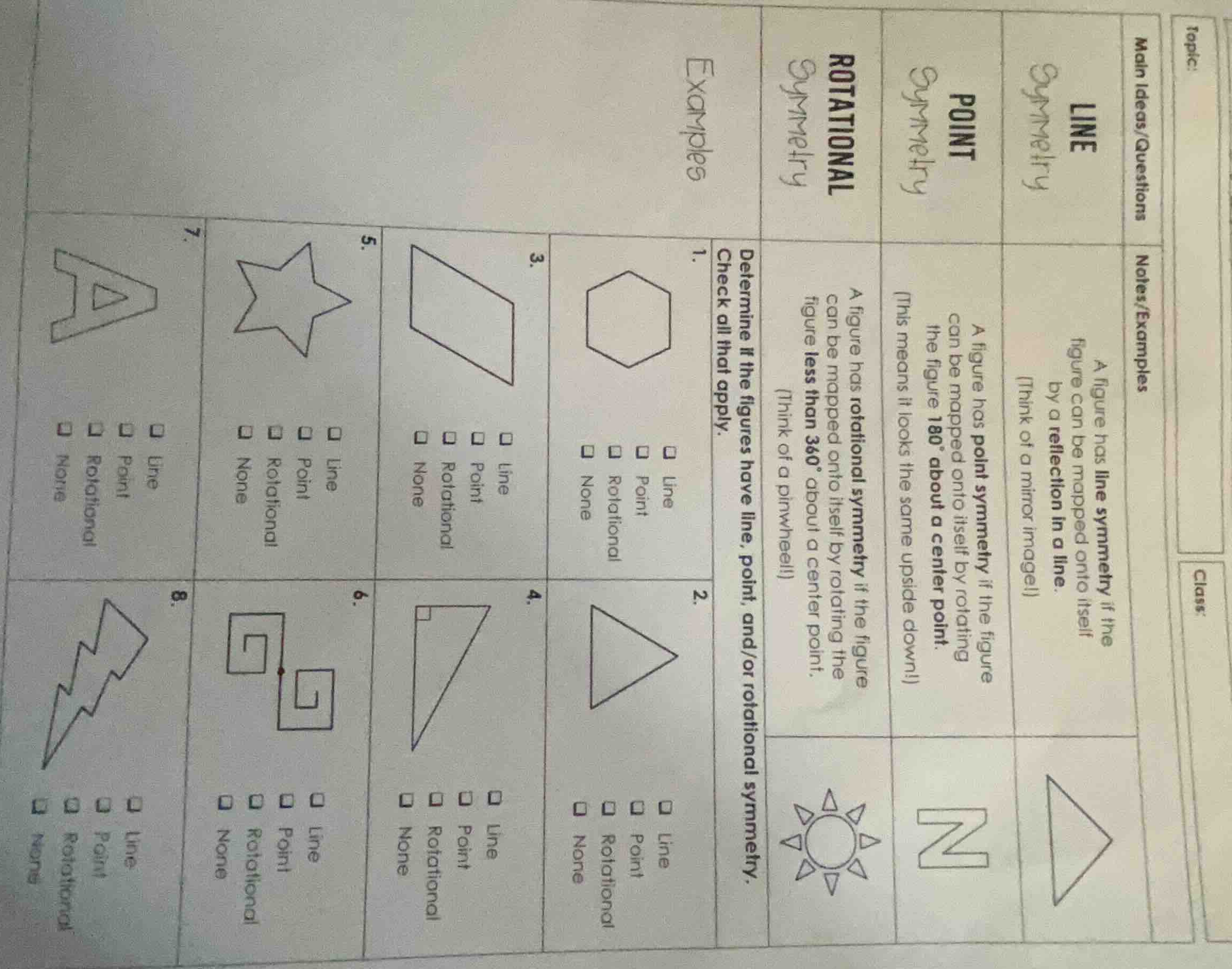
main ideas/questions | notes/examples
line symmetry | a figure has line symmetry if the figure can be mapped onto itself by a reflection in a line. (think of a mirror image!)
point symmetry | a figure has point symmetry if the figure can be mapped onto itself by rotating the figure 180° about a center point. (this means it looks the same upside down!)
rotational symmetry | a figure has rotational symmetry if the figure can be mapped onto itself by rotating the figure less than 360° about a center point. (think of a pinwheel!)
examples | determine if the figures have line, point, and/or rotational symmetry. check all that apply.
- regular hexagon
line
point
rotational
none
- isosceles triangle
line
point
rotational
none
- parallelogram
line
point
rotational
none
- right triangle
line
point
rotational
none
- five-pointed star
line
point
rotational
none
- symmetric spiral shape
line
point
rotational
none
- letter a
line
point
rotational
none
- lightning bolt shape
line
point
rotational
none
Analyze the regular hexagon (Question 1)
We examine the regular hexagon in Question 1.
- Line Symmetry: A regular hexagon has 6 lines of symmetry (3 passing through opposite vertices and 3 passing through midpoints of opposite sides).
- Point Symmetry: Rotating a regular hexagon by \(180^\circ\) maps it onto itself, so it has point symmetry.
- Rotational Symmetry: It can be mapped onto itself by rotations of \(60^\circ, 120^\circ, 180^\circ, 240^\circ, 300^\circ\), which are all less than \(360^\circ\).
Analyze the isosceles triangle (Question 2)
We examine the triangle in Question 2, which is shown as an isosceles triangle.
- Line Symmetry: It has 1 vertical line of symmetry passing through the top vertex and the midpoint of the base.
- Point Symmetry: Rotating it by \(180^\circ\) turns it upside down, which does not map onto itself.
- Rotational Symmetry: No rotation less than \(360^\circ\) maps it onto itself.
Analyze the parallelogram (Question 3)
We examine the non-rectangular parallelogram in Question 3.
- Line Symmetry: No line of reflection maps a general parallelogram onto itself.
- Point Symmetry: Rotating it by \(180^\circ\) about its center maps it onto itself.
- Rotational Symmetry: It has rotational symmetry of order 2 (angle of rotation is \(180^\circ\), which is less than \(360^\circ\)).
Analyze the right scalene triangle (Question 4)
We examine the right triangle in Question 4.
- Line Symmetry: Since the sides are of different lengths, no line of reflection maps it onto itself.
- Point Symmetry: Rotating it by \(180^\circ\) does not map it onto itself.
- Rotational Symmetry: No rotation less than \(360^\circ\) maps it onto itself.
- Therefore, it has none of these symmetries.
Analyze the regular five-pointed star (Question 5)
We examine the regular five-pointed star in Question 5.
- Line Symmetry: It has 5 lines of symmetry passing through each point and the opposite indentation.
- Point Symmetry: Rotating it by \(180^\circ\) turns it upside down, which does not map onto itself.
- Rotational Symmetry: It can be mapped onto itself by rotations of \(72^\circ, 144^\circ, 216^\circ, 288^\circ\), which are less than \(360^\circ\).
Analyze the symmetric spiral-like figure (Question 6)
We examine the figure in Question 6, which consists of two interlocking G-like shapes.
- Line Symmetry: No line of reflection maps this figure onto itself due to its winding direction.
- Point Symmetry: Rotating the figure by \(180^\circ\) about the center point maps it perfectly onto itself.
- Rotational Symmetry: It has rotational symmetry of order 2 (rotation of \(180^\circ\)).
Analyze the letter A (Question 7)
We examine the capital letter A in Question 7.
- Line Symmetry: It has 1 vertical line of symmetry down the center.
- Point Symmetry: Rotating it by \(180^\circ\) turns it upside down, which does not map onto itself.
- Rotational Symmetry: No rotation less than \(360^\circ\) maps it onto itself.
Analyze the lightning bolt (Question 8)
We examine the lightning bolt shape in Question 8.
- Line Symmetry: No li…

Snap & solve any problem in the app
Get step-by-step solutions on Sovi AI
Photo-based solutions with guided steps
Explore more problems and detailed explanations
Question 1
- [x] Line
- [x] Point
- [x] Rotational
- [ ] None
Question 2
- [x] Line
- [ ] Point
- [ ] Rotational
- [ ] None
Question 3
- [ ] Line
- [x] Point
- [x] Rotational
- [ ] None
Question 4
- [ ] Line
- [ ] Point
- [ ] Rotational
- [x] None
Question 5
- [x] Line
- [ ] Point
- [x] Rotational
- [ ] None
Question 6
- [ ] Line
- [x] Point
- [x] Rotational
- [ ] None
Question 7
- [x] Line
- [ ] Point
- [ ] Rotational
- [ ] None
Question 8
- [ ] Line
- [ ] Point
- [ ] Rotational
- [x] None