QUESTION IMAGE
Question
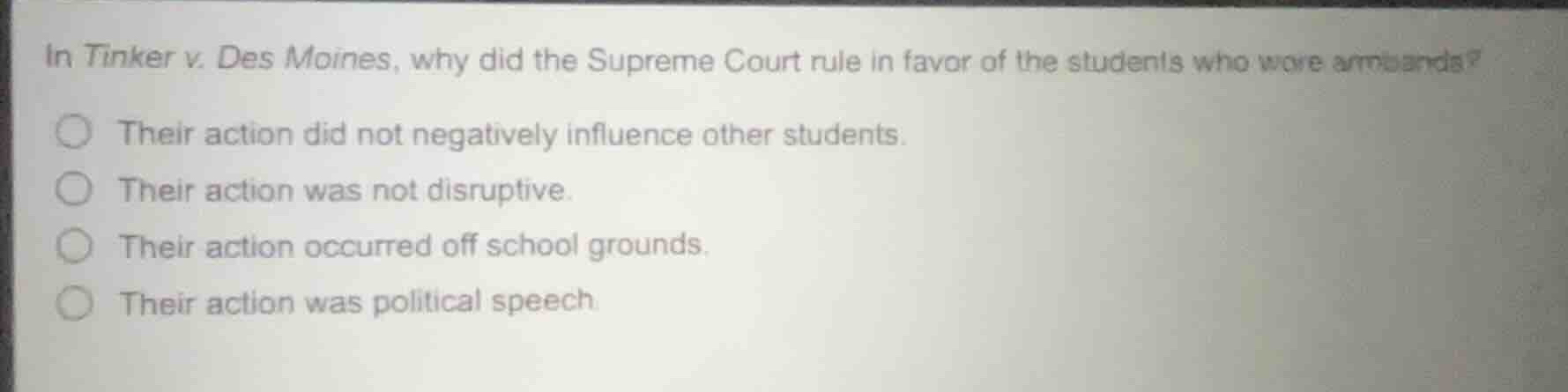
in tinker v. des moines, why did the supreme court rule in favor of the students who wore armbands?
their action did not negatively influence other students.
their action was not disruptive.
their action occurred off school grounds.
their action was political speech.
Identify the constitutional question
The question asks why the Supreme Court ruled in favor of the students wearing black armbands in the landmark case Tinker v. Des Moines Independent Community School District (1969). This case directly involves the First Amendment protection of symbolic speech within public schools.
Analyze the Supreme Court's reasoning
The Supreme Court held that students do not "shed their constitutional rights to freedom of speech or expression at the schoolhouse gate." For school officials to justify censoring speech, they must prove that the conduct would "materially and substantially interfere" with the operation of the school. Because wearing the armbands was a silent, passive expression of opinion that did not cause any such disruption, the school's ban was unconstitutional.
Evaluate the given options
- Option 1: "Their action did not negatively influence other students." While related to disruption, the legal standard specifically focuses on whether the action caused a substantial disruption to the educational environment, not general "influence."
- Option 2: "Their action was not disruptive." This directly aligns with the Court's "substantial disruption" test. Since the armbands did not cause a disruption, the speech was protected.
- Option 3: "Their action occurred off school grounds." This is factually incorrect; the students wore the armbands to school.
- Option 4: "Their action was political speech." While it was political speech, political speech can still be regulated in schools if it causes a substantial disruption. The key legal reason they won was the lack of disruption.

Snap & solve any problem in the app
Get step-by-step solutions on Sovi AI
Photo-based solutions with guided steps
Explore more problems and detailed explanations
- Their action did not negatively influence other students.
- Their action was not disruptive. (Correct answer)
- Their action occurred off school grounds.
- Their action was political speech.